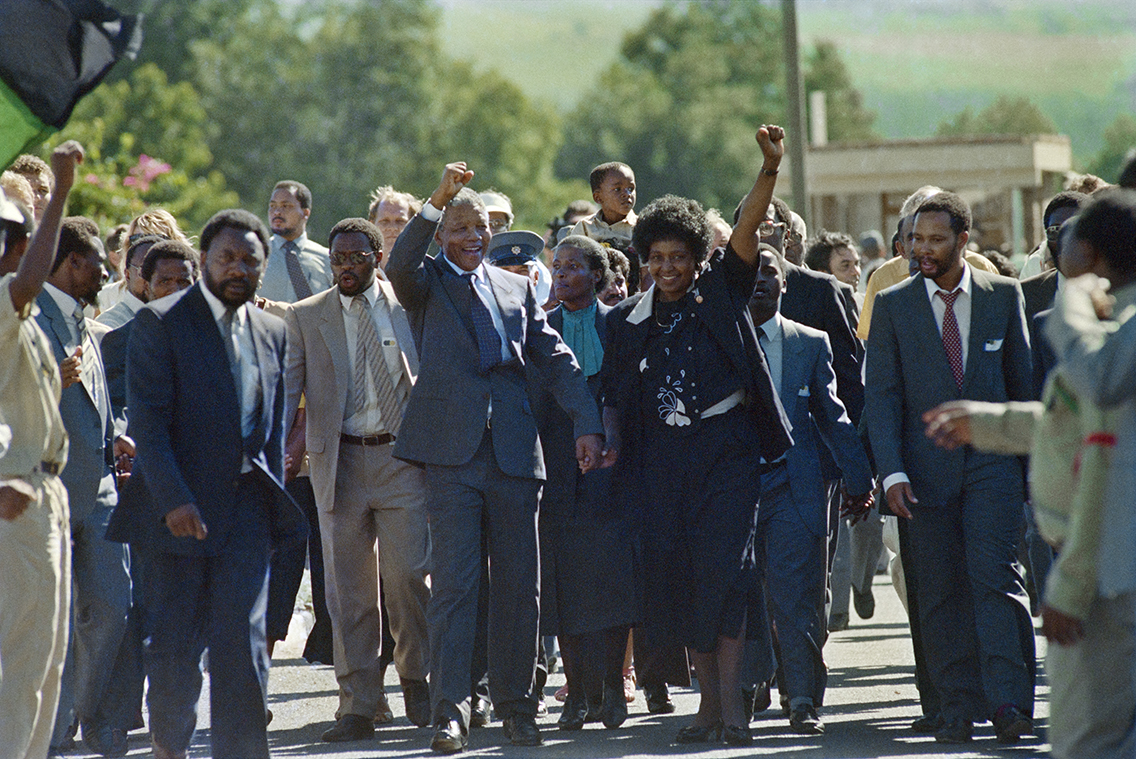
In his very first public statement after he came out of prison, Mandela began to lay out his thinking. He said there was no option but to continue the armed struggle. He also called on the international community to maintain sanctions. But almost immediately he expressed the hope that the climate for negotiations could be created so that the armed struggle would no longer be necessary.
He also paid tribute to President F. W. de Klerk, who, he said, had gone further than any other National Party President towards reaching a settlement. Mandela was clearly setting out his terms for negotiation.
Meanwhile, even F. W. de Klerk’s sternest critics and opponents agree that his speech to the South African parliament on 2 February broke new ground. For the first time, his government was prepared to change its politics, negotiate a new constitution and throw out apartheid.
He announced, among other measures, the unbanning of the African National Congress and other parties, including the South African Communist Party, the lifting of press restrictions, the suspension of the death penalty and the release of some political prisoners.
This was greeted by his lifetime opponents as a major step forward. Even the Communist leader Joe Slovo said his measures showed a “degree of freshness and courage”. While Walter Sisulu described them as “progressive, but only half a_ measure”. In fact, every African leader except those of the minority PAC and Black Consciousness Movement had something good to say about his speech.
Not far enough
It was clearly a turning point from which there is no return for South Africa. It also signalled the beginning of the end of apartheid.
But clearly de Klerk went nowhere near far enough to satisfy Mandela or his other critics. After the excitement had died down, it became clear that he had only begun to tackle the preconditions for negotiation, not yet the fundamental issues.
- Even after his release, Nelson Mandela did not think he had gone far enough to establish a basis for negotiations to start.
- He had only partially lifted the state of emergency.
- He had, in Mandela’s words, released some but not all the political prisoners.
- He had not tampered with the main racial legislation that underlies the whole structure of apartheid in South Africa.
The main acts granting white privilege still remained. The Population Registration Act classifying races, and the Group Areas Act and Land Act, restricting property to racial groups remained. And de Klerk’s cabinet ministers were soon arguing amongst themselves as to whether or not it was the intention to get rid of this discriminatory legislation and end segregation in housing and education.
But de Klerk’s stance was in reality only to be expected. In the first place, he had to preserve security, or as he said in a later interview, “avoid revolution”, while confirming that he really meant change. Secondly, he was, after all only setting out his stall for negotiation. He wants the freedom and time to manoeuvre and to convince his own right wing that he is not selling them down the river.
Nelson Mandela too wants his release to lead to real negotiations, not simply to a tidal wave of excitement and publicity.
Both de Klerk and Mandela are manoeuvring for the best possible start to negotiations, but they are both determined that they must take place and be a success. The whole future of South Africa depends on it.
Colin Legum writes: It has taken decades of State violence and counter-violence, the growing isolation of South Africa in the international community, and the dangerous run-down of the national economy for the White establishment to accept the historic role of the ANC and of
Nelson Mandela as its charismatic leader, without whom no serious political negotiations can even begin. The question at this late hour is whether the right conditions yet exist that make it possible for Mandela and de Klerk to get their respective supporters to agree on the basic elements of a post-apartheid society. They now face serious opposition from two diametrically opposed forces.
De Klerk is up against the Conservative Party, which remains totally opposed to ending apartheid, while Mandela is opposed by militant Black groups — a coalition represented by the Pan-Africanist Movement (PAM) — which remains unpersuaded that the time is ripe for meaningful negotiations since, as they claim, the White community has not yet come under sufficient pressure to give up the idea that White political control can be maintained indefinitely.
Mandela, even when he was in prison, was at the centre of prolonged talks with the government and with a cross-section of Black leaders. He has won agreement for the ANC’s proposals for negotiations from all the major Black movements with the exception of the Pan-Africanists. Although probably representing only a minority of Black opinion, their support is substantial enough to enable them to make it difficult for negotiations to be carried on in a tranquil atmosphere.
Unless Mandela’s release is quickly followed by the beginning of talks that hold out the promise of serious negotiations, the predictable result will be to strengthen the White backlash and stiffen opposition by Black militants. But both sides seem to have accepted that the first stage will be “talks about negotiations”. These preliminary talks will centre on the following issues:
- The right of all political exiles to return home under a guarantee of safety from arrest.
- The suspension of attacks by Umkhonto we Sizwe and of other forms of political violence.
- Ending the State of Emergency. (These last two issues are intimately connected.)
- Agreement that the negotiations will be without preconditions, other than a positive affirmation by the government of its readiness to end apartheid.
- Agreement on how to ensure that those involved in the negotiating process are the true representatives of their communities.
Can communities agree?
Now that the prospect for a negotiated settlement has opened up, it is time to ask the question whether there is the remotest chance of agreement being reached among the representatives of all four ethnic communities. Three crucial issues sharply divide the majority of White and Black South Africans: White South African fears about their future in a democratic political system based on a universal franchise; scrapping of the 1913 Land Act which appropriated over two-thirds of the land for exclusive White ownership; and the insistence by the government on “group rights” to protect the interests of Whites, but more particularly of the Afrikaners.
On the face of it, none of these critical issues is reconcilable with the minimum demands that are currently being put forward by either side. And yet, if there is no likely possibility of agreement, why should President de Klerk and Nelson Mandela entertain the hope — as they clearly do — that a negotiated settlement is possible?
The most difficult issue, clearly, is over the nature of a democratic political system which will not automatically reduce Whites to a minority position instead of as at present, being the politically dominant group. While there are historic precedents for minority interest groups (as in the United Kingdom) allowing power to pass from their hands through a political process, this has always occurred in essentially homogeneous societies: there is no precedent for a dominant ethnic minority agreeing to surrender power to a different ethnic group — at least not peacefully.
However, it is possible to envisage a federal type of constitution which, while maintaining the unity of the state, will effectively safeguard minority political rights. In South Africa’s case, the idea of “majority rule” being equated to “Black domination” is a crass oversimplification. Black interest groups are as strongly divided internally as are White interest groups.
Minority rights
South Africa, after all, is not Zimbabwe, Namibia or Kenya: its future is almost certain to be a “non-racial” government rather than a “Black government”. The balance of power and of representation between the four major communities will no doubt change during and after a transition period. While White South Africans have given a lot of thought to different forms of federal governments, the possibility of federal structure has never been on the agenda of either the African National Congress (ANC) or the Pan-Africanist Congress (PAC), although it is on the agenda of homeland leaders, like Chief Gatsha Buthelezi, who advocates a federal system based not on ethnic lines, but on economic regions.
Another possible alternative that is likely to be canvassed is to have a bicameral parliament in which — at least for a transitional period — there will be some kind of parity of voting between the different ethnic communities over a number of reserved powers. All sides agree on a Bill of Rights justifiable in the courts.
The abolition of the Land Act is a thorny subject, but it is a sine qua non for all representative African leaders. However, throwing open the land to free purchase by all citizens may not in the end prove as intractable as it now seems, provided it does not mean — as the PAC and Black Consciousness Movement insist — the compulsory redistribution of land, dispossessing a large number of White farmers. There is reliable evidence that the de Klerk administration has already begun to study possible alternatives to the present iniquitous Land Act. This is just one sign of possible flexibility on the side of government.
Another sign is its quiet diplomacy in an effort to persuade the four so-called “independent homelands” to consider “rejoining” the Republic and resuming a common citizenship. They will certainly have to abdicate their present status if they are to become participants in the negotiations over a new constitution. Transkei is the only one so far that has indicated a willingness to consider abandoning its spurious independence, but if the governments of Venda, Bophuthatswana and Ciskei attempt to hold out, they are bound to meet with massive internal protests when the present bottled-up resentments are given some encouragement to challenge their unpopular regimes.
No group rights
What is particularly encouraging is the significant change of thinking by the government over the controversial issue of “group rights” — which most opponents of apartheid regard as a technique for retaining White power, a view strengthened by the imprecision with which the idea of “group rights” has hitherto been presented.
Now, however, in a largely unreported television interview, Dr Gerrit Viljoen — the Minister for Constitutional Affairs and former chairman of the Broederbond — announced that the government has not set “the protection of group rights as a precondition for negotiations”. The only precondition was that all participants should bind themselves to a peaceful process of negotiations — a condition already accepted by the ANC.
“We are not prescriptive,” Dr Viljoen said. The ruling party, he added, was willing to negotiate over acceptable alternatives to the Group Areas Act, the Population Registration Act and the Separate Amenities Act — three of the pillars still remaining of the original apartheid system. The fourth, of course, is the Land Act, which dates back to long before apartheid was invented.
Dr Viljoen also said the government was prepared to negotiate on “the definition of groups” which would allow for “freedom of association and dis-association” in a system where there would be greater flexibility and freedom of choice and “an openness towards other alternatives for political association”. The manner in which groups were to be protected, he said, was negotiable. Then, in a telling paragraph, he declared:
“I understand the concept of alternatives for political association is not marketable if it is not based on acceptable, non-discriminatory principles. I must be very clear. We are not making group rights a condition for negotiation, but rather part of the negotiating process. Others could put on the table concepts we do not like, but which we will accept, because we believe the agenda must be open. Give us the opportunity to place on the table our concept of group rights so that we can debate the issue, and try to persuade others to accept a system which differs from that of the past. Eventually we will reach a broad consensus… In the past we were ‘guilty of emphasising our differences, while underemphasising our shared interests as South Africans. This is one of the most important changes which President de Klerk has brought about’. . .”
Nelson Mandela defined his, and the ANC’s, approach to a negotiated settlement in an article he wrote for South Weekly. “Two political issues,” he said, “will have to be addressed at a meeting (on negotiations): Firstly, the demand for majority rule in a unitary state; secondly, the concern of White Africans over this demand, as well as the insistence of Whites on structural guarantees that majority rule will not mean domination of the White minority by Blacks. The most crucial task which will face the government and the ANC will be to reconcile these two positions. Such reconciliation will be achieved only if both parties are willing to compromise…”
Compromise possible
By indicating a willingness to compromise, Mandela has matched the announcement of greater flexibility by Viljoen. Herein lies the possibility — and the hope — that the negotiations — though bound to be protracted and difficult — stand some chance of success. “Euphoria”, as has been said, “can be helpful to keeping up the momentum for change.”
The ANC appears to have an alternative strategy for the conduct of negotiations which seems to be what lies behind Walter Sisulu’s call for elections to be held on a non-racial voters’ roll to choose the team of negotiators. It seems he might have in mind that, once preliminary talks have sufficiently clarified the main issues and built up confidence in the sincerity of both sides, the present tricameral parliament should then be dissolved and elections held on a non-racial voters’ roll for a Constituent Assembly, as happened recently in Namibia.
Unrealistic as this proposal might seem at present, in a fast-changing situation it would be unwise to rule out any possibility.
This article was originally published in New African in March 1990. It is republished as part of our 60th anniversary archive series. The views and perspectives expressed reflect the context and circumstances at the time of original publication.