Rabbiatu Kuyateh, a Sierra Leonean woman, had spent three decades living in the US. She worked as a nurse in Maryland for more than 20 years, raised an American-born son, and regularly reported to US immigration authorities. An immigration judge had granted her protection against deportation to Sierra Leone, which she had fled fearing persecution.
But in November 2025, her life changed in an instant. After being detained during a regular US Immigration and Customs Enforcement (ICE) check-in in July, she was unexpectedly deported to Accra, Ghana.
Stark footage published by the investigative journalism consortium Forbidden Stories shows her struggling as she is dragged by officials across the lobby of a hotel in the Ghanaian capital.
From Ghana, she was forcibly repatriated – back to Sierra Leone, the very country she had fled.
Kuyateh is one of 536 identified people deported from the US to African countries between January 2025 and August 2026, according to a Human Rights Watch report published in October 2026, based on ICE data.
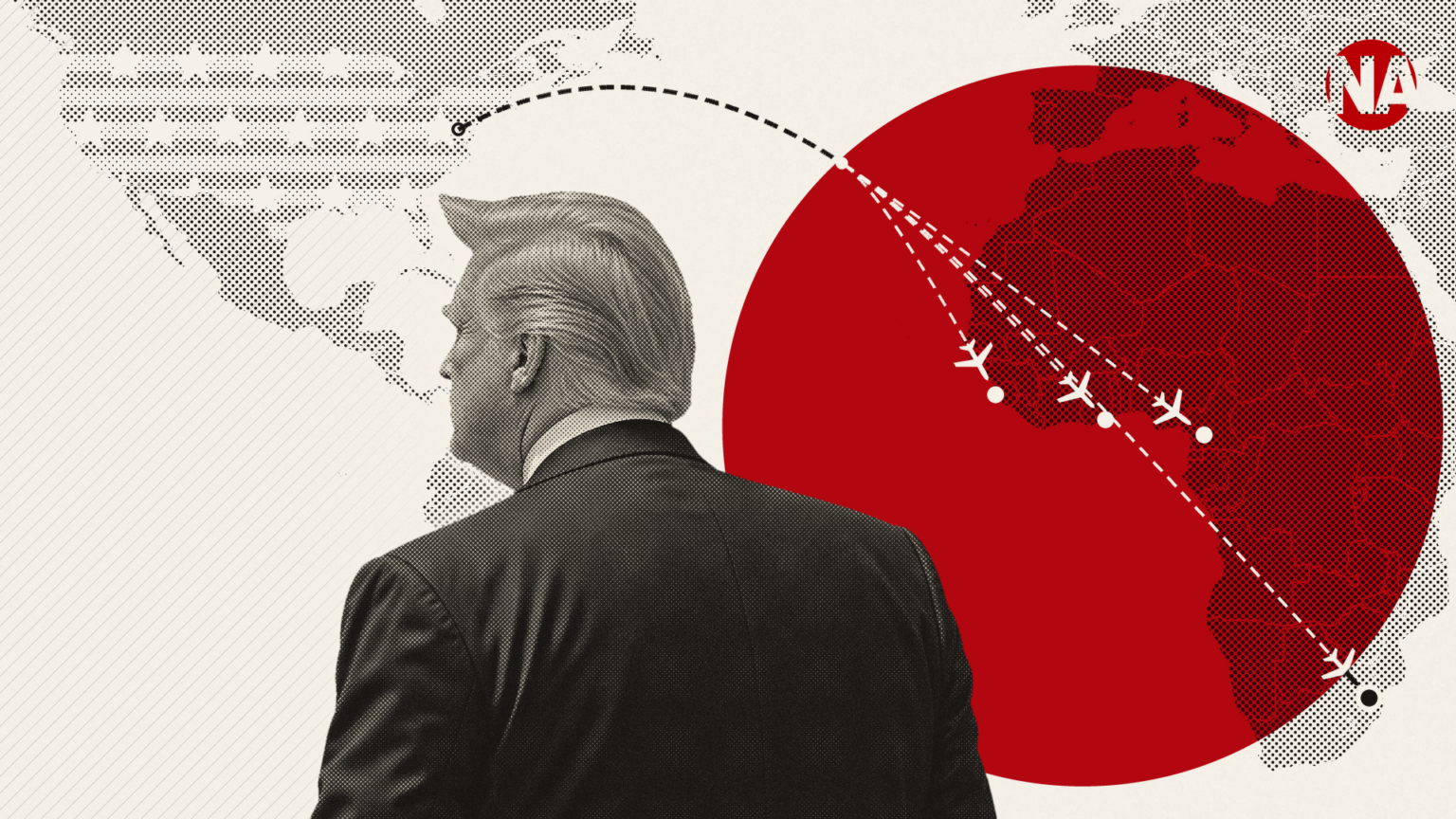
Under Trump’s immigration crackdown, at least 25,000 people have been deported to third countries through an extensive network of so-called ‘third-country deportation agreements’. These allow the US to remove migrants to countries other than their own, including individuals whom American courts have found would face persecution or torture if returned home.
Africa has become an important focus of this diplomatic operation. According to internal US State Department documents obtained by the Forbidden Stories investigation, Washington had approached 49 of the continent’s 54 countries about receiving deportees by March 2026.
Yet behind the growing network of bilateral agreements lies a troubling contradiction. Many of those being transferred have already been recognised by US courts as facing persecution or torture in their home countries. Now, they find themselves passed between governments, sometimes detained indefinitely, sometimes returned to the very places they fled.
The situation raises significant questions about African sovereignty, diplomatic bargaining – and who is responsible for protecting people once they arrive.
A complex network
For Édouard Perrin, editor-in-chief at Forbidden Stories, investigating the agreements has revealed a vast diplomatic operation stretching far beyond immigration enforcement inside the United States.
Their investigation began with the arrest of Salvadoran journalist Mario Guevara, who, while covering a demonstration in Atlanta (US), was taken into custody by ICE.
Forbidden Stories, whose mission is to continue investigations when journalists are threatened or silenced, began examining the wider treatment of journalists reporting on immigration enforcement, which led them to the complicated case in Cameroon.
Four journalists attempting to investigate a facility holding US deportees in Yaoundé were themselves detained. Forbidden Stories and its partners subsequently continued their reporting, tracking down two women who had been interviewed by the journalists before their detention.
“We saw the potential for a collaboration nearly instantly because we are talking about a global policy with multiple countries that are taking part of this,” Perrin tells me.
The Deportation Project, as they call it, became an investigation involving 72 journalists from 26 different global news organisations.
Journalists examined diplomatic documents and memorandums of understanding, tracked flights, and worked with data-collecting NGOs and local reporters to establish what happened to people after they reached their destinations.
Some agreements were publicly acknowledged; others remained secret. Even where documents were available, they frequently offered little detail about their implementation, making the system difficult to understand and scrutinise.
“Some of them were never made public. Some of them were not acknowledged. For instance, in the case of Mexico, which is where the largest number of people were expelled, Mexico adamantly denies having been in any kind of agreement with the US.”
The investigation identified agreements with at least 35 countries, predominantly in Africa and the Americas, but also extending to Europe and Asia.
Deportation as foreign policy
The investigation identified that the US government “flagged and dedicated” at least $410m to the third-country deportation project, including direct payments to governments and funding for international organisations.
Perrin emphasises the distinction between money earmarked and money spent. Not all planned expenditure could be verified as having been disbursed.
The State Department’s new Office of Remigration, which oversees negotiations with foreign governments, is playing a substantial role. The office forms part of a striking transformation within a department historically responsible for refugee assistance and resettlement.
The term remigration has strong associations with Europe’s far-right movements, where it has been used to advocate the mass removal of migrants, including people with citizenship rights.
The adoption of such terminology within an official US government office marks a significant departure from the State Department’s previous emphasis on refugee protection.
Yael Schacher, director for the Americas and Europe at Refugees International, argues that understanding the third-country deportation policy requires looking at it through precisely that lens.
“The Trump administration is very clear about this. It’s an ethnic purge. There were a lot of African asylum seekers that came to the United States during the Biden administration, same thing with the Latin Americans, and those people are being targeted for sure.
“The Trump administration really wants to portray what it’s doing as fixing all the wrong things that the Biden administration did.”
Although a State Department policy, Schacher argues that immigration enforcement must be thought of as the driving element behind it. “It’s the first time in US history that the State Department has made deportation its top priority,” argues Schacher.
“It’s a department that used to provide humanitarian support for refugees in third countries; the purpose of that money has been flipped on its head.”
Schacher helped establish Third Country Deportation Watch, a joint project with Human Rights First that monitors the agreements, deportations and associated legal challenges.
She identifies two overlapping dimensions of the policy: immigration enforcement and foreign policy. Beyond physically removing people, she argues, the threat of deportation to an unfamiliar country can discourage others from pursuing asylum claims.
“It’s using the threat to induce fear in the immigrant population in the United States, and to get people to give up their claims and self-deport. So it’s not only being used as a very real deportation tool but as a threat,” says Schacher.
Alma David, a US immigration lawyer representing people subjected to third-country deportations, highlights how the portrayal of African destinations can also undermine deportees’ credibility.
“Part of it is deliberately making it very clear that the reason why people are afraid is that they’re being sent to a place that’s less developed than where they want to be.
“It plays into this whole idea to undermine their credibility in terms of how afraid they really are. Like, if you were really that afraid, wouldn’t you just want to be anywhere where you weren’t in your own country?”
The policy’s impact has the potential to extend far beyond the relatively small number actually transferred to African countries.