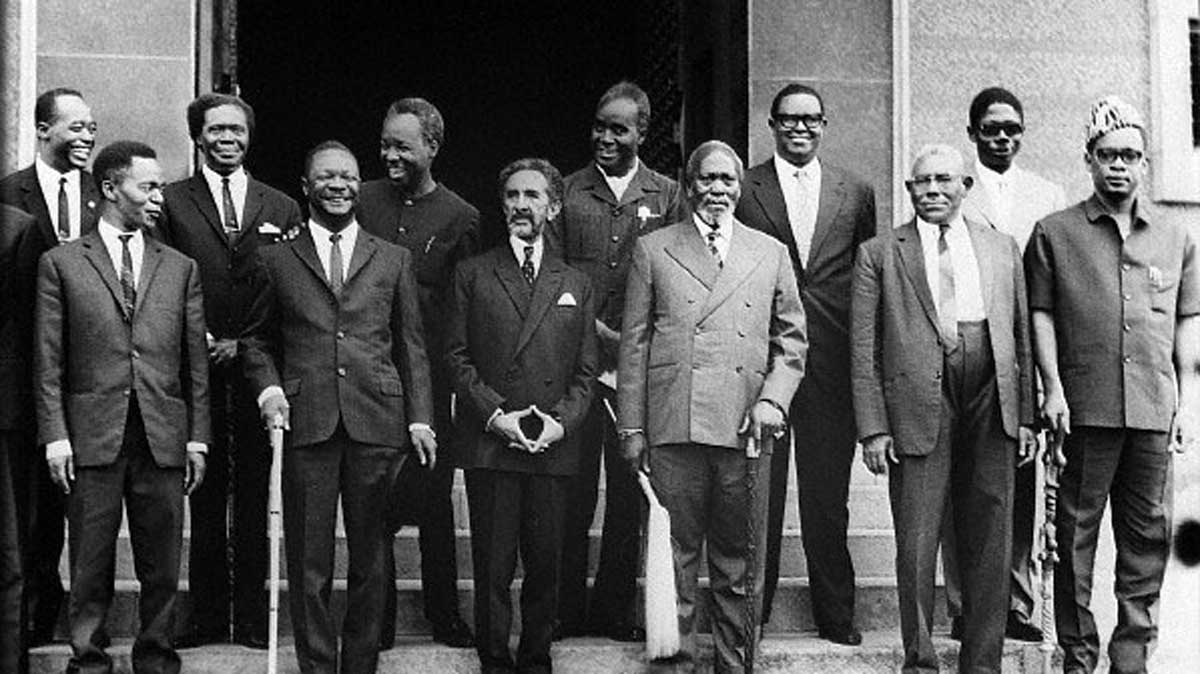
The year of Africa was 1960. The year in which 16 African states became independent. It was a year of great hope and expectation. To what degree have these hopes been fulfilled?
If we take the agenda of African political leadership of 1960, it will be easy to see the results. Decolonisation was followed by the achievement of political sovereignty under a system of universal suffrage almost everywhere in Africa. This, clearly, has been the zone of greatest achievement. What was called then the “downward sweep of African liberation” has been unceasing. The independence at last of Zimbabwe in 1980, coming after those of the former Portuguese colonies in 1975, is the fruit of a long struggle. The independence of Namibia is in sight, though the struggle will be arduous.
First move
The struggle in South Africa will be long. And the achievement of independence by the former Italian colony of Eritrea and the former Spanish colony of the Sahara are complicated because they have been incorporated into other independent African states. Nonetheless, the first objective is well on its way to fulfilment.
Then came the first serious move towards the achievement of African unity. The establishment of the OAU in 1963 was a compromise between groups favouring opposing strategies. The OAU is in no sense an all-African government, but it represents a real achievement nonetheless. It has managed, by its existence and its diplomacy, to keep in check many diviSive quarrels. It has sought more or less successfully to make itself the prime arbiter of inter-African disputes. It has, in short, kept relations between independent African states from deteriorating. It has also played a limited role in aiding in the decolonisation process in Southern Africa. While Africa has by no means achieved a stunning record in terms of unity, it has at least not lost ground or mortgaged the future.
Economic development was next on the list. Here one must admit that the record is weak. With a few exceptions, most African states have performed in a desultory manner. The gap with Europe in terms of economic structure and Standards of living is overall greater today than in 1960. Self-sufficiency in food has generally declined, as it has in other peripheral zones. The world inflation of the past 10 years has placed the non-oil-producing states in a very difficult balance-of-payments position, while the economic infrastructure has improved somewhat. Productivity has probably declined.
Dismal record
The fourth objective was the elimination of the role of outside non-African forces in the internal affairs of African states — what might be called the anti-imperialist objective, in addition to the anti-colonialist objective.
Here the record is dismal. In 1961, Julius Nyerere announced that the “second scramble for Africa” had begun. How right he was! The United States has, if anything, increased its direct and indirect interference in African affairs. France’s imperial influence is largely undiminished; see how she has overtly manipulated affairs in the Central African Republic.
Much is made in the Western Press of Soviet influence, directly or via Cuba. I would not deny that the USSR would like to play a bigger role, but in fact the role of the Russians has been remarkably small, even in those countries which have the most friendly relations with them.
China’s example
To see, however, how little Africa has achieved in this domain, the comparison to make is with China. Before 1945, outside powers played a major role in internal Chinese affairs. This is not so today. Despite all the internal divisions of the Chinese political leadership, the crucial decisions are made autonomously. Is this true to any significant extent in Africa today?
This is closely linked to the failure of the fifth objective: the creation of strong State structures with wide popular support. The strength of the one-party regimes is largely papier-maché, not merely vis-à-vis the outside world, but internally. The frequency of coups is one measure.
Most, not all, African regimes are in the hands of small, often rapacious, elites who have by and large no political programme other than self-aggrandisement. Just as the gap is growing between Africa and the core states of the world economy, so is the internal gap growing between a small upper crust and the large masses of the population. The state machinery has become a mechanism that facilitates the private accumulation of the few, through embezzlement and subsidy.
Finally, there was cultural renaissance. Here the picture is better — one of slow but significant achievement. There has been an Africanisation of cadres, not total by any means, but significant. There has been some linguistic Africanisation. There has been the extension of African arts: modern literature, plastic arts, cinema, and soon.
In this domain, where the policy choices are not easy, Africans have shown evidence of a good deal of common sense in trying to combine links with their traditional heritage and a response to the problems of today.
A blessing
Where can Africa go from here? The 1980s present an even more difficult environment for Africa than the past 20 years. World economic stagnation will mean that outside economic assistance will be even scarcer than before. This, of course, may be a blessing in disguise.
The process of swelling urban centres with marginalised unemployed should continue. The worldwide scramble for Africa’s mineral wealth promises to be even more intense. In short, there will be increased popular misery and increased outside pressure.
Up to now, the basic African political impulse has been nationalist. Africans have sought to unite with each other against an outside oppressor. This instinct was natural and necessary. It has, however, achieved what it can achieve.
Today, Africa has achieved, largely, the minimal nationalist objectives. The problem now is largely one of participating more directly in the world-class struggle, in which the lines of division internally correspond with lines of division in the world-economy as a whole. Not the East-West conflict but the struggle within the capitalist world economy as a whole, between its bourgeoisie and worldwide popular masses.
Africans will have to develop their own appropriate modes of struggle. To do that, however, requires taking stock of the balance sheet of the nationalist phase of African history.
This article was originally published in New African in June 1981. It is republished as part of our 60th anniversary archive series. The views and perspectives expressed reflect the context and circumstances at the time of original publication.