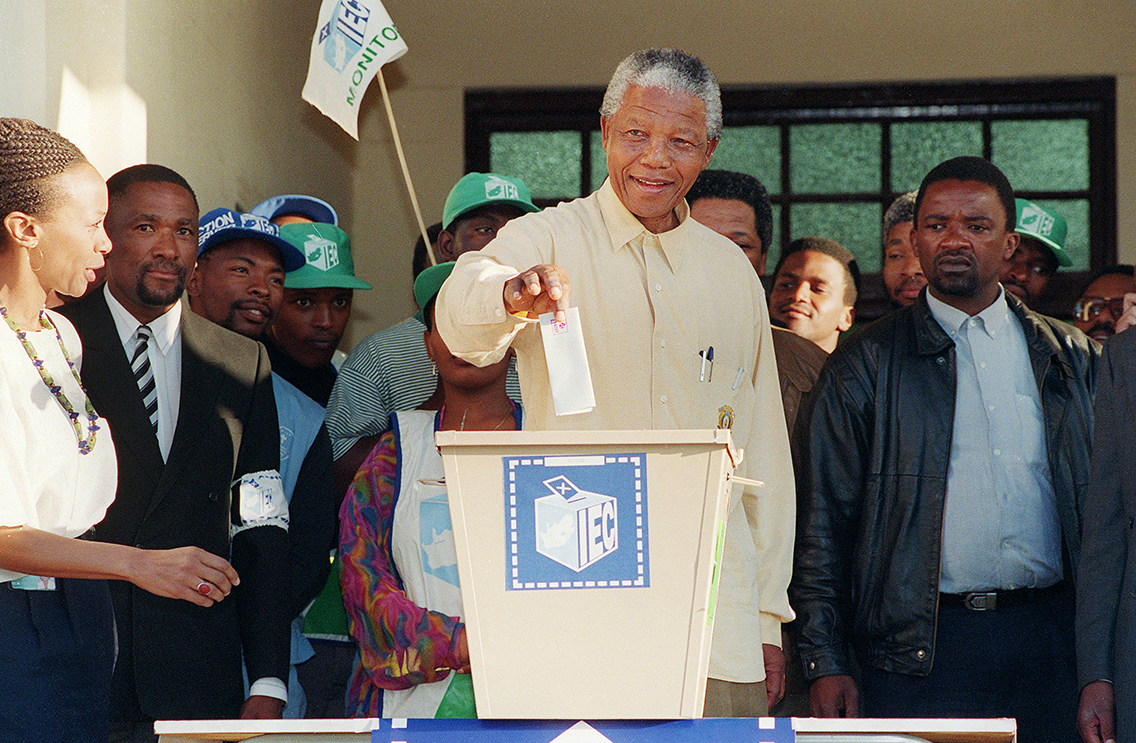
We have seen it all – the first all-race elections, the tears, the joy, the new flag, the parties, the excitement and that morning-after feeling. The elections were massively disorganised, some would say chaotic. There was inefficiency everywhere and much deliberate rigging.
Whole ballot boxes went missing, while caches of others stuffed with marked papers were exposed. Some official polling stations never opened. Others had queues lasting from dawn to dusk for several days. Pirate stations were opened where voters were not entitled to vote, while at secret rendezvous officials were carefully stuffing unauthorised ballot boxes. At the very time when the Independent Electoral Commission (IEC) ran out of ballot papers and was forced to print new ones, pirate stations had an inexhaustible supply and government officials were caught hoarding thousands of ballot papers.
The IEC had no idea where the 35 million ballot papers had gone, nor what happened to them after that. The lack of serial numbers made reconciliation impossible. A one-day public holiday became two; a three-day election became four.
And yet 23 million voted (almost the whole electorate), a bigger turnout than anywhere else in the world. People arrived on crutches, in wheelbarrows; they walked for miles just to vote. People of all races queued patiently for days in the blazing sun. And there was peace.
Crime rates, according to the police, fell by some 50%. Hospitals were emptied, and the emergency staff called in to deal with anticipated violence had nothing to do. The whites who thought that the revolution was coming and had stocked up for along seige found that their portable gas burners and blankets and guns were not needed. A spate of major bomb blasts just before the elections (in central Johannesburg and at Jan Smuts Airport) turned out to be the last major incidents of violence during the electoral period. Even the terrorists seemed cowed by the national mood of reconciliation. This turned to rejoicing when a whole gang of right-wing disruptionists, including two policemen, were caught with their arms.
The elections proceeded in an atmosphere of national euphoria, but it soon became clear that strict accuracy over results would never be possible. When Justice Johann Kriegler, the much criticised head of the IEC, was challenged over the way he had run things, he riposted, “the election was about national reconciliation, not about ballot reconciliation.”
And most of the leading contenders seemed to agree with him. As long as the figures were roughly right, everyone would agree to compromise in the new spirit of give and take.
No need for an election
And the extraordinary thing about the whole chaotic electoral circus, the rigging and the rejoicing, is that the results worked out almost exactly as the analysts had predicted. There was really no statistical need to hold the elections at all.
It was simply a mark of entering a new era of freedom, not of counting heads.
Indeed, towards the end, when arguments really got nasty over ballot rigging in KwaZulu, the parties simply negotiated their share of disputed votes. The IEC and the ANC simply conspired to hand over control of KwaZulu to Chief Buthelezi. They thought it would be safer to have him as part of the system rather than causing trouble from the outside.
New African has frequently forecast that the ANC would get about two-thirds of the vote, that the new-style National Party under De Klerk’s charismatic campaign would do better than expected, that Inkatha would fail outside its own fiefdom and that the Democratic Party would disintegrate as its members moved into the bosom of other parties. All this was fulfilled. It turned out to have been a “designer election” manipulated so that all the main parties would get a share of the cake.
But behind this pattern there were striking anomalies. The Western Cape turned out to be not so liberal after all. The majority coloureds in the region were more worried about the “black peril” than about the Nationalist government that had made their life hell in the long years of apartheid. They were worried about the total breakdown of the system that gave them preference in the job market over black Africans.
As a result, the Western Cape returned Hendrik Verster as its Prime Minister. He was the former Minister of Law and Order and a die-hard right-winger in the cabinet. The doyen journalist Allister Sparks wrote in a South African newspaper. “He was the minister in charge at the time of the Umtata massacre when 13-year-old children were butchered in the night as they slept…He was in charge when the Goldstone Commission presented prima facie evidence of Third Force connivance and gun running in the very top echelons of the police force. “If there really were a new NP it would have honoured the principle of ministerial responsibility, and Kriel would not have remained in the cabinet – never mind as candidate for the premier of Western Cape.”
But in KwaZulu, where Inkatha was allowed to win 41 seats to the ANC’s 21, the IFP has already agreed that the two parties must share power in the 10-member regional executive.
Another curiosity is that the Government of National Unity, which will be in power for the next five years, is really but an extension of the power-sharing system which existed before. True Nelson Mandela is President and De Klerk his right-hand man, but most of the old parties and ministers who negotiated the transition are still there. The only real difference is the inclusion of Chief Buthelezi, formerly the chief obstructionist.
All the major players have pledged to work as part of Mandela’s team. The jockeying for power is over; now all parties must concentrate on the need to build a new, non-racial South Africa where at least the minimum aspirations of the long-suffering people are met.
But first there will be two major political hang-overs. What is to be done with General Constand Viljoen, who was given many vague promises as a price for getting him to participate in the elections?
Dangers on the right
Viljoen’s Freedom Front (FF) was promised that an advisory commission would investigate the demand for a white Volkstaat. But now that the elections are over and he has been soundly beaten, winning less than half a million votes and only nine seats, the idea seems more preposterous than ever. Where would the Volkstaat be? In no region did the Freedom Front get 10% of the vote. It did best in the North West, but even there the ANC got nearly 80% of the vote. Surely there is no way in which a white state could be set up in an area where the black population has a huge majority.
Mandela has already chosen his team and has deliberately picked the most moderate and pragmatic of all the talent available to him. He has left the white technocrats in their old positions – Derek Keys as Minister of Finance and Chris Stals as Governor of the Central Bank to give reassurance to financial markets.
Mandela has appointed the unpopular Joe Modise as Minister of Defence because he has won the grudging acceptance of the generals and military establishment. Joe Slovo has been given the portfolio of Housing and Welfare to see what he can do to achieve results where expectations are greatest. But why was the slow-moving Alfred Nzo put in such a high-profile position as Foreign Minister, and why wasn’t the dynamic Cyril Ramaphosa persuaded to come into the cabinet?
But all in all Mandela has picked a moderate and sensible team, their challenge will be to see whether they can deliver sufficient to the masses hungry for social and economic advancement.
This article was originally published in New African in June 1994. It is republished as part of our 60th anniversary archive series. The views and perspectives expressed reflect the context and circumstances at the time of original publication.