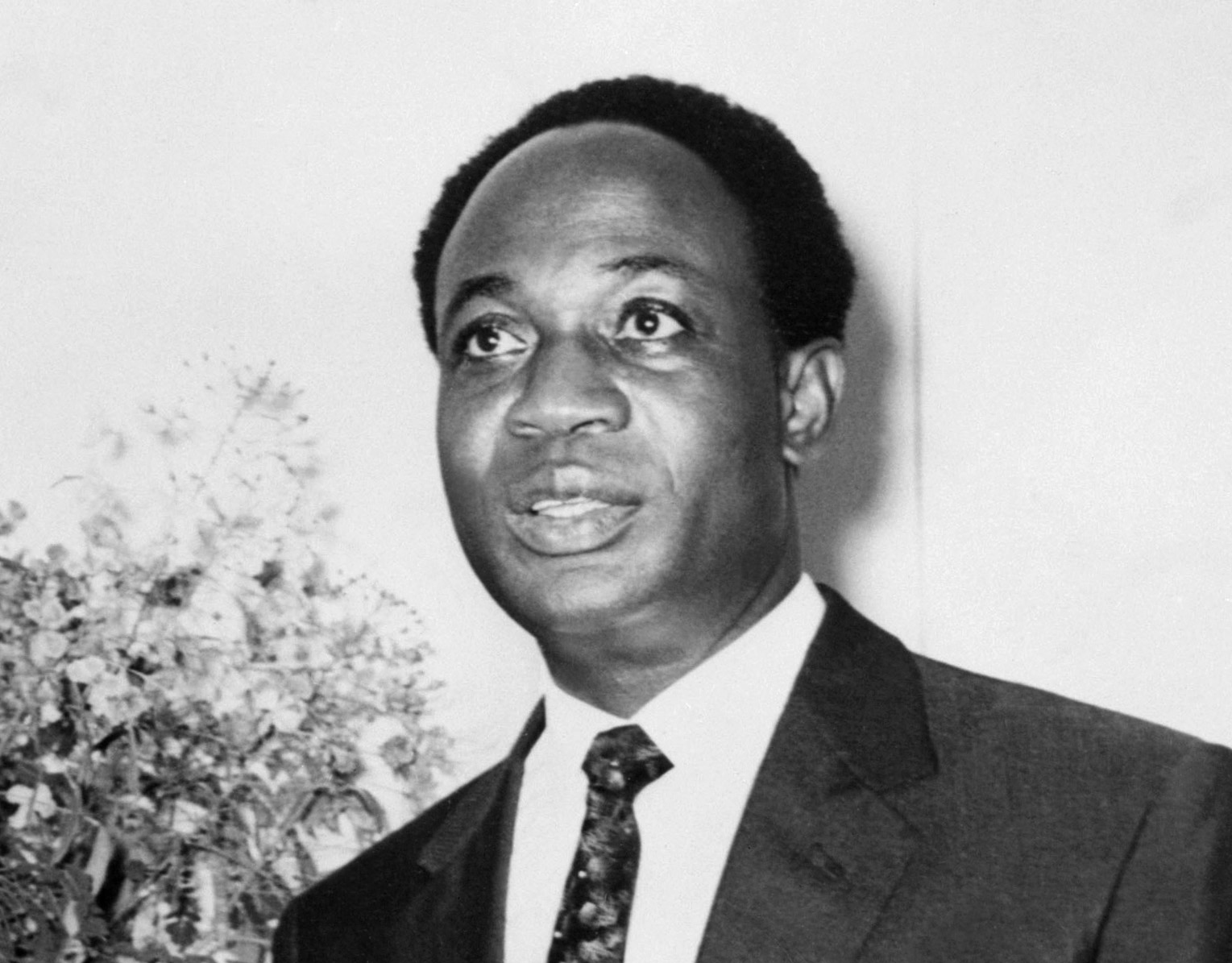
At the national helm was Kwame Nkrumah, already a prophet among his people, who inherited a happy, reasonably united country with a viable economy and strong foreign exchange reserves.
The charisma and flamboyant character of Kwame Nkrumah concentrated the spotlight of African attention even more firmly on Ghana. Here was a small nation of only eight million people which enjoyed more prestige and publicity than any other African country, including even Nigeria.
Nkrumah wanted to change the world in a hurry. He was larger than life, a man of vision, an idealist, a dreamer who stirred African souls with his lofty conception of Pan-Africanism, universal socialism and continental unity. He made his listeners, in a still colonial continent, proud of being African. He gave the ordinary people pride in his leadership and self-respect.
But, in practice, Nkrumah wanted to do too much too soon. He advocated Pan-African government long before the rest of a divided continent was ready. He insisted on achieving Pan-Africanism in one jump—to the extent of attacking pragmatic, regional organisations such as the East African Community.
His headlong rush simply resulted in a split between his allies in the Casablanca bloc and the much larger group of Monrovia moderates. His desire for quick results plunged him headlong into a union with Guinea, which existed merely in name. His continual attacks on colonialism lost him the goodwill of Britain and the United States and put him increasingly at the mercy of a Russian alliance.
At home, his haste for results soon changed an easy-going, sunny democracy into an authoritarian regime. He gradually built up his own power at the expense of the democratic institutions in the country. He abolished municipal assemblies, curtailed the powers of the chiefs, overrode the judiciary, bypassed the executive by setting up his own parallel organisations and turned parliament into a talking shop.
Gradually he tightened the screws of dictatorship as he became increasingly out of step with the wishes of his people. Successive coup attempts made him rely increasingly on his Russian-advised and trained Presidential Guard.
While the money lasted, he scored some notable economic achievements. Among them was the best educational system in Africa at the time (free universal primary education, which Nigeria is achieving now, was established in Ghana in 1962). He built a sophisticated network of communications, some of the best urban African housing, the Tema port and freeway and the Volta Dam, which has many times justified the faith that he put into it.
But his economic management was minimal. His search for quick solutions—his state farms and corporations, the Young Pioneers, the prestige construction projects brought Ghana to a state of economic ruin within a few years. When the coup came in 1966, he left Ghana crippled by debt, with falling production, large capital outflows and an economy on the point of chaos.
Contrast with Acheampong
There is a marked contrast between Nkrumah’s militant, one-party government and today’s military rule. Nkrumah achieved power legitimately through the ballot box but lost the goodwill of his people. General Acheampong gained power by the barrel of a gun, but most Ghanaians today feel that his government is sincerely seeking a national consensus.
In style too, the two leaders are starkly different. Nkrumah had his head in the clouds; Acheampong has his feet on the ground. Nkrumah’s government was Passionate, socialist, doctrinaire; Acheampong’s is pragmatic, practical without a shred of ideology.
Nkrumah would wake up and talk to the nation in his dawn broadcasts with messianic fervour, uplifting men’s souls and [obscured word] them to think of higher things. Acheampong makes bread-and-butter speeches about the nuts and bolts of economic policy. Nkrumah blamed everything on the wicked colonialists; Acheampong blames most things that go wrong on the hoarders, smugglers and saboteurs in Ghana.
The contrast extends also to the record of achievement. Apart from the notorious construction projects, Nkrumah’s achievements were mostly spiritual, Acheampong’s mostly practical. While Nkrumah talked about harnessing the energy of the masses, Acheampong introduced “Operation Feed Yourself”. While Nkrumah concentrated on industrialisation as the quick way to economic salvation, Acheampong realised that Ghana could not make economic progress unless it could grow enough food to feed itself.
Twenty years ago Nkrumah spearheaded the struggle against economic [neo-] colonialism. He argued that if Africa concentrated on agriculture then its people would remain the hewers of wood and the drawers of water. The route to economic salvation lay in rapid industrialisation.
But in the years that have passed, experience has taught that countries which followed Nkrumah along that path ended with a series of badly run, overprotected industries, dependent heavily on imports of raw materials and spare parts, which almost invariably made losses and caused a continual drain on foreign exchange. Industrialisation did little to solve unemployment problems.
In the 20 years since the heady hopes of Nkrumah, development thinking has undergone a complete change. Instead of trying to compete industrially, African countries have espoused the formula of balanced growth, with industry based on local raw materials and agriculture producing cash crops to earn foreign exchange and food crops to feed the [people] and economise on imports.
Ghana’s last two governments have shown an increasing awareness of these economic priorities. The Supreme Military Council introduced Operation Feed Yourself in 1972, and then Operation Feed Your Industries. Most of the loss-making state farms have been rehabilitated under better management and have switched from food crops to plantation crops, such as rubber, citrus and oil palm, to which they are best suited.
Ghana is placing great emphasis on irrigation projects for rice and sugar and has embarked on a programme of improving storage facilities. If plans for nationwide storage in propylene butyl silos work, then Ghana should be self-sufficient on a long-term basis in rice, maize and other food crops.
But despite the government’s efforts over the years, the country has still not achieved self-sufficiency in sugar production. Prices of local foods continue to rise with the mounting inflation, and there is a desperate shortage of many raw materials for industry that could be produced locally. Meanwhile, cocoa production, which is the lifeblood of increased export earnings, has gradually declined over the years, despite massive government subsidies for fertilisers and insecticides.
Over the past 20 years, Ghana has built up a comprehensive and sophisticated industrial structure, which appears to be in continual trouble because there is not enough foreign exchange to pay for essential imports. The problems will persist as long as there are fundamental payment difficulties, but Ghanaian businessmen have learnt a lot from their hardships and are in a position to boost production should foreign exchange become available.
Despite Ghana’s economic problems, the general standard of living remains one of the highest in West Africa. The education system is well established, public health facilities are widespread, and standards of housing, water supply and communications are high.
Rehabilitation of Dr Nkrumah
When Nkrumah was toppled by the National Liberation Council in February 1966, his name was vilified. Now, sufficient time has passed for him to be restored to his rightful place in Ghanaian history.
The Acheampong government remains true to the principles of the 1966 coup, but pressure from a sizeable body of public opinion has ensured that Nkrumah is gradually rehabilitated. The ordinary Ghanaian, especially the younger generation, has already forgotten the later years of bitter dictatorship and now sees Nkrumah as a giant who stood head and shoulders above the leaders who succeeded him. Although he was widely criticised for his costly prestige projects, Ghanaians frequently point out that “nothing new has been built since his day”.
Nkrumah’s rehabilitation has taken many diverse forms. The old Nkrumah statue, which was dragged from its pedestal outside the parliament building in 1966, is now carefully preserved in the museum (with its head and feet missing). Meanwhile, a new statue has been cast in Italy and is to be erected at the old polo grounds opposite the old parliament buildings.
Nkrumah’s notorious Job 600 has been renamed the Kwame Nkrumah Centre and is fully used for international conferences. The Tema freeway has been renamed Kwame Nkrumah Highway. His old attorney general, Geoffrey Bing, who was bundled out of the country at the time of the coup, was invited back as a government guest to attend the fifth anniversary of the revolution.
Chief Awolowo of Nigeria visited Accra and said that the time had come to look back and restore Nkrumah to his proper place in history. President Kaunda arrived to talk about southern Africa, but insisted on being taken to visit Nkrumah’s birthplace. Nkrumah’s wife, Fathia, who had been living in exile in Cairo, has returned to Ghana and lives in a house provided for her by the government.
Meanwhile, differences between the family and the government have meant that Nkrumah has not yet been granted his final funeral rights. But a date has now been agreed for April, and the government has drawn up a crash programme amounting to about $135,000 to prepare Nkrumah’s birthplace at Nkroful in preparation for the final rites in his home town.
The government has ordered that the road leading from Axim to Nkroful should be retarred and is constructing a new rest house and motel at the cost of $60,000 to accommodate visitors. The intention is also to build him a mausoleum. But while Nkrumah’s name is being restored, not one ot his old political colleagues or allies holds any important position in government. Indeed, an old NLC decree still prohibits them from exercising any political rights or holding any public office.
Most of his old ministers, such as Krobo Edusei (whose wife had the golden bed), Komla Gbedemah (his disaffected finance minister! and Archie Casley Hayford (who resigned early in the regime) are now in private business or professions.
Kojo Botsio, detained for planning an Nkrumahist counter-coup in December 1973, was released a sick man in January. But John Tettegah, Nkrumah’s former trades union boss, remains inside.
When Acheampong was asked recently whether he could do anything to lift the NLC decree that bans CPP men from exercising their political rights, he refused point blank.
He said he was not victimising anybody because of their political past and that his was a government of national reconciliation. But he was hard put to it to find an example of anyone the SMC had been able to help, quoting only the case of Komla Gbedemah, who was roving ambassador for a short time after Acheampong came to power.
Nkrumah and Acheampong, a study in contrasts. Nkrumah would talk to the nation in dawn broadcasts with messianic fervour. Acheampong made bread-and-butter speeches.
This article was originally published in New African in March 1977. It is republished as part of our 60th anniversary archive series. The views and perspectives expressed reflect the context and circumstances at the time of original publication.