
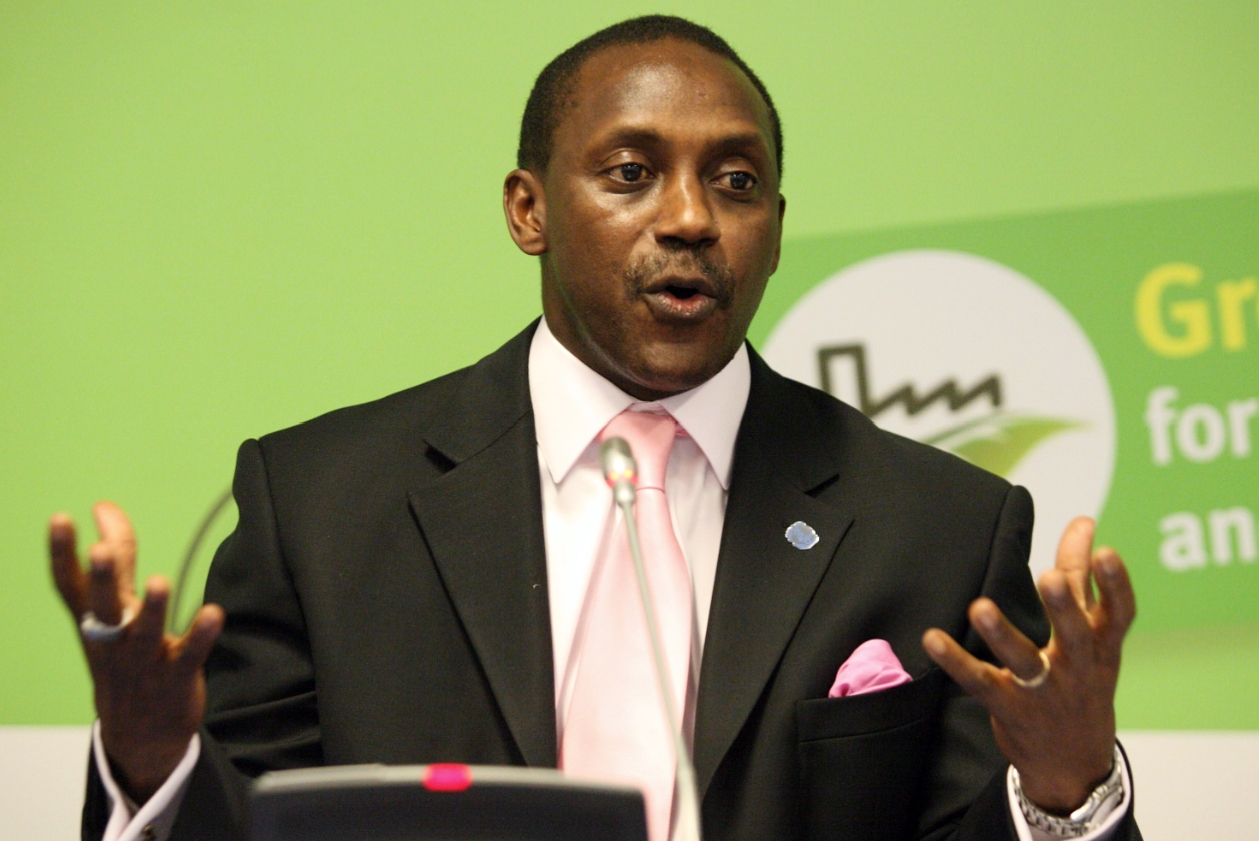
Among all the voices discussing the direction that Africa should take, perhaps none is more realistic or compelling than Dr Kandeh Yumkella’s. Stephen Williams went to hear him speak.
Dr. Kandeh Yumkella is one of the most inspiring African speakers currently addressing the future of the continent. This is perhaps unusual for a senior UN representative – Yumkella is director-general of the UN Industrial Development Organisation (UNIDO). When he spoke recently at an investment conference, he inspired a rather staid audience in a luxury hotel to rise as one to their feet and give a long and appreciative standing ovation.
However, in November, when Yumkella spoke at the London Business School, it was to a very different audience. They were generally (though not exclusively) younger, more academic – but certainly no less responsive to him. He acknowledged them as a new generation to which he was handing on his experience and vision for safekeeping. It made for a persuasive and somehow more intimate experience.
When he took to the podium, he thanked the organisers of the debate, Eirenicon Africa, and made it clear that he had not come with any major prescription for Africa’s many economic challenges, but rather was there to challenge the young audience to “be more ambitious for Africa”.
He began by relating a lecture that he had been invited to at Warwick University’s Economics Society about five years previously, when a senior banker had given the audience what Yumkella described as “a wonderful presentation” about what the global economy would look like in the next 10 to 15 years. However, during the whole of the banker’s presentation, he did not mention Africa once.
When the banker had finished, he sat down to answer questions. One of the young African students enquired: “You didn’t say anything about Africa, why is that?”
The banker was frank. Africa would not affect the economic trends that he had described and there were three reasons why: one, the continent’s manufacturing base was not very significant, less than 2% of global manufacturing value added; two, the foreign direct investment that Africa attracted was miniscule; and three, Africa’s capital markets, except perhaps in South Africa, were irrelevant, being so small.
“I’m sorry,” the banker said, “but in terms of economic trends, Africa simply will not impact.”
Yumkella asked his London Business School audience to just imagine the effect of this answer on the young Africans that were present. “But it was reality,” Yumkella insisted. He then methodically examined Africa’s economic track record.
“You know in the 1980s and 1990s,” Yumkella said, “Africa did reasonably well. The numbers are there that illustrate a good performance – a number of economies recorded an average 5% growth rate, some economists say 7%. Seven of the 10 fastest growing economies are African, according to the IMF. We’ve done reasonably well.
“But of course there is a commodity boom and everybody is making a deal with Africa. In the last five years, I have attended a number of those partnership conferences; the EU-Africa partnership, Africa-Brazil, Africa-China, Africa-India, you name it! I have been to many of them, and the one thing driving them all is the global appetite for commodities. Everybody needs a piece of our real estate!”
Remarking further on the commodity boom, Yumkella described Africa as sitting on significant mineral deposits, in some cases possessing 30%, 40%, or 60% of the world’s total, depending on the mineral.
Warming to his theme, he then quoted a former World Bank president, James Wolfensohn, who had categorised countries as falling into four different divisions: the affluent, the converging, the struggling and the poor.
The converging nations are those that are closing the gap with the affluent countries while the struggling nations are those that are progressing from a poor towards a middle-income status.
According to Yumkella, many of the world’s poorer countries are in Africa. Based on the classification of poverty being an average per capita income of $1.25 per day, the number of extreme poor African countries had fallen from 35 to 21 in the 1990s.
“That’s not too bad,” Yumkella said, “and the number of developed converging countries have increased from two to 17.”
But he added a caution. “Twelve of the 17 convergents are oil exporting or mineral-exporting countries. Three of them, Ethiopia, Uganda and Rwanda have achieved convergence through agricultural development and the last two, Mauritius and Cape Verde, are not resource-exporters. But the bulk of those that were converging were relying on the commodity boom.
“The reality is that in 2005, sub-Saharan Africa was the world’s poorest region with just over 50% of its population still living on $1.25 a day. This is almost the same as it was 25 years ago. But, in fact, the income gap between Africa and other developing regions has been widening over the past 40 years.”
And here Yumkella came to the crux of his argument. Africa might have done well, but manufacturing has driven growth in most other global regions whereas in Africa the growth has been driven simply by commodity exports. And, he insisted, that must change. He drew on the example of the Asian countries, including China, that had achieved rapid economic growth over the past two decades through labour intensive manufacturing – and the potential for Africa to do the same, rather than relying only on commodity exports to generate wealth.
“Let me tell you why I feel it is very urgent why African nations should become very ambitious and very aggressive in pursuing social change and industrialisation in this context. I will give you three reasons.
“The first is that there have been a lot of writings over the last year-and-a-half, including the work of Jeremy Rifkind of Wharton University [USA], that point to a new industrial revolution taking place.
“In fact, Rifkind’s work describes this as the third industrial revolution to be based on new energy sources. He shows how in the first and second industrial revolutions, you see a convergence between new energy systems, such as steam and the combustion engine, and new communications systems like the telegraph and telephone.
“The third industrial revolution, Rifkind believes, will be driven by clean decentralised energy sources, and their intersection with the digital revolution that is taking place. Now, you may not believe that it is an industrial revolution, but I encourage you to look at what Germany is doing, what South Korea is doing, and what Denmark and Japan are doing. They are driving ahead with green growth.
“South Korea has decided to invest 2% of its GDP in green growth, projecting growth 20-25 years from now and the technologies that will lead it, and why they will be leaders in these technologies. The new leaders in Denmark are doing the same, and Germany’s push for a new energy sector and green crops is also significant.
“The European Union (EU) has in fact adopted the pillars proposed by Jeremy Rifkind for the third industrial revolution as part of the EU strategy for pushing industrialisation, particularly green growth, within the EU. It is happening and I can give you numbers for China as well, as I sit on the China Council that is looking for green growth to create a harmonised society, projected 20-30 years from now.
“The second reason is climate change. Climate change is real, if you look at all the projections, if business as usual continues, we stand to lose 50% of our crop yields in Africa.
“Let me tell you why this is so serious. We have projected already in the FAO, WFP, IFAD and others that we need to increase food production by 50% globally by 2030, and 70% by 2050 because our world population will be 8 billion or 9 billion going forward.
“According to statistics, Africa’s population will be about 1.3 billion by 2030, and about 2.2 billion by 2050. We have one of the fastest urbanisation rates in the world and the average age in urban communities is 18 years. So think about it: rapid population growth, massive urbanisation, and lower food production – that’s a recipe for disaster!
“Thirdly, the discovery of natural resources every year in Africa is also a major factor. In the case of my own country, Sierra Leone, eight years ago we began to recover from a devastating civil war and just five years ago we found huge reserves of iron ore, the world’s fifth largest deposit. And we discovered offshore oil and gas a few months ago.
“There have also been finds in Mozambique, Tanzania, Ghana and Mauritania. For me, this gives us an opportunity to jump-start industrial transformation in our countries.”
Yumkella is clear that Africa needs to learn from the Asian experience. And leadership, in his view, is absolutely crucial in order to introduce structural changes and market-oriented public private partnerships, to promote a shift to new productive sectors and away from a reliance on commodities. And as Yumkella puts it: “Everything you heard about good governance is crucial. We need deliberate strategies and good leadership.”
He added that both strategy and good leadership needed to be linked to natural resource management: “We must aggressively pursue the Extractive Industries Transparency Initiative and also the Natural Resource Charter that have been launched within the last seven years, as they will assist us to manage our assets properly and invest in new productive sectors for future generations. Norway has done it, Botswana has done it. We all must do it.”
Lowering the cost of doing business in Africa is also essential. Yumkellah recalled that when he was working in Nigeria in 2002-03, it sometimes took companies three to four weeks to clear their goods from the port. “By the time they cleared their goods, the Asian competitor had already shipped and the client had already received it,” he explained. “So the cost of doing business needs to go down even faster if we’re going to be industrially competitive.”
Turning his attention to infrastructure, Yumkella said that he could not over-emphasise the need for investing in physical infrastructure such as roads, bridges, port facilities, and, of course, his major preoccupation, energy. In September 2012, the UN secretary-general, Ban Ki-moon, asked Yumkella to serve as his special representative for Sustainable Energy for All and the chief executive of the initiative.
Laying out the situation today, Yumkellah said: “We have today, based on the statistics of the International Energy Agency, 580 million Africans without electricity. We are the world’s most energy-poor region. We estimated with the World Bank that Africa loses 2% to 3% of its GDP because of the lack of reliable energy.
“My favourite statistic is always Nigeria, and I do hope that my Nigerian brothers and sisters don’t get offended here! I have lived in Nigeria, I have worked there. I was there recently attending an energy forum organised by the European Bank for Reconstruction and Development. The country had just reached 4,500MW of electricity generation, but they really need 10,000MW.
“Nigeria has been flaring gas for over 40 years. We estimate that the gas flared in Africa can supply about half of the continent’s electricity needs, but we burn it with no value addition. We don’t use it for generating power.
“Now, let’s talk about the continent’s human capital. We have to go beyond just providing education. We know that today, a lot of the educated kids that have gone through school cannot find work as they don’t have the appropriate skills and knowledge. We have to develop skills. People say ‘yes Africa’s labour is cheap, but it’s unskilled’.
“What worries us is this massive urbanisation and youthful population. The estimate is that Nigeria’s population will be about 300 million in 20-25 years, and 30-40 million of those will live in Lagos. Just think about it. There will be both a lack of infrastructure and no jobs. There is going to be a crisis.
“And Sierra Leone’s population will also double around the same period and everybody is getting into Freetown, the capital which was built for 250,000 people. Now we are already at 2 million in the capital.”
Once again, Yumkella drew attention to what is happening in Asia. “When we look at similar numbers in Vietnam or India, they will tell you that they look at the demographic transition, and see it as their competitive advantage in the future, because they are investing in education and skills so that they will remain the factory of the world. And so they look at the demographic landscape of the youthful population as a dividend. They know that if the youth are not educated, it will be a crisis.”
Yumkella also made a heartfelt plea for institutional reform because, what happens in Africa is typically that when governments change, policies change too. Neither the investors nor the local people have the continuity required for industrial transformation. In Yumkella’s view, you need stable, presentable policies over time. In fact, during discussions that he has been having with energy companies looking at gas and power generating markets, they are looking for ‘TLC’ – transparency, longevity and credibility of government policy.
“Because it takes so much time to see a return on building infrastructure and investing in the energy sector, investors need assurances that policies will be retained and investments are going to be protected.
“In fact, we also need to push forward regional trade. And lastly, we must be ready to learn from others. Look at how China learnt from what Japan did, and how Korea learnt from Japan,” Yumkellah said. “And Africa must be willing to experiment, and governments have to be entrepreneurial. Some policies do not work, such as when we tried import substitution, but we didn’t learn. Even when the policies were not working, we didn’t adjust. Learning from others is, I believe, a key issue.
“In conclusion, you are Africa’s next generation. I think with the results of the last 12 years, we can do it. We see an increase in democracy in Africa. We see stability. But I can tell you that if the demographic numbers continue, if we continue to rely only on commodities, what will happen will be disastrous. But I am sure that we can do it. We must do it. Africa must manufacture to survive.”








