
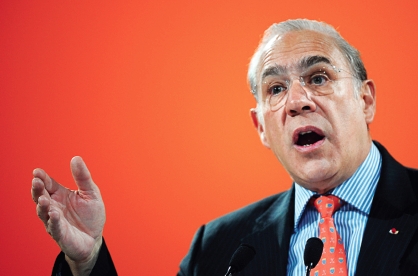
In April, the Organisation for Economic Co-operation and Development (OECD) held a Global Forum on Development at its Paris headquarters to examine the post-2015 landscape and what should replace the UN Millennium Development Goals (MDGs). It was also an opportunity for New African to learn more about the OECD’s innovative approaches to poverty reduction, social cohesion and progress. Stephen Williams reports.
In the gleaming halls of the modern headquarters of the OECD in Paris, the Global Forum on Development (GFD) took place over a day and a half in early April. It was, essentially, a meeting to discuss the ways and means to achieve poverty reduction, environmental sustainability, and economic and social growth. Somewhat ironically, running in parallel in an adjacent conference hall to the GFD was an equally important meeting discussing Green Growth. It might be argued that these were the two sides of the same coin, and while the OECD chose to keep the events apart, an evening reception did at least allow the two sets of participants to mingle.
The GFD took place just a day after figures were released which indicated that development aid fell by 4% in real terms in 2012, following a 2% fall in 2011. The OECD secretary general, Angel Gurría, referred to this fall in his opening remarks, telling the summit of his concern over this trend: “It is worrying that budgetary duress in our member countries has led to a second successive fall in total aid,” Gurría said, “but I take heart from the fact that, in spite of the crisis, nine countries still managed to increase their aid.”
Continuing with his observations, he said: “As we approach the 2015 deadline for achieving the Millennium Development Goals, I hope that the trend in aid dropping away from the poorest countries will be reversed. This is essential if aid is to play its part in helping achieve the MDGs.” He identified the fall in official development assistance (ODA) as being due to the continuing financial crisis and euro zone turmoil that has led several governments to tighten their budgets, which has had a direct impact on development aid. There is also a noticeable shift in aid allocations away from the poorest countries and towards middleincome countries; however, on the basis of the OECD’s Development Assistance Committee’s Survey on Donors’ Forward Spending Plans, a moderate recovery in aid levels is expected this year.
Nigeria’s former president, Olusegun Obasanjo, delivered a keynote speech that followed the secretary general’s welcoming remarks to the GDF. Obasanjo’s address covered many of the global development agenda’s key points from a specifically African perspective, including the necessity to boost skills training to Africa’s youth; to build the continent’s transport infrastructure; to focus on agriculture and enter the global agri-business value chain; and to fight the scourge of corruption.
Nor did Obasanjo miss the opportunity to speak at some length about his recently launched initiative, the Olusegun Obasanjo Foundation; and outline its agenda as being to strengthen human security. The former president has selected five key pillars for this initiative: to educate the girl child; build Africa’s health services; create meaningful youth employment; develop food security; and stimulate good leadership. Obasanjo also identified the growing menace of illicit drugs in the West Africa region, which has evolved from being a waystation for Latin American and Asian drugs cartels to feed drugs to European and North American markets, into becoming an increasingly attractive market in its own right.
For this reason, Obasanjo now chairs the West Africa Commission on Drugs which, as well as mobilising public awareness, develops policy recommendations and capacities to counter this particular scourge. While Obasanjo’s presence greatly raised the African profile of this development forum, it was notable that there were so few other speakers from Africa. However, amid all the government ministers, representatives from development agencies, and civil society speakers from developed and developing countries discussing new approaches to fostering sustainable economic growth and human well-being, one speaker, from South Africa, offered his views on social cohesion and the role that poverty reduction has in this regard. Alan Hirsch, a professor and director at the Graduate School of Development Policy and Practice at the University of Cape Town (UCT), South Africa, explained that he had spent 18 years in the government of South Africa, first in the trade and industry ministry and then in the office of the presidency, before joining the UCT.
He made the following analysis, from his personal experience: “Obviously in 1994 we had an extremely divided society in South Africa. We had the absolute opposite of cohesion. We had an inferior, divided educational system and healthcare. We had huge gaps in language and mathematical proficiency; and higher education was incredibly weak for most people.
“Lots of people were located far from their places of work. Black people were seeking professional responsibility, and occupational and managerial positions. We had devastated social capital through removing and relocating people from where they lived to places that were more convenient in the society, and we had very uneven systems of social protection. It was an incredibly divided society.”
But, as Hirsch pointed out, the new democratic dispensation in South Africa ushered in a raft of new policies from the government. “We did a lot of things to try to address those problems,” he continued. “There were a number of initiatives attempting to build social cohesion in our society. There were some positive impacts. We unified the school system… we unified the health system. We extended primary care in particular.
“Today, there are free basic services: free electricity and water to a certain minimum level for all citizens. There were more than two million houses built – a sixth of households were able to move into new houses. “And we introduced massive social transfers [income support] and from about two million people receiving social transfers just over a decade ago, there are today over 17 million people receiving social transfers, which is an achievement rather than an indictment on the need for the transfers to take place.”
Hirsch also pointed to a number of other improvements in South Africa in terms of social cohesion, such as life expectancy rising, and increases in formal employment, especially of black women.
However, he also painted a darker side to a number of trends within South African society. “The level of sexual assault in South Africa remains very high,” he told the delegates. “We have increasing rates of service delivery protests, and violence in social protests is also increasing. That led to the Marikana tragedy, which was an enormous shock to South African society. I think it told us how much more we have to achieve in terms of social cohesion.”
Like most South Africans, Hirsch believes that Nelson Mandela as president represented “a fantastic period”, especially for the racial reconciliation that he inculcated. However, the lesson that has been learnt, he believes, is that reconciliation does not necessarily result in social cohesion. “Reconciliation results in some sort of political base and stability, but not in social cohesion in the long run,” he avers. “There are some fundamental cleavages that remain. So we need to think, as a society and as a political society, to be able to contribute to strategic leadership. We need to measure social conditions by measuring the influence of social cohesion on social conflict, gender violence, attitudes towards race, and the importance of communicative protests. It is really a fascinating concept that South Africa managed the reconciliation but it did not lead to cohesion.”
If the idea that reconciliation does not automatically result in greater social cohesion seems counter-intuitive, as he told the forum, there was another surprising issue in South Africa. “The problem in our country is not so much the poorest of the poor. The programmes that we have got are actually focused on the poorest of the poor. “The big gap that we have is actually underemployment, the semi-employed, the seasonal workers, people very much in the margins who are not classified in terms of the economic definitions as being poor enough to receive direct benefits. We have established, I think, relatively effective programmes for the most vulnerable but not for this very large group.”
The role of civil society
Yet it is probably true that this is a uniquely South African situation. For most of the developing world, and this includes much of Middle Africa, the issue of reducing levels of poverty remains a daunting challenge. As Hirsch said in his address to the Forum, there is a need to measure social conditions. This viewpoint was echoed by Emele Duituturaga, the co-chair of the Civil Society Organisations Partnership for Development Effectiveness (CPDE). Duituturaga is a Fiji national and the honorary executive director of the Pacific Islands Association of Non Governmental Organisations (PIANGO), a regional coordinating body for national umbrella NGOs.
A gender expert, social policy analyst, and a keen political observer with a wide and varied background in public sector management, Duituturaga has experience working in the public, private and civil society sectors.
Since becoming the executive director of PIANGO, Duituturaga has been actively involved in CPDE, whose founding document calls for a new approach to development. Part of it reads: “Unchecked globalisation and profit-driven economic growth are failing the planet and people living in poverty. They have exacerbated inequalities at all levels – between and within regions, countries and communities, between men and women – and have sparked multiple crises of food, fuel, finance and climate that still remain unresolved: 1.6bn people (70% of them women and girls) still live in extreme poverty.”
As Duituturaga explained to New African:
“The CPDE is a global platform. The whole idea was to organise ourselves to influence the seat that we have, or the voice that we have, in the Global Partnership for Effective Development Cooperation, which has governments, donors, multilaterals and Civil Society and Private Sector representation. Essentially, our focus has been to lobby for policies that lead to development effectiveness.” According to Duituturaga, for too long the focus has been on aid effectiveness and how well ODA is being spent. But she believes that while aid is important, it is its development effectiveness that needs to be measured.
“The CPDE have several representatives in Africa,” Duituturaga confirms. “We have the feminist representatives who come through the feminist global organisations. We also collaborate with the Africa Reality of Aid Network, and they have representatives throughout Africa. In addition, there is also Richard Ssewakiryanga of the Uganda NGO Forum who is part of the global network, and with other NGOs we have a focal organisations in most countries.” The CPDE’s key messages are these: That poverty is a symptom of maldevelopment. The post-2015 development agenda must address both the root causes and symptoms of poverty. That the desired world post-2015 is one where there is respect for human rights, participatory democracy, social justice, environmental sustainability, gender equality and equity, decent work, sustainable change, justice, and dignity for the poor. And that poverty is multidimensional and requires a multisectoral approach and policy coherence.
Finally, they want civil society organisations to be recognised as independent development actors in their own right, who should be included in multi-stakeholder policy dialogues at the global, regional and national levels, in particular in development planning at the national level.








