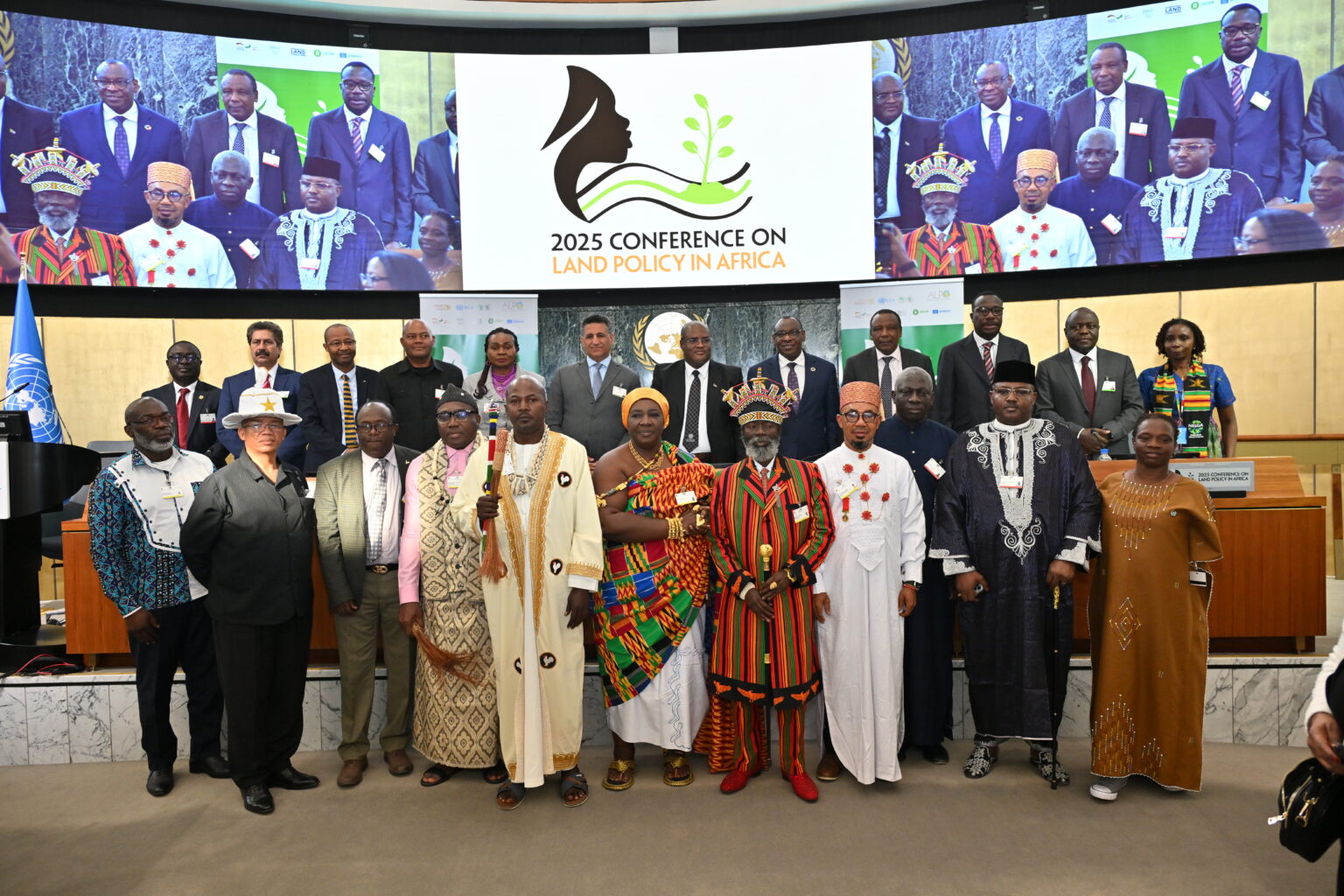
The 2025 Conference on Land Policy in Africa (CLPA) reaffirmed a central truth: in Africa, land is far more than a surface to be surveyed, titled, or traded. It is memory, culture, governance, identity – and the foundation upon which African reparations and justice must stand.
Organised by the African Union, UNECA and the AfDB, this sixth CLPA, held in November in Addis Ababa and aligned with the AU’s 2025 focus on reparations for Africans and people of African descent, arrived at a moment of deep urgency for the continent.
Seventy years after independence, Africa is once again facing an aggressive land grab over what lies beneath and above. Multinational corporations, geopolitical blocs and NGOs are seeking mining concessions, oil fields, critical minerals, carbon markets, and conservation territories.
In turn, they are fuelling civil wars and localised conflicts, environmental degradation, and trapping land use within the logic of a privatised global economic order.
Under strained public finances – and, in some cases, elite corruption – governments are trading away sovereignty and long-term prosperity. All of this unfolds against the erosion of communal African land traditions that long shielded societies from unrestrained commodification and protected land as spiritual and social heritage.
It was therefore fitting that one of the conference’s central plenaries – ‘Colonial Continuities and Discontinuities: Who Has the Right to Access and Own Land in Africa?’, addressed these dilemmas directly.
Panellists Justice Smokin Wanjala, Tsitsi Choruma-Dozwa, and Jimmy Ochom invited the continent to confront its past and reimagine land governance grounded in African values, communal wellbeing, and true economic sovereignty.
Kenyan Supreme Court Justice Smokin Wanjala reminded participants that African land systems and legal frameworks still carry the imprint of colonial dispossession, with its extractive logic, which has led to displaced communities in the name of ‘development’.
This model is possible only when land is treated as a commodity. By contrast, customary and communal systems – which see land as ancestral, spiritual, and ecological – remain strong barriers to unrestrained exploitation. Yet many reform processes continue to weaken these systems, sometimes with the encouragement of African financial institutions seeking collateral-based models.
Alongside extraction, Western-driven conservation continues to dispossess communities. The irony is stark: the very communities that safeguarded Africa’s biodiversity for centuries are now excluded as threats, while extractive industries that degrade ecosystems are legally protected. Any vision of land justice must therefore confront both extraction and exclusion.
Tsitsi Choruma-Dozwa’s reflections on Zimbabwe’s land reforms illustrated what reparative land redistribution can achieve. The dismantling of racially segregated land acts, widespread resettlement, and the creation of institutions like the Land Bank and Land Commission have demonstrated that redistribution can be both just and productive, empowering women and youths. As Head of the Land Commission, she noted that despite sanctions, Zimbabwe achieved agricultural self-sufficiency – showing that land justice can underpin economic transformation.
Elsewhere, CLPA revisited a long-running debate: should African land be privately owned or communally held?
Privatisation promises collateral, investor confidence, and easier statutory protection. But it also risks landlessness, elite capture, speculative markets, and the deepening of colonial inequalities.
Meanwhile, communal land systems ensure universal access, social cohesion, and stewardship rooted in culture. They protect land from speculation but face challenges: weak documentation, discriminatory practices affecting women and youth, and limited access to finance.
Preserving communal tenure
A central challenge – discussed widely in the margins of the conference – is how to unlock capital while preserving communal ownership. The solution lies not in abandoning communal systems but in re-designing Africa’s financial architecture around them.
African banks and financial institutions can create collective collateral instruments that: recognise communal land certificates and customary tenure as valid security; use group guarantees, co-operative ownership, and revenue-sharing models; and support community trusts or landholding companies that can borrow collectively while retaining communal custodianship.
Regional development banks, pension funds, and sovereign wealth funds can partner with traditional authorities to finance agroecology, green value chains, community-led land restoration, heritage land trusts, and diaspora investment linked to restitution. Such innovations would preserve communal land while enabling access to capital – creating an African alternative to the collateral models inherited from colonial law.
Whether through extractive concessions, conservation enclosures, privatisation, or debt-driven policy pressure, Africa’s land remains the terrain on which sovereignty is won or lost.