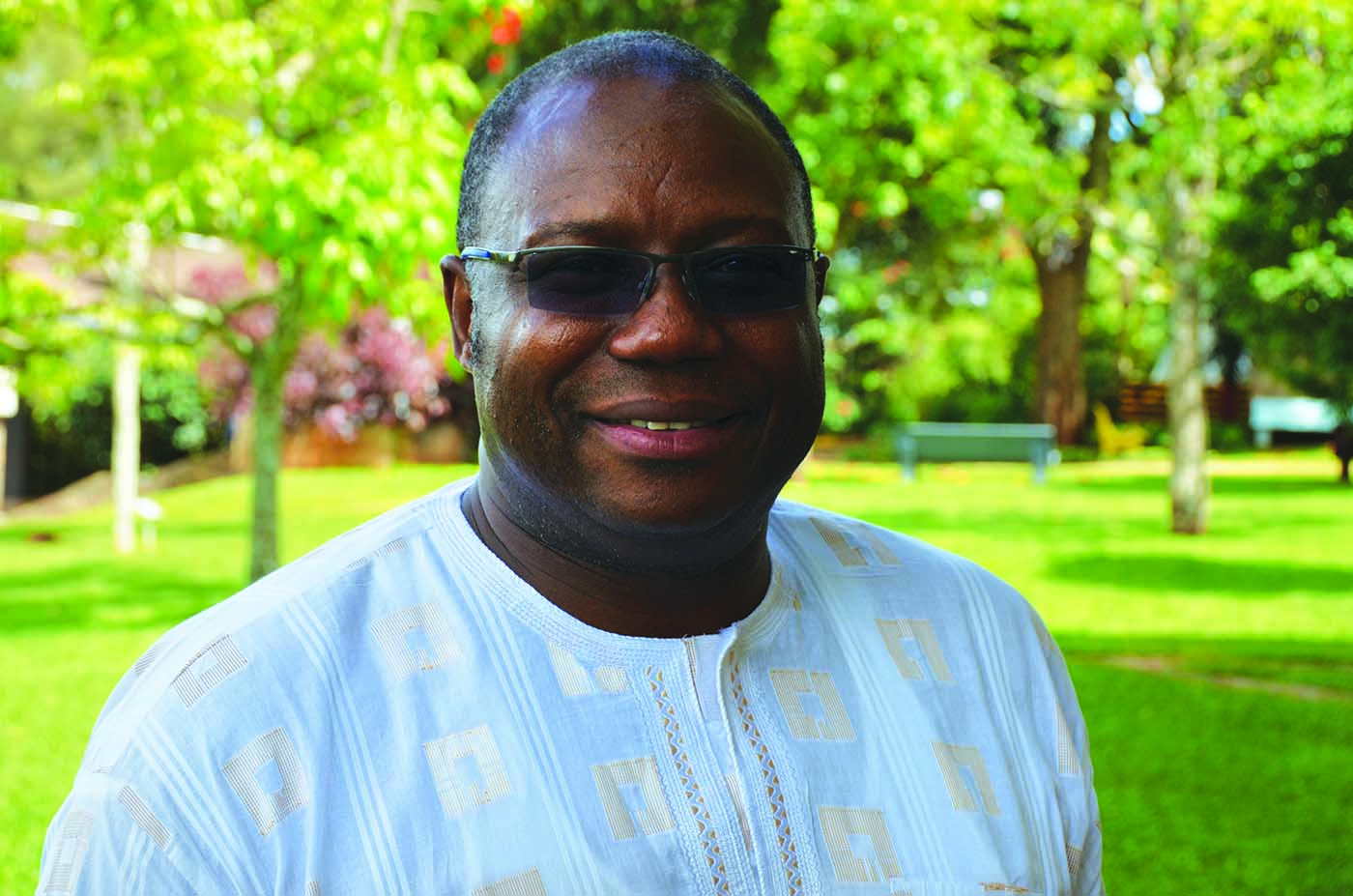
FARA’s Executive Director, Yemi Akinbamijo, explains that improving Africa’s food security and growing its agricultural economies will require a concerted effort to improve the continent’s scientific human capital and sustained investments in capacity building.
In 1984, Yemi Akinbamijo used the last grant-funded bottle of silver chloride at the nutrition biochemistry laboratory of the Faculty of Agriculture, University of Ife (Obafemi Awolowo University), Ife-Ife, Nigeria, finally depleting a stock that began to dwindle when USAID funding dried up in the mid 1980s.
“I was trained in Nigeria by a cohort of lecturers that were educated in the space of 15 years when the Western world concentrated on strengthening the capacity of Africans,” says Akinbamijo, now the Executive Director of the Forum for Agricultural Research in Africa.
“I was in the university for my first degree between 1979 and 1984. The bulk of my lecturers were returnees who benefitted from these massive investments in capacity – both intellectual/know-how, and infrastructure capacities. That was not unique to my university. It was what happened across the developing world. But once those facilities came to an end in the eighties, and they came to an end in 1979, 1980, then the cookie began to crumble and things began to deteriorate.”
Things rapidly began to “nosedive”, Akinbamijo says. Without funding, cross-pollination between international institutions and faculties did not happen, institutions shrank and became insular and research capabilities withered.
“We started what I’d call a technological or intellectual inbreeding,” he says. “If you look at the faculties today you find that there has been a complete reversal compared to when I was in school. At that time, 95 per cent of my lecturers were trained overseas. Today less than 5 per cent will be trained overseas, the other 95 are products of [academics] just being recycled [within universities].”
The implications of this falling capacity are serious, as the continent faces the unprecedented twin challenges of population pressure and climate change. The population of Sub-Saharan Africa is growing faster than any other region, and much of the growth is happening in the region’s booming cities. Agrarian societies are shifting to urban, consumerist ones, creating a mismatch between the supply and demand of food.
At the same time, a changing climate has altered weather patterns across the continent placing an enormous strain on the rain-fed agriculture that feeds most of the continent. These two factors have huge social implications, but also create potent economic threats. The majority of African countries depend on imports of food, sapping national resources and exporting jobs.
Efforts to change this scenario are under way. At its Summit in Malabo this year, heads of state of the African Union reaffirmed a commitment to the Comprehensive African Agriculture Development Programme (CAADP). It is heart-warming that agriculture is again a high priority item on the development agenda. However, increasing Africa’s food production demands more than just money, Akinbamijo says – it needs the continent to rebuild its research capacity and innovate.
“It is clear in my mind, as clear as daylight,” he says. “The quantum of food that is needed on the continent has to increase by 150 per cent over the next 10 years. I repeat that. The quantum of food needs to increase by 150 per cent in the next 10 years. If we do not meet this target, we will still go cap in hand and also remain a net importer of food. Now, to improve the quantum of required food is a demand for science in agriculture.”
To a large extent, that effort is going to have to come from domestic funding sources. Currently, the majority of agricultural technologies and food research systems depend on international funding, meaning that they are exposed to the shifting priorities of donors.
“Africa had always believed that technological capacities or capacity development in the agri-food system was the preserve of the development partners, such that when the support began to dwindle, nobody felt the nudge to fill the gap that was being created, and that void is still continuous today,” Akinbamijo says. Africa’s own international organisations and governments have rarely focused on building this capacity, meaning that research on the continent is still outsourced.
“When it comes to funding of agricultural biotechnologies and agrifood research systems, 90 per cent of the monies are still donor-dependent. So when the priorities of the donor countries began to change, and the grants began to wane, there was nothing coming in from the continent. And that is the situation that we are in today – that the resources driving agricultural research, especially in institutions that have trans-boundary mandates, in institutions that have regional or continental implications, [the responsibility is] neither mine nor yours. So whose responsibility is it? Who’s going to pick up the wheel of these institutions?”
The African Union declared 2014 the year of agriculture and food security, and Akinbamijo is insistent that research will find its place among the many initiatives and pledges being made, and he is positioning FARA to take the lead role in the debate.
Over the past 18 months, the organisation has developed “S3A”, the Science Agenda for Agriculture in Africa, which pushes for a greater acknowledgment with transnational bodies and national governments that science can have transformative impacts on food, nutrition and health securities and the agricultural economy. The Conference of African Ministers of Agriculture (CAMA) in April 2014 adopted S3A, and the agenda was endorsed by the Malabo Summit in July 2014.
“We now have the mandate of the heads of state behind this agenda. But remember that the agenda in itself is not standing in a vacuum,” Akinbamijo says. “It is all in the context of sustaining the CAADP momentum and those of the 2025 and 2063 benchmarks elaborated by the Department of Rural Economy and Agriculture (of the AUC) and the African Union Commission. In short, we are aligning these tools to serve the continental good.”
Human capital
Part of FARA’s mission in support of the agricultural transformation agenda will be to empower policymakers to make informed decisions about appropriate agricultural technology. Debates over the use of, for example, genetically modified (GM) crops, which can increase agricultural yields but are subject to safety concerns, continue to rage across the continent, with different governments taking diametrically-opposed decisions. This is, Akinbamijo says, partly a function of the lack of an independent authority on agricultural technology issues.
“Up to date, the African Union has very limited access to knowledge pools on subject matter-specific issues like genetically modified organisms (GMOs). It is anybody’s game. That is why we have a rudderless boat situation at the moment,” he says.
“But unfortunately, who is answering the agriculture science-related questions for Africa? Non-biologists, ‘non-scientists presenting as scientific advisers to African policymakers on the kind of science required to make a food-secure Africa happen. Of course, we cannot but be in the quagmire that we are in. That is natural. Because we are asking the wrong questions.
“For myself, I think we cannot be so specific when it comes to what technology we need. We first of all need a generic approach. That’s why I shy away from saying GM or no GM. For me, it is the wrong narrative, it is the wrong discussion, it is the wrong question. What is Africa’s contribution to knowledge? And what kind of science do we need to promote? What is Africa’s contribution to the generation of innovations?”
To bridge the gap in knowledge management, FARA is creating the African Academy for Agricultural Sciences and Technology (AAAST), which will be a federated body of knowledge pools to provide the much-needed authoritative guidance on agricultural science and technology.
“The academy is a platform that is being put together to govern the human resources, the African human capital that will turn this big wheel of agricultural research. Let me say that up until today, putting together African human capital in agricultural research is on an ad hoc basis. There is no federated body anywhere. We do have one or two academies, and a lot of national academies, but on a continental basis we have never had a dedicated academy for agricultural sciences.”
The Academy will be based in the FARA Secretariat in Accra. The governance structure will be announced shortly. It will publish occasional papers on a quarterly basis and a peer-review journal, according to
Akinbamijo.
“The science agenda is the horse that we will need in sustaining the CAADP momentum,” he says. “The rider of the horse is the human capital of the continent. So the human capital of the continent is who we are now federating with the academy. You can see the contextual linkages between the academy, the agenda and the continental programme of CAADP.”
Fixing the lack of human capital will require some serious introspection from policymakers, he adds:
“It is very clear that the contribution of Africa to science is infinitesimal. Our contribution is still so low, and we should concern ourselves with changing that statistic. And ask ourselves why are we so disproportional vis-à-vis the other continents.”
Smallholders
The majority of Africa’s farmers are not large, commercial entities. Most farm only a few acres for subsistence, selling any surpluses into the market. It has been widely acknowledged that any African agricultural revolution will need to start amongst this fragmented group of small-scale operators.
Making sure that technology is appropriate and applicable for smallholders will also be an important part of FARA’s mission. The Pan-African Farmers’ Organisation, PAFO, is on FARA’s board, and Akinbamijo believes in bringing science out of its “ivory tower” and ensuring that policymakers, scientists and farmers mix to share ideas. Innovation for innovation’s sake is unlikely to change the continent’s food security.
“I was speaking to a group of scientists, and I said to them, nobody goes out to buy an aircraft like you are shopping for chocolates. Every aircraft and thought through as a project, 4-5 years before it flies. When a Dreamliner production process is launched, it is the case that the buyer is already known and is a part of the assembly process,” Akinbamijo says. “We don’t want to start from the lab until we have concluded who’s going to use these technologies. We don’t roll out technologies and then say, hey, I have got technology for sale. It doesn’t work like that.”
Smallholders, who more often than not do not use advanced seed or inputs, are also on the frontline of climate change. A global acknowledgement that Africa needs more resources to adapt to the changing climate has prompted the creation of a new initiative, headed by the former Ghanaian president John Kufuor, to look into the promotion of ‘climate smart’ agriculture.
The need to adapt to climate change and to lower carbon emissions could re-energise Africa’s agricultural science agenda, Akinbamijo says.
“We are very strong proponents of climate smart agriculture,” he says. We should be responsible stewards of the environment. Which means that we will produce twice as much with half the resources. With minimal impact on the environment. That is innovation. Anything short of that will be disastrous.
“If you are talking about cutting down emissions in livestock… there is no two ways around minimising ruminant emissions outside science. If it is reducing the carbon footprint from rice fields, there is no two ways about it outside science. If it is a question of fertiliser use efficiency, there is no two ways about it, outside science,” he says. “you need nothing but science. I repeat: it’s nothing but science, pure science.”