Our new editorial initiative seeks to answer a question that most development institutions have debated, but few have resolved: why does a continent that grows some of the world’s finest cotton wear clothes made somewhere else, and what would it actually take to change that?
The answer is not, as it is so often presented, simply a story about roads, ports or missing technology. For centuries, the processing of Africa’s raw materials into finished goods took place elsewhere by design, and the wealth generated by that process remained elsewhere as a consequence.
That is the inheritance this generation of African industrialists, financiers and policymakers is trying to overturn. Our programme will document, through journalism, whether they succeed.
The initiative is built on a straightforward premise. Africa’s industrial potential is not poorly understood because the facts are unavailable. It is poorly understood because the right stories are not being told to the right audiences, in the right language and context.
A $60 million commodity export that could become an $800 million manufacturing industry is not primarily a financing problem. It is also a narrative problem, and one that journalism, data and sustained institutional distribution can help address.
The programme is anchored in cotton and textiles because the value chain is visible, traceable and deeply human, from the smallholder farmer harvesting seed cotton by hand to the factory floor where garments are produced for European retailers.
But ultimately, this is not a story about cotton. It is a story about whether Africa can manufacture, add value and compete globally, and about what the continent’s financial institutions, entrepreneurs and policymakers are doing to make that possible.
We distribute our journalism through an institutional network that reaches fund managers, analysts, trade ministers and development finance executives who assess African risk every day.
The argument is simple: the story Africa tells about itself does not yet reflect the industrial performance of which the continent is capable.
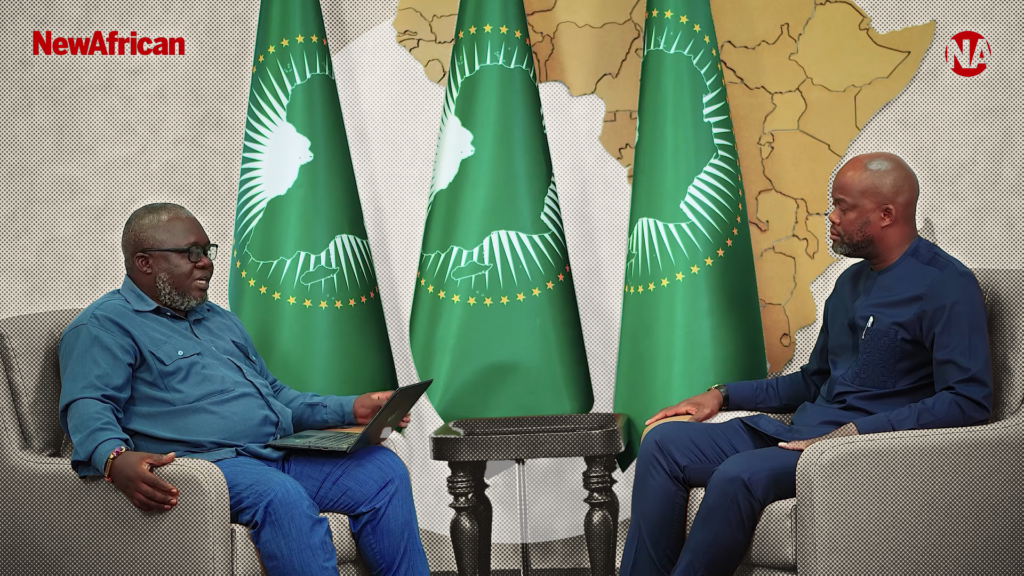
To begin this work, our editorial team sat down with Ms Oluranti Doherty, Managing Director for Export Development at Afreximbank, to understand what more than two decades inside the practical mechanics of African industrial finance look like from the inside.
The conversation ranged from the mathematics of a cotton boll to the architecture of a $70 billion African capital coalition, from the five-year ramp-up period of a new factory to the $4.2 billion annual cost associated with a negative narrative about the continent.
The Math Behind the Optimism
The numbers, when she lays them out, are striking not so much for the scale of the loss as for the scale of the opportunity that remains.
Raw Beninese cotton, from farm to port, sells for between $1,500 and $2,000 per metric tonne. Transformed into garments, the same fibre is worth approximately $16,000 to $20,000 per tonne, representing a value increase of ten to fifteen times.
Scale that across 40,000 tonnes of annual production, and a $60 million commodity export can become an $800 million manufacturing industry.
“Africa produces and exports cotton lint,” Doherty says, “but much of the value generated in the cotton, textile and garment value chain occurs through spinning, weaving, dyeing, finishing, garment manufacturing, branding and retailing.”
These are the stages that have historically taken place elsewhere. Benin’s industrial zone, known as Glo Djigbé, was built specifically to bring those activities back to the continent.
Not as a copy and paste template, she is careful to explain, but adapted to the political context, infrastructure and ambitions of each country that seeks to replicate the model.
A Different Theory of the Challenge
For years, the conventional explanation for why more African countries have not replicated that success has been simple: insufficient financing.
Doherty, whose job is precisely to arrange that financing, disagrees.
Her position is perhaps the most encouraging point in the conversation because it identifies a problem that can be solved rather than an intractable obstacle.
“Financing is relevant,” she says, “but what you need is a combination of financing solutions” tailored to each stage of a project’s life.
That means patient equity during the earliest and riskiest years, long-term project financing for construction and the operationalisation of the factory, and working capital structured around the actual rhythm of the business, whether the trade cycle runs for 60 days or 360 days.
The failures she has seen tend to arise from mismatches, such as a seven-year project financed with three-year money, rather than from a complete absence of capital.
That is a problem that can be fixed. Afreximbank has spent the past several years building tools to address it, including a dedicated project preparation facility to help entrepreneurs make their initial plans investment-ready, and FEDA, a Rwanda-based equity fund designed to provide the patient capital that traditional lending cannot.
Closing the Coordination Gap
When Doherty steps back from individual transactions to describe the broader architecture of African industrial finance, her diagnosis shifts from frustration to strategic clarity.
The continent does not lack capital. It does not lack viable projects. What it has lacked, until recently, is a mechanism for connecting the two.
“Africa has development institutions, commercial banks, pension funds and sovereign wealth funds,” Doherty says.
What has been missing is what she describes as “systemic fragmentation”, in which capable institutions operate in silos rather than in partnership.
The Alliance for African Multilateral Financial Institutions (AAMFI), a coalition that Afreximbank helped launch, has brought together African-owned lenders with a combined balance sheet of $70 billion.
That capital can now support major industrial projects in a coordinated way, rather than requiring a single institution to shoulder an entire transaction.
Rewriting the Risk Premium
Researchers have estimated that negative media narratives about the continent add up to $4.2 billion a year to sovereign borrowing costs. Doherty believes the true figure is considerably higher once corporate financing is taken into account.
An accurate assessment, she argues, should weigh a young, rapidly urbanising and increasingly educated population, together with proven projects such as Glo Djigbé, against the risks inherent in any market.
It should not price an entire continent on the basis of a single, outdated narrative.
“I would like the fund manager to look at projects such as the Glo Djigbé Industrial Zone as evidence that African cotton can be processed sustainably in Africa into exportable garments at industrial scale,” she says.
The evidence, she argues, is already emerging, one factory at a time.
A Continent Coming Into Alignment
The continent’s most ambitious trade project, the African Continental Free Trade Area, offers grounds for cautious optimism.
Its architecture, Doherty says, is “directionally aligned” with what a West African textile manufacturer needs. Tariff schedules, rules of origin and Afreximbank’s cross-border payment system, PAPSS, are all moving towards the same objective.
The destination she describes is striking: cotton grown in one African country, spun and woven in a second and sold in a third, with predictable rules and efficient payments throughout the process.
That system does not yet exist at scale. But in this conversation, it feels less like an aspiration and more like a roadmap.
Benin’s 20,000 new jobs, its rising share of processed cotton and its garments now appearing in European stores do not yet constitute the full story of African industrialisation.
But they are, Doherty insists, proof that the story is real, that it can be replicated and that the remaining question is one of speed.
This article originally appeared on Allafrica.com and is republished here with permission. Read the original article.