Zimbabwe’s Minister of Finance has learnt the hard way that academic knowledge and practical politics don’t always mix. In an effort to solve the country’s huge debt burden, he inadvertently plunged the nation into an economic tailspin. Baffour Ankomah reports from Harare.
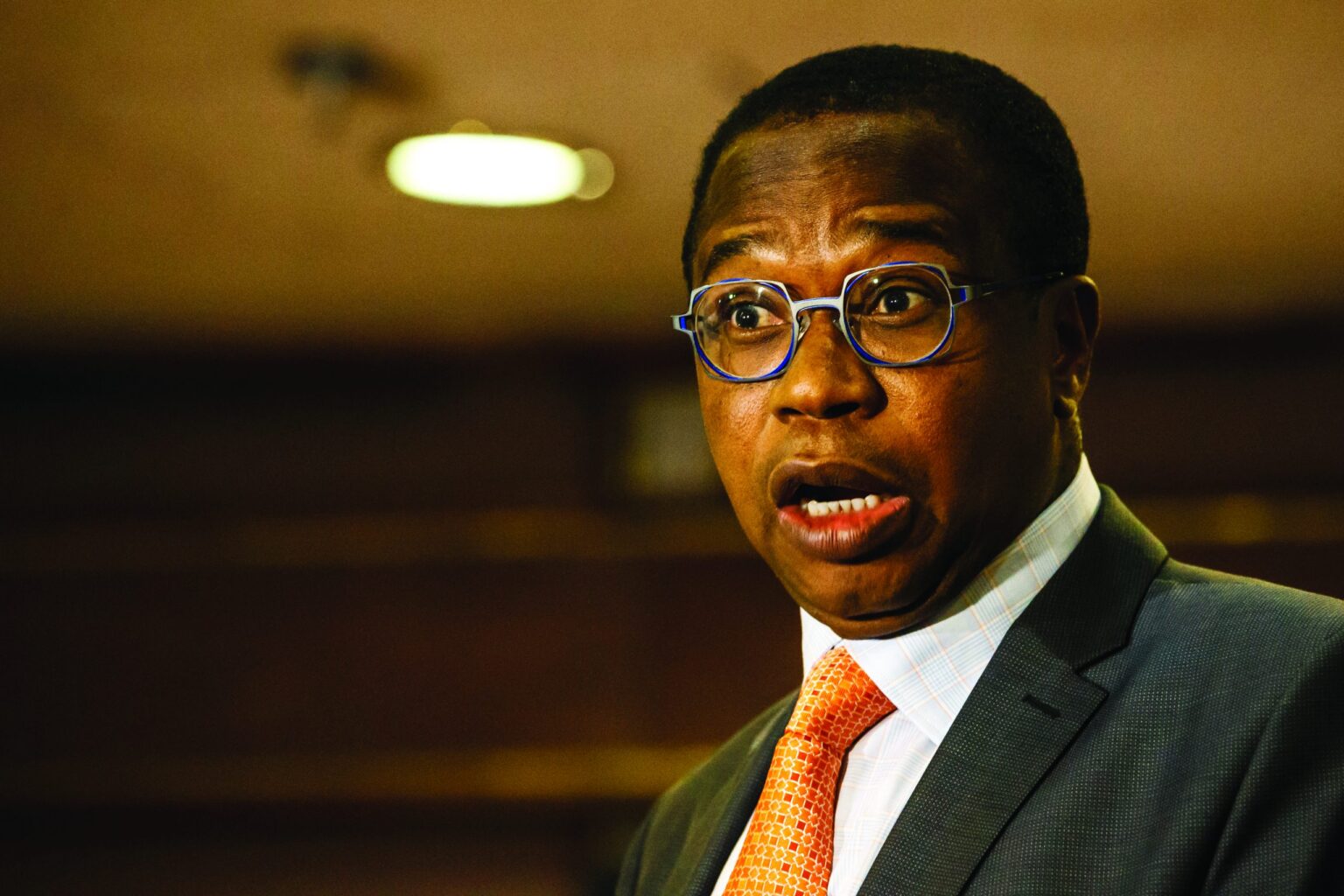
Zimbabwe’s new Finance Minister, Prof. Mthuli Ncube, 55, has had a baptism of fire so chastening that it will live with him for the rest of his life.
Three weeks after he was appointed by President Emmerson Dambudzo Mnangagwa, Prof. Ncube announced a set of fiscal policies that sent his nation into a tailspin which reminded them of 2008, their annus horribilis, when hyper-inflation hit a 79.6 billion per cent rate in November 2008 and caused the death of the local currency, the Zimbabwe dollar, and the introduction of a multi-currency regime with the US dollar at the centre of it.
And the fault is entirely Prof. Ncube’s. In fact he is lucky to be still in office. Anywhere else in the world, he would be out by now. But this is Second Republic Zimbabwe where things are done differently by a President who, though his middle name is “Trouble” (Dambudzo), yet says he is “as soft as wool”.
Maybe, despite all the chaos Prof. Ncube has caused in his first month in office, it would have reflected more badly on the President than the Finance Minister if he had sacked him after only three weeks.
So, for the sake of decorum, the President is holding his nose and soldiering on with Prof. Ncube even though the nation will take some time to live down the huge damage he has caused.
Remarkably, Prof. Ncube is a man with all the economic credentials any president would want in his cabinet. But what he has done to his country within three weeks of taking office is eloquent testimony to how book knowledge does not automatically translate to practical sagacity.
A man of letters – economic letters – Prof. Ncube has vast experience in academia and even some practical economics, having been a successful entrepreneur in an earlier life. He worked as chief economist and vice president of the African Development Bank and was a lecturer in economics at Oxford University (where he taught economic development, public policy and doing business in Africa) and at the University of the Witwatersrand in South Africa.
A one-time lecturer at the London School of Economics, Prof. Mthuli holds a PhD in Mathematical Finance from Cambridge University. His four books to date are all on finance and economics: Mathematical Finance; South African Dictionary of Finance; Financial Systems and Monetary Policy in Africa; and Development Dynamics: Theories and Lessons from Zimbabwe.
Let loose mayhem
Yet all that failed him when push came to shove. Only sworn into office on 10 September as Finance Minister, Prof. Ncube returned from a conference at Chatham House in London in late September only to trigger off massive mayhem in his home country. He announced a set of fiscal policies on 1 October without adequate consultation with his colleagues in government and the citizenry who elected the government he is part of only two months earlier.
Insiders even swear that President Mnangagwa did not know about Mthuli’s fiscal policies until he announced them. Which is a bureaucratic crime in many countries. “Now, all apologetic, he knows that economic policies have a political price,” says one of Mthuli’s colleagues in government, who is not too pleased with the chaos he has caused and the swagger he thought he was bringing as somebody from the diaspora. Yet on paper, Ncube’s fiscal policies are not that bad – if only he had consulted more widely and got the buy-in of his colleagues and the population.
For some time, Zimbabwe has been living on borrowed money – and lots of it. This has led to an “unsustainable budget deficit”, says Prof. Ncube, which in turn “has ignited expansion of domestic debt from $275.8m in 2012 to current levels of $9.5bn against $7.4bn external debt. This brings total public debt to $16.9bn.”
Therefore, “macro-economic and fiscal stabilisation becomes critical and urgent and should invariably target the fiscal deficit [as] a stable macro-economic environment is an essential precondition for growth and improvement of living standards.” This is Ncube’s argument. And not only that: After the recent elections, President Mnangagwa’s new government needs money to rebuild the infrastructure of the country, decayed by nearly two decades of Western economic sanctions.
As I write, the major roads in the city of Harare are being repaired. Signs of renewal are all over the place, which is giving hope to the citizens that good times are ahead, and they would gladly contribute to bringing the good times sooner if they are consulted and taken along.
This is where Prof. Ncube got it wrong. He announced unilaterally that his way forward entails a bit of pain, “but good pain”. As he put it: “Various measures need to be taken in order to reduce the unsustainable budget deficit, so that it ceases to be an albatross on the growth of the economy. The [government] overdraft with the central bank stands at $2.3bn, as at end of August 2018, well above the statutory limit of $762.8m.”
On top of this, treasury bill issuances had increased from $2.1bn in 2016 to a cumulative $7.6bn by the end of August 2018. In 2014, the treasury bills to GDP ratio was at 4.4%; it has since increased to 36.5% by end of August 2018.
In short, the government was going to have to find new ways of paying its high domestic and foreign debt, reduce the budget deficit, and embark on the path of growth, which Prof. Ncube estimated would be at 6.3% this year against the original budget projection of 4.5%.
All this makes good economics but bad politics. Prof. Ncube’s sin was trying unilaterally to widen the tax base of the country by making more Zimbabweans contribute to the development of their country via an indirect tax called Intermediated Money Transfer Tax (IMTT), which was first introduced by the government in 2003.
Statistics show that only 6% of the population pay income tax, and 90% of this 6% are from the civil service. Thus, a good 94% of the taxable population pays no income tax at all because over the last 18 years of Western economic sanctions and the subsequent loss of formal employment, most people have migrated into informal employment and are thus out of the reach of the taxman.
Ncube’s argument was this: “Due to the increase in the informalisation of the economy and the huge increase in electronic and mobile phone-based financial transactions and RTGS [Real Time Gross Settlement] transactions, there is need to expand the tax collection base and ensure that the tax collection points are aligned with electronic mobile payment transactions and the RTGS system.”
RTGS is a funds transfer system where money transfer takes place electronically from one bank to another on a ‘real time’ and ‘gross’ basis. Settlement in ‘real time’ means that the transaction happens almost immediately. Since 2016, when cash disappeared from Zimbabwean banks, plastic money has become king. For example, while there are only $300m bond notes in circulation, a good $9.1bn-worth of electronic money transactions are done via the RTGS system nationwide.
Ncube therefore targeted the huge volume of money going through the RTGS system and announced an amendment of the IMTT. Where in the past the tax was set at 5 cents per a transaction of money transfer, now, effective from 1 October, it would be 2 cents per dollar transacted above $10. This means everybody in the country, rich or poor, will contribute to the tax pro rata, and the national tax base will be broadened. Hoping to raise billions of dollars for national development, Ncube announced a number of exemptions to the 2 cents tax to make it palatable to various constituents depending on their line of business.
Hell broke loose
But all hell broke loose after his announcement because his fiscal policies also included a return of foreign currency accounts (FCAs) in the banks and a separation of RTGS transactions from the forex in the same accounts held by customers, which the population interpreted as an effective devaluation of the bond note. All of a sudden, they were seeing the ghost of the annus horribilis of 2008 where they lost everything.
Within 24 hours, everything was in a free fall as people went into panic mode. Shopkeepers and supermarkets not only increased their prices between 100% and 500%, they also removed the price tags from the shelves as people rushed to panic-buy. You only got to know the price at the till.
What’s more: All of a sudden, everything, including fuel and bottled water, was in short supply. Transport fares went up, first by 25% and later 100%. Pharmacies and other smaller shops refused to accept not only plastic money but the bond note, whose official rate of 1:1 to the US dollar had suddenly climbed to 5:1 on the black market that dominates the national economy. 70% of the US dollars in circulation are in private hands, and only 30% are contributed by the government via the central bank.
As the country continued in a tailspin a week after Ncube’s announcement, President Mnangagwa appeared to exacerbate it when he came out to support the two cents tax, even though in private, insiders say he is against it.
As I write, two weeks after the madness, things have calmed down considerably but the point of normalcy has not been reached. Prices are reluctantly coming down, the fuel queues are still in place but shortening, bread is still sold at a maximum of two loaves per person but the price is up by 30%, and the people of this long-suffering country are praying for a quick return of the pre-Ncube days. NA