
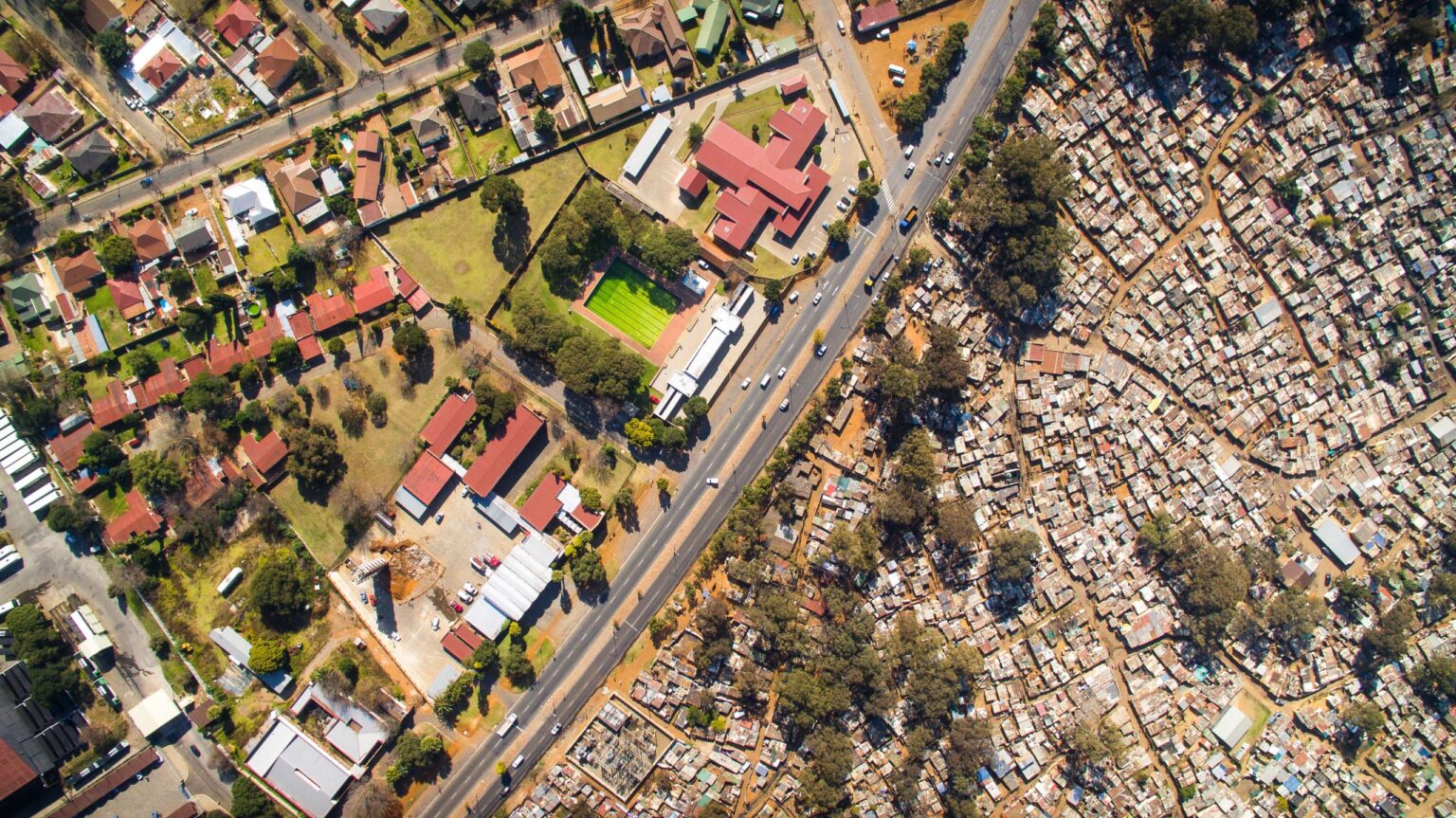
Twenty-four years after independence, South Africa remains a country racially divided and pregnant with inequalities. It is said that only three white billionaires own the same wealth as the poorest half of the black population or 22 million people, a sign that the gap between the super-rich white people and the poor blacks has reached levels of obscenity that must be urgently addressed to avoid social unrest. By Allen Choruma
Although statistics are not easily available, media reports indicate that 77% of securities listed on the Johannesburg Stock Exchange (JSE) are majority-owned by whites, foreign and local institutional investors, with blacks, directly and mainly through institutional investments (pension funds), controlling the remainder – about 23%. The conglomerates listed on the JSE are also managed overwhelmingly by white male executives: 91% of CEOs and 75% of directors are white.
Many of the mammoth JSE-listed businesses have advanced into the townships and rural areas, previously a stronghold of black businesses. This is demonstrated by the mushrooming of huge malls, pushing the once-thriving black business people – who are unable to compete – into the informal sector of tuck-shops and petty businesses, further widening the gap in wealth between blacks and whites.
Land ownership and the agriculture sector show similar trends of white domination. About 79% of prime agricultural land – and associated resources – is majority-owned by 35,000 white commercial farmers and big corporations and a tiny fraction of black elites.
The economic system in South Africa is therefore firmly in the hands of the minority whites. The benefits of the country’s economic success have not trickled down to the poorest – the ordinary black South African – but are the exclusive province of a small group, mainly white.
Unless these inequalities and poverty levels are addressed, South Africa will remain a hotbed for social unrest and political tensions.
Independence in 1994, a product of a negotiated settlement, merely shifted political power from whites to blacks and kept the economic structure and institutions intact, thus perpetuating the colonial and apartheid system of economic discrimination and inequalities.
Post-independence, only a few black elites, the so-called ‘political aristocracy’ – including President Cyril Ramaphosa and a few others – have prospered, thanks to affirmative action policies such as Black Economic Empowerment (BEE).
Dr Allan Boesak, a renowned activist, correctly identified the historical legacy as the source of current problems. According to him, at independence South Africa “chose a neoliberal capitalist system”, a system that “demands inequalities, that thrives upon inequalities”.
The striking inequalities in the ownership of the means of production have led to the coining of the phrase ‘White Monopoly Capital’ (abbreviated to WMC). WMC simply refers to the white dominance in ownership, management and control of the land, economy, resources, capital, labour and so on.
However, use of the label ‘white’ by ‘monopoly capital’ has become politicised to the point that using the term can lead to accusations of being simply a racist, anti-white bigot.
There is also the narrative to do with ‘WMC’ being a phrase coined by the UK PR company Bell Pottinger, when hired by the Gupta family, to divert public attention away from the ‘state capture’ report based on former President Zuma’s dealings and the Gupta family. The idea was to generate support for the Guptas and Jacob Zuma by portraying them as victims of a conspiracy, led by WMC, to discredit them. These revelations associated the term WMC with a PR approach that allegedly involved fuelling racial tensions.
Such developments may have clouded the issue over the terminology, but one should not assume that the phenomenon of White Monopoly Capital does not exist.
Different perspectives
On the political activist side, some movements, such as the Decolonisation Foundation, Black Management Forum, and Blacks First Land First, see no harm in calling ‘a spade a spade’, and believe that economic justice cannot be served unless the phenomenon of WMC – as a reflection of an unjust economic system – is dismantled.
On the ANC party side, policy advisor Joel Netshitenzhe, at the 5th national policy conference in July 2017, announced that nine out of 11 of the ANC thematic commissions rejected “the controversial concept of white monopoly capital” and it was agreed in the Strategy and Tactics report that it would be incorrect to label the phenomenon of capital as “white monopoly capital”.
The then President, Jacob Zuma later contradicted this statement more than once, for example during Mandela Day celebrations in July 2017, reiterating: “If you don’t believe in white monopoly capital, you live in another country”.
Former President Thabo Mbeki also warned against using the phrase WMC, urging that “the focus should be… on the capitalist system itself”.
So is WMC a myth, apparition or reality in South Africa?
The experience of colonialism and apartheid gives black South Africans a different view and perspective on “monopoly capital” to that of their white compatriots.
Generally, the narrative amongst the majority blacks is that WMC is a reality. The economy is owned and controlled by whites – not blacks. And those who own and control the economy also influence politics.
Black people view WMC as the source of their historical enslavement, disenfranchisement, oppression and alienation from their primary ancestral asset: land.
WMC is also seen as being responsible for black people’s exclusion from participating and benefitting from the mainstream economy, pre- and post-independence. The face of unemployment and poverty is black – not white. On the other hand, the face of wealth and opulence is white, not black. This is where all the WMC narrative and racial undertones are centred.
Taking the issue of the colour of monopoly capital aside, what is clear in South Africa is that there is a fundamental structural problem within the economic system inherited from the apartheid past and that has been allowed to continue, benefitting the minority white people post-independence. Maintaining
the status quo is a travesty to justice as it leaves the majority blacks on the fringes of the mainstream economy.
Need for a new economic deal
A new economic deal is what is needed to address black poverty. The new system needs to be structured in a manner that allows every citizen to participate in it, earn a decent living from it and share in the wealth created by it.
Several transformative policies, such as the ANC’s Radical Economic Transformation (RET), are being articulated in the country. All speak of changing the status quo. All these transformative policies converge on the need to uplift blacks from poverty and narrow the inequalities between blacks and whites.
These transformative policies cannot however serve both blacks and whites in equal measure.
Economic justice requires equity and equity cannot be served in South Africa without implementation of inclusive empowerment policies that are deliberately designed to benefit blacks and uplift them from the deep trenches of poverty.
As Anver Versi, editor at New African puts it: “There will always be the rich, the middle class and the poor in all societies but it is the level of poverty that cannot be tolerated (in Africa) after 70 years of independence.”
The government has an obligation to craft national development plans and other broad-based transformative economic policies that will fix the gaps in inequalities and reduce the alarming poverty levels that exist in South Africa.
The focus should not be on catchphrases, populism, finger-pointing, or on vote-catching politicking. Instead, the focus should be on acknowledging, not sweeping issues under the carpet, and sustainably solving the problems inherent in the economic system that have led to the whole phenomenon of labelling monopoly capital as ‘white monopoly capital’. NA








