
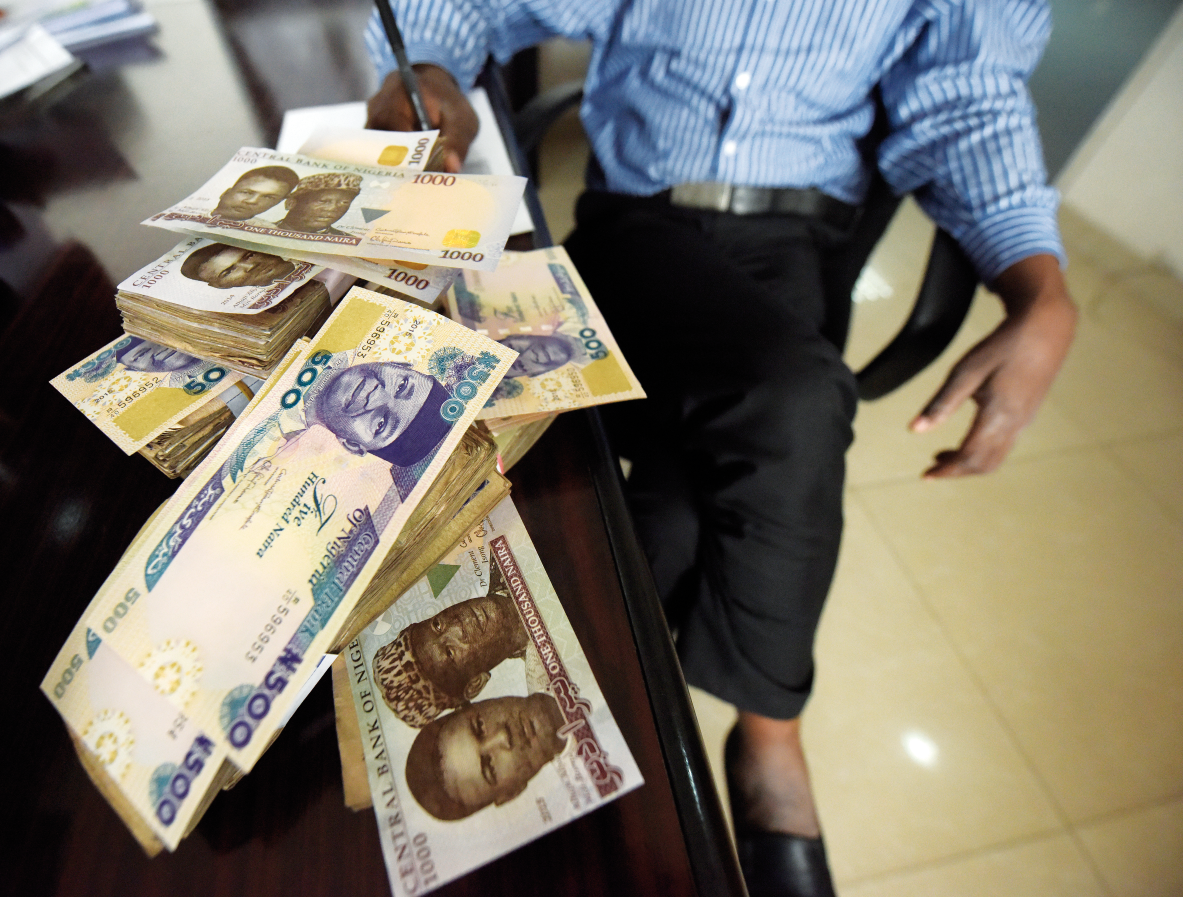
Nigeria’s economy, after dipping into recession fairly recently, has managed to come to the surface again but its recovery has been spasmodic. What is the near-term outlook? Rafiq Raji consults two international bankers for their views in this analysis.
When a man who has been virtually paralysed begins walking, even slowly, he is greeted with joy by well-meaning friends. But as expectations are raised, disappointment begins to set in if his progress is slow. Surely, he should be able to walk more briskly by now, some wonder aloud.
This is perhaps a fitting allegory for the Nigerian economy at the moment. Incidentally, it is also characteristic of its many contradictions. With wealth palpably abundant, from oil and gas to numerous other natural resources, most Nigerians are poor.
And a lot of them that would argue that even when the economy was booming at above 5% levels some years back, their lives during today’s supposedly sluggish times are not much different from then.
Coming out of a five-quarter recession since Q2 2017, Nigeria’s growth remains sluggish. Most recently, in Q2 2018, real GDP growth was 1.5%, from almost 2% in the first quarter of the year; a slowdown.
It was a little heartening, of course, that the main driver of growth in the second quarter was the non-oil sector, which rose by 2% year-on-year; thus helping to fill some of the gap that an almost 4% contraction in oil sector GDP created.
With elections due in a couple of months, and the consequent slowdown that tends to ensue, as investment decisions are delayed or postponed till afterwards, hopes are down on any significant revival.
Add to that the recently forced resignation of former finance minister Kemi Adeosun over a certificate forgery scandal in September, and you might be forgiven for being so dour.
Officials would probably take comfort in the fact that the prospects of another recession are relatively slim. South Africa was not so lucky, entering into a recession in Q2 2018.
Still, but for unnecessary and avoidable holdups, there certainly should have been more spring in the steps of the Nigerian economy by now.
The central government’s N9.1 trillion ($29.8bn) budget, after a half a billion naira increase by legislators, was not passed until May, for instance; well into the year, and about seven months after it was submitted in November for legislative approval by President Muhammadu Buhari.
And now, a request for virement of some components of the budget to ensure proper funding of the upcoming elections has become a source of tensions. Why? Buhari proposes that funds hitherto allocated for constituency projects of federal legislators should instead now be used to fund the polls.
With the President of the Nigerian Senate now aiming to unseat the incumbent at the State House and many of his colleagues looking to become governors or retain their seats, there is little chance of much governance till after the polls.
Naturally, the economy is likely to become a casualty. In July, the IMF put it succinctly: “Under current policies, the outlook remains challenging…[Thus] a coherent set of policies to reduce vulnerabilities and increase growth remains urgent.” But how likely are the chances of that with the 2019 polls top-of-mind among policymakers?
Better growth on reforms
Gaimin Nonyane, head of economic research at Ecobank, a pan-African bank, in London says: “The outlook is for a stronger recovery despite the recent slowdown seen in Q2 2018.”
But if that is the case, why is the economy still sluggish? “The slowdown in Q2 real GDP growth was owing mainly to challenges in two key pipelines (Trans Forcados and Nembe Creek) in May 2018, security challenges in major agricultural belts in
North-East and North-Central regions, slower-than-expected recovery of the trade sector and administrative inertia in implementing structural reforms,” she says.
“With efforts to resolve the technical difficulties in the pipelines underway, we expect the oil sector to move back into positive territory in the coming quarters (barring any major disruptions to foreign oil installations), while the non-oil sector will continue to drive growth driven by strengthening activity in the utilities, construction, ICT and transport sectors,” she adds.
The authorities’ ambitious spending plans also underpin relative optimism about growth. Real GDP growth should be closer to 3% in 2019, according to Ecobank; from about 2% estimated by the IMF for 2018. This is below potential, for sure.
Thus, if growth is to be restored to pre-crisis levels of 5-6%, reforms would have to be deepened, Ms Nonyane avers. The probability of major policy actions in this regard during an election season already in high gear is quite slim, however.
Cautious markets due to political uncertainty
Investors are understandably taking precautions. Ecobank’s Nonyane says: “From a financial market perspective, we have certainly seen investors being a lot more conservative with risk-taking on NGN [Nigerian naira] assets over the past six months, on the back of the rising political risk.”
Andrew Nevin, chief economist at PwC, a consultancy, in Lagos agrees: “Investors are obviously slowing down as we head into a complex election season. Outsiders certainly cannot be expected to understand all the players and issues and this election is highly uncertain.
“In this environment, they will prefer to wait. In addition, high-profile incidents that put regulators and major players in conflict will also cause investors to be cautious,” he says.
There is already evidence of this. “The Nigerian equity market is currently amongst the worst performing in the world in local currency terms, indicating that beyond the EM/FM risk aversion, there is an element of political risk in the pricing of Nigerian equities,” adds Ecobank’s Nonyane.
“Furthermore,” she adds, “portfolio inflows via the IE Window dropped to a one-year low in August $546m, just a third of the monthly average over Q1 2018 ($1.6bn), with FDI inflow falling to a 13-month low in July ($11.4m) and setting a new record low in August ($8.7m).”
In short, despite the economy needing all the tender loving care it can get, it will remain back-of-the-mind until the elections have come and gone. NA








