
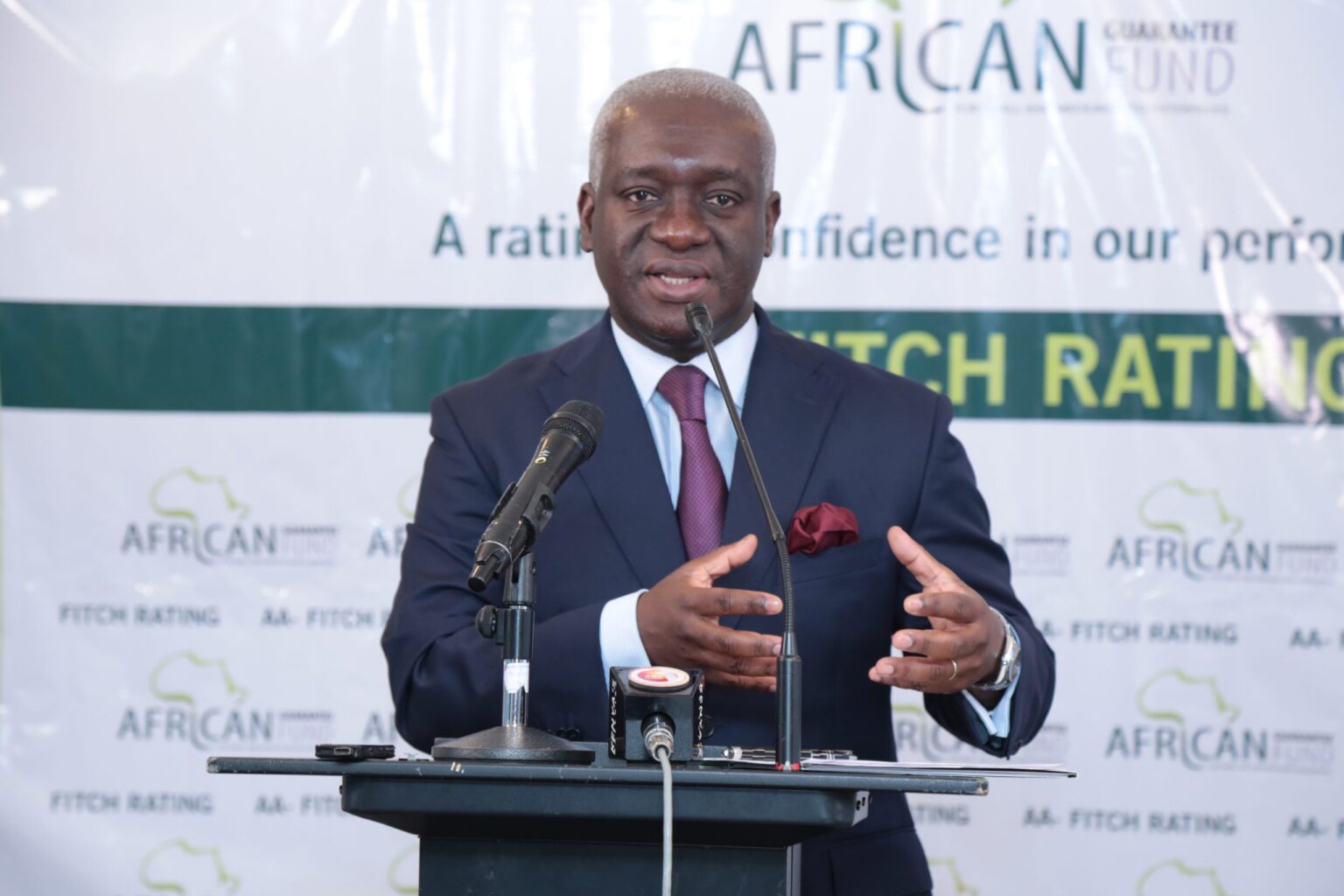
It has been a good year for Felix Bikpo, CEO of the African Guarantee Fund. The institution he heads has recently received an AA- rating from Fitch and he is on his way to trebling the Fund’s equity, which will enable him to greatly expand the Fund’s activities and leverage its balance sheet to have a meaningful impact on small business lending across the continent. By Felix Bikpo
When we met in London, with the freezing ‘beast from the east’ Siberian blizzards chilling temperatures and moods, Felix Bikpo came across as a welcome warming presence. The softly-spoken Ivorian, unlike the UK transport system which had succumbed to the worst in the freeze, was calm and composed.
He also exuded confidence and felt that the African Guarantee Fund (AGF) had reached a happy tipping point and that progress in the last year had positioned it to roll out its services and take it to the next level, from concept to implementation.
Bikpo was in London to sign a re-agreement with GuarantCo, a global guarantee fund specialising in infrastructure. He immediately made it clear that AGF had been created from public funds but is run very much as a private sector company, with a clear mandate to deliver returns for its shareholders – it was set up by the governments of Spain and Denmark and the African Development Bank.
The AGF was launched in 2012 with a $50m capital base. It estimates that over that period it has enabled over $700m of loans to 8,000+ SMEs. Today, its equity has doubled to $100m and the objective is for it to reach $500m by 2021. Bikpo believes he can get there by 2020, which will enable the Fund to issue up to $1bn of guarantees to the SME sector, and more specifically the ‘S’ of SME.
Shareholders that have signed up to the Fund in the last two years include France’s Agence Française de Développement (AFD) and also, the Nordic Development Fund. Bikpo says he is in advanced talks with at least five other institutions interested to come on board.
The Fund primarily works with banks across the continent to help them lend to SMEs by providing guarantees on their loans. The guarantee works in two ways; it mitigates some of the risk faced by the bank (the financial institution, or FI) undertaking the lending to SMEs but more importantly, it lowers the cost of that lending.
SMEs face a high cost of capital not only from the interest charged on loans but also, due to the collateral that they need to put forward to access funding. This collateral can be crippling and will ultimately slow down a company’s growth because that capital could be put to better use.
By providing guarantees, AGF enables SMEs to access finance without having to provide 200% of the loan amount in collateral, which is common for this market segment. The fact that AGF is now AA- rated, Bikpo says, means the cost of the guarantee for the financial institution is effectively reduced and it will lower further the collateral that SMEs have to put forward.
Bikpo is also keen to point out that the tenure of these loans is often understated as a factor in transactions. Loans to SMEs are generally very short term. Most small businesses, it is said, fail within five years, but according to Bikpo it’s the system that fails them, not necessarily the business model. AGF’s intervention allows lending institutions to provide longer-term loans, thus giving businesses space to establish themselves.
The real work, he says, is in educating banks to ensure they are equipped to finance SMEs. Capacity building is one of the key strategic pillars of the Fund and Bikpo still believes that banks need to do more to position themselves to lend to this segment.
“You cannot use the same models for SMEs that you do for big companies. That’s why we work with our partner FIs to strengthen their systems, the internal processes and risk assessment tools, to give them more comfort to lend to this sector and to lend to it in a manner that is reasoned and that will ensure that the non-performing loan [NPL] ratios are sustainable.”
Bikpo is adamant that the SMEs’ reputation for being a risky asset class and bad payers is unjustified and that with the FIs they have worked with, all have healthy NPL ratios and that it is the larger loans that have proved more risky. The threshold they have set the loan books of their partner institutions is an NPL ratio of 3%, something he says they are achieving. And the Fund does that by also carefully choosing the FIs they work with – institutions with strong processes, good credit allocation procedures and high quality people. He sees working with partners to strengthen these attributes as one of the Fund’s remits.
He is somewhat embarassed, as an Ivorian, that it is often the francophone countries that lag behind when it comes to supporting SME financing. He believes that government has a role to play, pointing to what is happening in Egypt, where government has taken a decision to get banks to put 20% of their portfolio into SME financing.
AGF, he says, is working to help the banks in Egypt implement this, by building the capacity to lend to SMEs and also by providing guarantees to help de-risk this asset class. However, setting such a benchmark requires the necessary framework and mechanisms to be in place. In other words, government also needs to support the financial institutions by helping to upgrade the legal system or other constraints that may be holding the banks back.
Consummate diplomat
Working for a DFI, Bikpo is the consummate diplomat and careful with his words. For example, on being asked if there should be caps on lending rates to SMEs – as there were in Kenya when government passed a bill to cap rates to 4% above the benchmark rate – he holds back from criticising such policies, instead pointing out that the bill has not had the desired effect, and SME lending did not grow as a result.
If anything, he says, banks will generally retreat to what they perceive as safer asset classes – the bigger businesses. As it happens, Kenya’s central bank is looking at reviewing this decision to add more flexibility in the market.
When asked about the state of the continent and the uptick in the continent’s growth outlook, Bikpo urges caution. The last time we saw sustained economic growth, driven largely by high commodity prices, he says, it did not translate into greater economic diversification; and this lack of diversification is directly linked to the lack of support and attention that has been given to the SME sector.
Financing is just one of the constraints that SMEs face. The high cost of doing business, because of a lack of power or good quality roads, makes Africa a harder place to succeed in than in other countries. This is why the deal Bikpo was in London to sign with GuarantCo was of particular interest. GuarantCo, part of emerging market infrastructure investors the PIDG group, specialises in providing instruments to de-risk infrastructure. This $74m re-insurance agreement is to be used by AGF and GuarantCo to provide guarantees to FIs lending to SMEs in the infrastructure sector, for both larger and smaller transactions. AGF will be able to support SMEs being subcontracted to support the infrastructure projects that are taking place across the continent. “Not only will these SMEs benefit,” Bikpo says, “but they will be contributing to enhancing the business climate through better infrastructure.”
“My job,” he concludes, “is not to help banks finance the Coca-Colas or the Nestlés, but encourage and help the banks to finance the future Coca-Colas and Nestlés of Africa.” We can all drink to that. NA
(The African Guarantee Fund is the platinum sponsor of the African Banker Awards, organised by the events arm of IC Publications.)








