
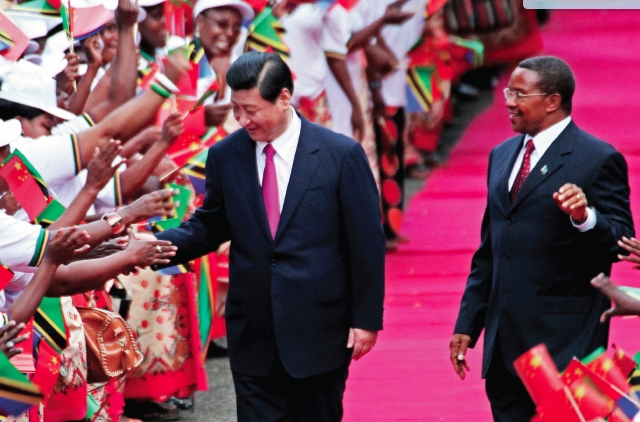
Even though it is common knowledge that returns on investment in Africa have been the highest in the world for the past 20 years, and the IMF projects that 12 of the 20 fastest-growing national economies over the next 5 years will be in Africa, Western companies, especially those in America, are still reluctant to invest in Africa, unlike the Chinese who are now investing all over the continent. Survey results released by two US-based firms in early April blame old, worn out, negative perceptions of Africa as a major constraint to investing on the continent. Osei Boateng reports.
Despite the huge progress made in Africa in recent decades, regarding governance issues, the improved business climate on the continent, and the high returns on investment (higher than anywhere else in the world), Western multinational companies, especially those in America, still view Africa through the tinted lenses of old negative perceptions, and thus are unwilling to invest on the continent.
New survey results released on 8 April by the American-based law firms, AlixPartners and Dentons, confirm anecdotal evidence that suggests that despite the progress achieved in Africa in the past two decades, the continent continues to be plagued by negative perception and a limited understanding of its investment prospects. “This situation may represent a lost opportunity for all sides,” say the law firms.
“Based on our survey,” the two law firms add, “many [Western] companies have yet to fully recognise the growth potential that Africa represents. Concerns related to corruption and transparency in African business, along with uncertainties related to regulatory processes and local partners, seem to have discouraged many multinationals from investing there.”
AlixPartners is a financial/legal advisory services company that provides legal counsel to board members and corporate executives in urgent, high-stakes disputes and investigations globally. It also conducts a broad range of surveys and research in industries around the world. Their latest survey, done in conjunction with their partner company, Dentons, was on doing business in Africa. The results, released in early April, did not make happy reading for African countries. They showed that, important though Western companies’ concerns about corruption in Africa and other challenges associated with doing business on the continent are, many companies may not be aware of tools that could help in addressing those concerns.
“Our experience indicates that there are excellent risk-reward returns for those informed companies that are able to take a differentiated view and adopt the practices needed to manage legal, financial and operational risks,” AlixPartners said, adding that “the US business and legal communities have lagged behind others in reorienting their perspectives on the business opportunities in Africa. Now is a chance to catch up.”
The report
According to the survey results, opportunities abound for companies seeking to share in Africa’s rapidly growing markets, especially when the IMF projects that over the next five years, 12 out of the 20 fastestgrowing national economies will be on the African continent. “With the American economy relatively flat,” AlixPartners said, “US companies cannot afford to overlook the potential for expanding growth presented in Africa and in other dynamic developing regions.”
The survey showed that while the challenge of development in many African countries should not be underestimated, the rising middle class and ensuing breadth of needs across industries, including power generation and distribution, transportation, telecoms, agribusiness, oil and gas, financial services, healthcare, education, housing, and consumer goods, provide an array of prospects for foreign investment.
“Although Africa’s legacy of political instability and corruption continues to be a concern, economic gains have gone handin-glove with improvements in governance and security in many of the countries in Africa,” said AlixPartners. “Nevertheless, companies that are seeking to invest in Africa should conduct risk-based due diligence as part of their decision-making process. It is also important for companies to give early consideration to potential postclosing compliance programmes and internal controls enhancement that can help mitigate structural, third-party, and other potential risks.”
AlixPartners continued: “Our sense is that many within the international business community have not fully realised the evolving picture in Africa or have not found the strategies that may allow them to benefit from it. A considerable gap persists between stereotypical perceptions of Africa as a single place of prohibitive risks and the evolving reality of the rising potential within an extraordinarily diverse and vibrant continent.”
The reason for the survey was to find a way to bridge this gap between the realities on the ground in Africa and the perceptions of senior executives at Western multinational companies about their business objectives and experiences in Africa. “Our survey group was comprised of chief operating officers, general counsel, and other senior executives who are responsible for legal, compliance, and corporate business development,” says AlixPartners. Most of them came from US companies with annual revenues of £250m or more, in fact more than a third had revenues of $10 billion or more. “Accordingly, the survey results do not purport to present a ‘world view’, admits AlixPartners. “On the contrary, we recognise from our own experience and client work that in a number of respects, the US business and legal communities have lagged behind others in re-orienting their perspectives of the business opportunities in Africa. Now is a chance to catch up.” In conducting the survey, AlixPartners and Dentons hoped to better understand the extent to which Western senior executives were aware of opportunities in Africa and to identify any concerns they had. They also wanted to determine whether companies were already investing in Africa, and if so, in which countries.
“We also sought to identify industries that viewed Africa as strategically important and assess the attractiveness of markets in Africa, relative to other regions. We asked participants how well they understood Africa’s business cultures and their risks, and to identify factors that might increase their likelihood of investing there.”
The results are quite revealing. Unlike the Chinese who are happy to invest all over Africa, many Western companies have yet to enter Africa. More than two-thirds (68%) of respondents indicated that their companies were currently not doing business in Africa. Of those doing business there, nearly 60% said it was important to their overall businesses. Within this group, business and professional services (16%), energy (16%), and technology (13%) companies indicated that Africa was critical to their businesses.
Conversely, companies in chemical (3%), real estate/construction (3%), and healthcare/ life sciences (3%) said that Africa was not important strategically. As AlixPartners put it: “We wondered which countries were perceived as the most attractive among respondents doing business in Africa, particularly in light of the fact that African markets are diverse and at various stages of economic development. South Africa ranked the highest among our respondents – 72% indicated they did business there. Egypt came second, followed by Nigeria, Kenya and Ghana.”
AlixPartners were also interested in assessing the attractiveness of doing business in Africa relative to other parts of the world. Therefore, participants were asked to compare Africa with growth regions such as Asia, Latin America, and the former Soviet Union. Nearly a third of respondents that are currently doing business in Africa indicated that the continent was as or more attractive than both Asia and Latin America. More than half (52%) said that doing business in Africa was as or more attractive than the former Soviet Union.
Challenges ahead
Given that a majority of respondents indicated that their companies did not operate in Africa, AlixPartners wanted to know why – what prevented them from doing business there? What concerns did they have? What changes or improvements in African countries might increase their likelihood of doing business there?
The answers, again, were revealing. “Companies that do not operate in Africa were concerned about governance and regulatory frameworks,” says AlixPartners. “Within this group, 58% indicated that they were not considering doing business in Africa. Among companies that operate in Africa, three-quarters indicated that a more transparent local business culture was necessary in order for them to increase their business there.
“Approximately 70% said that more transparency in regulatory processes and better interaction with government officials were needed. Half of these respondents said they wanted more effective working relationships with local counterparts.”
One of the main concerns of the Western companies was corruption in Africa, which they considered to be a serious issue.
A good 86% of respondents whose companies currently operate in Africa said they faced some risk associated with corruption. Nearly two-thirds based this risk on the general reputation of the continent, while more than half attributed it to credible accounts by others.
And then this: “Sixty percent of the respondents at companies that are not operating in Africa based these risks on the continent’s general reputation. Only 10% attributed this concern to first-hand knowledge,” says AlixPartners. “Regardless, concerns about corruption are clearly shaping companies’ decisions to invest in Africa. A quarter of all respondents said they avoided or ceased doing business in Africa because of concerns about their ability to comply with anti-corruption laws.”
A majority of the respondents said that more stringent regulatory enforcement by local governments would reduce exposure to corruption, while a better understanding of African business cultures and assistance from legal and financial advisors would also help to mitigate these risks. This left AlixPartners and Dentons to say: “Perhaps not surprisingly, three-quarters of those respondents whose companies do not do business in Africa said they had a limited understanding of the opportunities present in Africa. Interestingly, 40% of respondents at companies that currently operate in Africa said their knowledge of Africa was [also] limited.
“A lack of understanding may be the key reason behind many companies’ reluctance to do business in Africa – 73% of respondents at companies not operating in Africa said their companies had no plans to initiate business there.”
Based on the survey, it is clear that many Western companies have yet to fully recognise the growth potential that Africa represents. Concerns related to corruption and transparency may be legitimate, along with uncertainties related to regulatory processes and local partners, but the major constraint appears to be the unwillingness of many multinationals to change the negative perceptions they hold about Africa.
“With so many microeconomic and demographic factors on the upswing, there are good reasons for companies to consider ways to overcome the actual and perceived hurdles to doing business in Africa,” Alix-Partners urged. “As companies seek to capitalise on these opportunities, they will need reliable information from trusted partners to help guide them through business decisions.
“In addition to sound legal and financial advice integrating international expertise and local insights, they will also need compliance mechanisms tailored to operating within Africa’s diverse contexts.” The ball is now firmly in the courts of the Western multinational companies – to change or not to change their perceptions is the question.








