Djibouti continues to post enviable economic growth figures, and for President Ismail Omar Guelleh’s government the priority is keeping up this momentum and meeting the challenges that lie ahead.
Stephen Williams reports.
Djibouti is celebrating its 35th independence anniversary this month. It is a time for reflection for this small enclave that is so strategically important to the world and Africa’s economy. It is also a time to look towards the future and the best way forward.
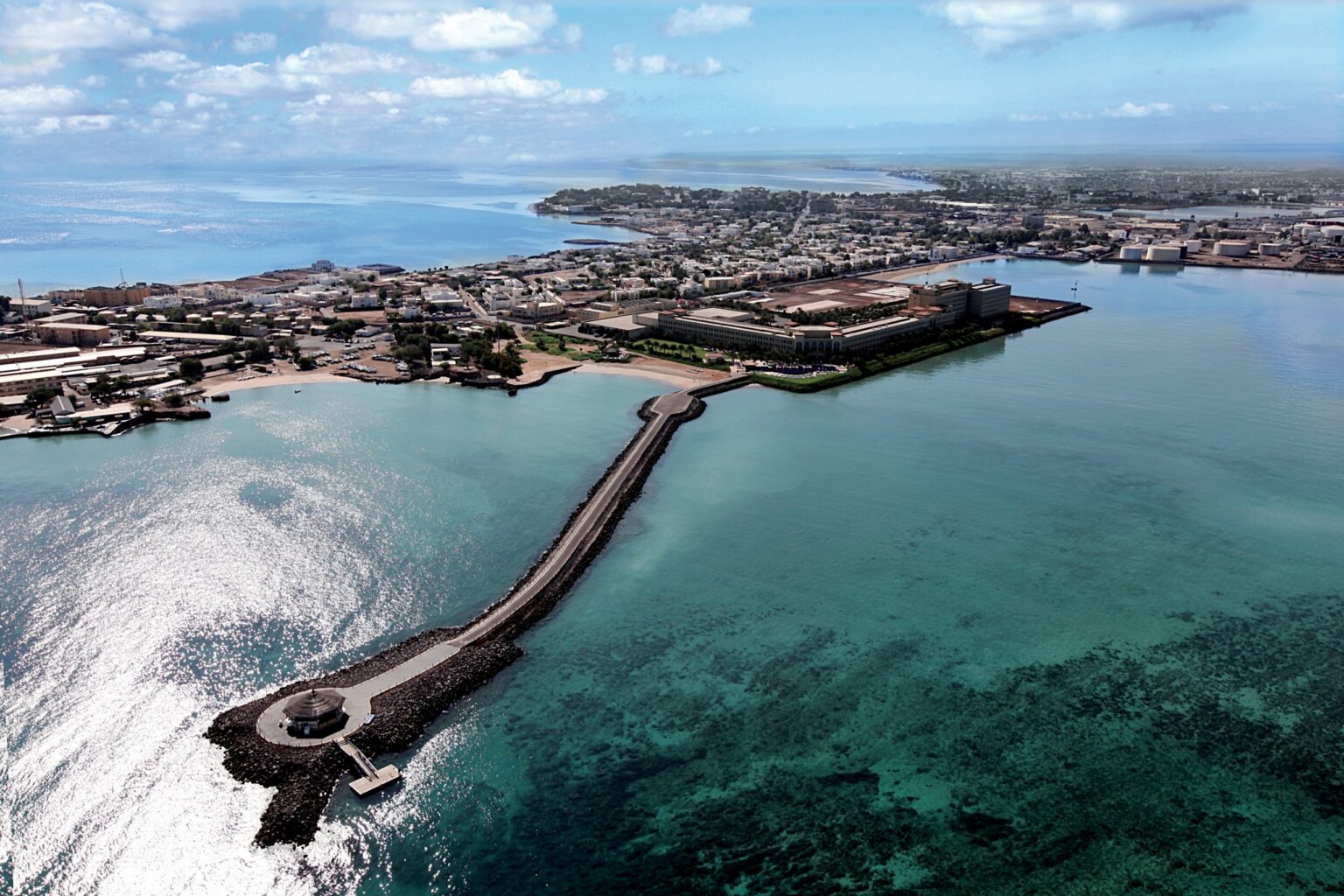
Djibouti’s economy continued to grow last year by around 4.5% and the country carried on attracting foreign investment. Essentially, this investment was focussed on Djibouti’s most valuable asset – its location at the southern entrance of the Red Sea and the business and trade that it serves with deep-water ports.
Its ambition to serve as the Horn of Africa’s gateway to, and for, sub-Saharan Africa has, in many respects, already been achieved. There is a sentiment that suggests that Djibouti should become for the Horn and East Africa what Dubai has become for the Gulf – an entrepôt that can serve as a modern and highly efficient trading hub for the region.
Driving this vision forward, the government has given the green light to place the port (and the airport) under private management contracts, and is building the second stage of a new container terminal at Doraleh, with an adjoining oil terminal and transhipment complex.
The expansion of the Doraleh port has benefited from a $427m guarantee by the Multilateral Investment Guarantee Agency for the development, design, construction, management, operation and maintenance of the container terminal. In addition, as a means of underpinning Djibouti’s position as a hub for trade, logistics and related services, the country has embarked on building several road corridors.
By improving container facilities in Djibouti, the idea is to stimulate an increase in port traffic and open up new opportunities for investment and growth, including attracting other African countries to use the port as a trade gateway.
Djibouti has also established a Free Zone to bring in manufacturing companies. A new $300m airport upgrade is under way. A $400m ship maintenance yard, and a $100m desalination plant (for the Doraleh project) are also currently being built.
In the longer term, Djibouti must be fully prepared to compete with the proposed new port being constructed at Lamu, Kenya – further south on the Indian Ocean littoral – which could pose a threat to its own port operations. Lamu, and the new rail links that will serve the port, would certainly prove attractive to both Ethiopia and South Sudan – the former currently being Djibouti’s major trading partner.
Meanwhile, the country’s capital flows have more than doubled to a very respectable 21% of GDP, consequently creating a balance of payments deficit of just 1.1% of GDP.
But, as the World Bank points out, the balance of payments account is likely to widen as the launch of Djibouti’s numerous projects will involve the importation of a considerable amount of capital goods. However, the Bank adds that the deficits will not present a problem, as FDI, and external borrowing can comfortably finance them.
More worryingly, the country’s recent economic growth has done little to reduce the unemployment numbers, as even the massive investments in the port and free zones have not generated enough jobs – and clearly Djibouti is highly vulnerable to external shocks such as rising food and fuel prices.
By way of a response, the government has launched the National Initiative for Social Development (INDS) to meet various social and economic challenges. The objective of this new policy is to promote access to basic social services and improve the quality and effectiveness of their delivery. INDS has a $47m budget to focus on health, energy, rural community development and urban poverty reduction.
Meanwhile, government has acknowledged the need to identify the sectors that can drive growth while creating jobs and plans to market Djibouti’s many attractions as an investment destination. Specifically, the country is positioning itself as a regional centre for the importation, warehousing, value-addition and re-export of goods originating in neighbouring countries.
Djibouti’s geological characteristics, lying on the Great Rift, make it especially suitable for geothermal energy generation – a capital-intensive clean energy source that involves pumping water deep underground to be heated, creating steam that is brought to the surface to drive steam turbines generating electricity.
It has also identified the financial sector as a prime area for growth. The government has already passed several new pieces of legislation, notably regulating capital requirements, and relating to both financial co-operatives and Islamic banking institutions.
Another sector deemed to hold considerable promise is tourism. Djibouti offers ready access to some of the best scuba diving sites in the world, and the wealth of ocean life in the Red Sea is truly astounding. From the highly endangered horn-billed turtle to the shark-whale, and the multitude of brightly coloured tropical fish that, along with the wonderful coral, call these waters home, this is Djibouti’s top tourism attraction.
The Gulf of Tadjoura (especially around the town of Obock) contains many species of fish and coral, and is ideal for diving, snorkeling and underwater photography. Waterskiing and windsurfing are also on offer.
On dry land, Lake Assal is surrounded by a strange lunar-like landscape of dormant volcanoes and lava fields, and is less than 100km south-west of Djibouti city. It is one of the world’s lowest points, and also one of its hottest areas. You can only reach it by 4×4 vehicle (or camel). Lake Assal is the centre of a nascent salt-mining initiative.