
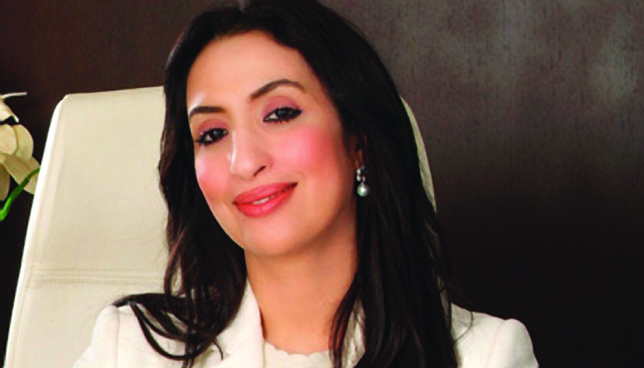
Salwa Idrissi Akhannouch, Morocco is the founder and president of one of Morocco’s leading holdings, the Aksal Group. Aksal was created in 2005 and currently operates across a number of sectors including retail, real estate, and luxury brands. Driven by a strong ambition to transform and innovate the Moroccan commercial and consumer goods market, Akhannouch has built her Group’s success on the values of dynamism, modernity, efficiency and humanity. She is an African business leader with innovative ideas and strategic management skills, and this year opened the largest mall on the continent. Her success story continues to represent an inspirational example to Moroccan women to excel in business.
“We wanted to go that extra mile, to place ourselves in a new league to traditional shopping centres.”
Aliko Dangote, Nigeria
You’ll be hard pressed to find any African business news story not featuring the 55-year-old cement baron; however, having held the coveted post of Africa’s richest man for less than a year, the next 12 months promise to be eventful as the recently deposed richest man looks to regain this crown. A London listing of his $11bn cement empire would be enough to ease him back into top spot; however, it will have to come at a cost, with the LSE imposing stricter corporate governance requirements than those to which his companies are currently familiar with (he has recently been reinstated as the president of the NSE on which many of his companies are already listed). When asked if he could see himself as the world’s richest man, he responded:
“Why not? Of course it’s possible. We will talk about this in five years time.”
Jean Louis Billon, Côte d’Ivoire
The son of Pierre Billon, founder and chairman of the board of the SIFCA Group, and CEO of SIFCOM, Jean Louis Billon succeeded his late father in 2001 to head these companies, bringing his own leadership and management skills. Like his father, he has been appointed as a government adviser and in 2002 became vice-president of the West African Economic and Monetary Union as well as other influential institutions. Today he plays an important role advising the government and is a spokesperson for business leaders in French-speaking Africa. He carries much influence as a development leader.
“The Ivorian private sector wants a new partnership, not only for economic reasons, but also because today the world is responding to the logic of co-operation instead of confrontation.”
Sheikh Mohammed Al-Amoudi, Ethiopia
The richest African, according to some rankings, the Ethiopian-born oil baron moved to the Middle East aged 19 and quickly established himself in the right circles winning large infrastructure contracts – he has never looked back. Today, Al-Amoudi maintains interests in real estate and more recently in agriculture in Africa, but much of his self-made $12.5bn comes from activities in both the downstream and upstream oil sectors.
“I lost my right hand.” – Al-Amoudi comments on the death of Prime Minister Meles Zenawi.
Aigboje Aig-Imoukhuede, Nigeria
This young and dynamic banker is approaching his 10-year maximum tenure at Access Bank. He has taken an increasingly international view and become a global business player. At home he is part of the National Economic Management Team, a group of business leaders who advise President Goodluck Jonathan and the president’s cabinet. A thinker and a doer, he symbolises the new breed of African leaders and entrepreneurs. Active in business, Aig-Imoukhuede also advises on many initiatives from climate change, to transparency and better governance.
“I will never, ever, be left [behind] again. It defines my life. I play to win”
Lamido Sanusi, Nigeria
The ‘governors’ governor: Lamido Sanusi commands respect within financial centres across the world. The grandson of a former Emir of Kano, Alhaji Muhammadu Sanusi, Sanusi is known for his intellect and for challenging conventional wisdom. His forthright approach to cleaning up the Nigerian banking system ruffled many feathers, as previously “untouchable” heads began to roll. Vested interests have also criticised the licensing of Islamic Banking in Nigeria and the introduction of a high denomination Naira bill to help reduce capital flight He remains a key actor in Nigerian and international financial circles.
“In this country, almost everybody uses the dollar. This year alone, the records we have based on the declared amount at the airports is getting to about $11bn in cash that was taken out of Nigeria.”
James Mwangi, Kenya
James Mwangi, the CEO and MD of Kenya’s Equity Bank was named the Ernst & Young World Entrepreneur Of The Year for 2012. Mwangi inherited a near-bankrupt building society when he joined Equity Bank in 1993 but today it has the largest customer base in East and Central Africa. With more than seven million accounts, it holds over half of all bank accounts in Kenya. It also has operations in Uganda, South Sudan, Rwanda and Tanzania. Mwangi is currently the chairman of Kenya’s Vision 2030 board with the responsibility for ensuring Kenya becomes a middle-income country by 2030. He serves on several international bodies as an adviser and sits on the Board of the Africa Leadership Academy in South Africa. With no noise and fanfare, he continues to inspire others.
“You’ve got to be a showman. You can’t just do your work. You’ve got to put it out there. Nobody’s going to give you £10m if you can’t demonstrate your ability.”
Evelyn Oputu, Nigeria
Nigeria’s Bank of Industry is aiming big, because its managing director, Evelyn Oputu, thinks big. Tasked with the responsibility of injecting life into Nigeria’s moribund industrial sector, the bank and Oputu are embarking on an investment drive labelled New World Nigeria, which is aimed as much at rebranding the country’s battered image as it is showcasing investment opportunities. A proactive, natural-born achiever, Oputu’s efforts are being rewarded as Nigeria recently overtook South Africa as Africa’s largest Foreign Direct Investment destination with $8.9bn streaming into the economy in 2011. The particular focus of the bank is on SMEs.
“There is an expiry date for blaming our past leaders, our governments and our parents for the state of our country. The expiry date is now.”
Shafik Gabr, Egypt
This Egyptian businessman has built one of the largest conglomerates in the continent with interests in steel fabrication, prefabricated factories, and logistical services for oil and gas companies. He is now looking across Libya and Tunisia to expand his business interests. Gabr is a keen philanthropist and a lover of the arts, having amassed one of the largest private collections of Orientalist paintings. Inspired by these Orientalists, he is launching a new East-West initiative, The Art of Dialogue, to repair relations between the Middle East and the West.
“As I collect Orientalist pictures, I’m always reminded to take the long view of our region.”
Henri-Claude Oyima, Gabon
Joining Paribas Gabon (later renamed BGFIBank) from Citibank in 1983 as a deputy general manager, in 1985, Henri-Claude Oyima became the bank’s CEO in 1986. Since then he has steered BGFI’s growth at the national and international levvel. Besides his managerial duties, Oyima presides over many organisations, such as the Gabonese Executive Trade Union and the African Leadership for Financial Institutions. His is reputedly close to the president of Gabon with whom he shares advice on fiscal matters.
“My relationship with the head of state is excellent: he consults me and takes my advice.”
Acha Leke, Cameroon
Last year, Acha Leke’s good friend, Fred Swaniker, with whom he founded the African Leadership Academy, made our top 100. This year Leke, who heads McKinsey’s office in Lagos, Nigeria, makes our list as his influence continues to grow. Leke today advises policymakers and business leaders across the continent. He is also a co-founder of the African Leadership Network, a group of next-generation African leaders who aspire to bring prosperity to the continent.
“Africa’s image has been improving over the past decade and in particular over the past five years. There have been a number of positive factors behind this [such as] economic reforms, better governance, rising commodity prices and foreign investment – including the involvement of China.”
Abdelwahab Ben Ayed, Tunisia
This discreet businessman is one of Tunisia’s most respected business leaders. The company he founded, Poulina group, which started in the poultry business has become one of the leading industrial groups in the region, with operations in neighbouring Libya and Algeria. The group continues to invest massively and last month won a joint bid to buy the nationalised assets of Tunisia’s largest vehicle dealership which once belonged to the former President’s son-in-law. Ben Ayed was invited to the board of the Central Bank of Tunisia earlier in the year.
Jim Ovia, Nigeria
This Nigerian billionaire, the founder of Zenith Bank, is conspicuous in the discrete manner that he has of conducting business. Having made his first fortune in banking, he is now also active in real estate and telecoms. A silent actor who has a killer business instinct, he operates both within Nigeria and throughout Africa.
“It would give me happiness that I have been able to change the lives of people especially the youth.”
Eleni Zaude Gabre-Madhin, Ethiopia
The Ethiopian economist has established herself as one of the continent’s leading pioneers and has been fundamental in changing the livelihoods of farmers in one of Africa’s strongest agricultural economies. Having already made a name for herself at the United Nations, the World Bank and the International Food Policy Research Institute, Gabre-Madhin returned to her native Ethiopia in 2008 where she established the country’s highly respected commodities market. Since then, the Ethiopian Commodity Exchange, which turned over almost $1.2bn in 2011, has attracted much attention from those looking to replicate its impressive financial strength.
“The market is neutral as to who is on either side, it is the connection that counts.”
Gervais Koffi Djondo, Togo
The indefatigable Gervais Koffi Djondo, a former Togolese minister of public enterprise and industry, is the honorary chairman of the Ecobank Group. He spearheaded the foundation of the Asky airline in June 2008 when Ethiopian Airlines (one of its investors) decided to make Togo’s capital Lome its West African hub. With six aircraft, Asky now serves 17 regional destinations across West and Central Africa. Koffi Djondo was also instrumental in launching in Lome the first industrial manufacturing free zone and export hub in West Africa.
“We still have a lot of African countries to serve: South Africa, the countries of East Africa and North Africa… these are the next steps. This does not mean that we abandon our international ambitions. We will go to Asia, America and Europe – but when the time comes.”
Tokyo Sexwale, South Africa
Tokyo Sexwale is renowned as a formidable businessperson in South Africa. However, he left business for politics, and is seen by people in political circles as a potential leader of the ANC. Active in the anti-apartheid struggle and a former political prisoner. Sexwale placed his interest in Mvela Holdings in a “blind” trust when he re-entered government in 2009. Although he still enjoys the benefit of its investments, he and the company say that he no longer participates in its decisions. His ambitions now seem clearly set on politics, and he has rarely come second-best.
“Business should not rely on political connections for success. There is no quick fix to business with reliance on political networks of who knows who. In entrepreneurial development, there is no substitute for hard works.”
Ahmed Heikal, Egypt
Egypt’s Citadel Capital founder and chairman, Ahmed Heikal has a distinctly pan-African vision. For example, he led a buyout of Rift Valley Railways, which operates the national railways of Kenya and Uganda linking the Indian Ocean port of Mombasa to Uganda’s capital Kampala – instigating a $300m five-year renovation programme through Citadel Capital’s Africa Railways platform. He identifies the growth drivers of this deal as being in the investment that will allow higher speeds for freight and passenger services, more than double the limits today. He envisages the railway playing a key role as a service provider to Uganda’s oil industry. He has become an international commentator on a number of important Egyptian and African issues.
“Africa is rocking with opportunities for savvy private equity players.”
Tidjane Thiam, Côte d’Ivoire
The publicity-shy Ivorian has risen to become the first black African of a FTSE-100 company. Having trained as a consultant with McKinsey & Co, Thiam returned to Côte d’Ivoire to become the minister of planning and development. Following the coup in 1999, he declined the position of prime minister in the new government and left politics. He became the chief financial officer of Prudential in 2007 and its chief executive in 2009. A committed family man and passionate African, known for his strong human values, he is a member of the Africa Progress Panel and chairs the G20 High Level Panel on Infrastructure Investment.
“We should never underestimate the power of role models. When teenagers see high achievers who look like them, who have reached the top in law, business, politics, they’re going to think, ‘I can do that; I can go far too’.”
Thierry Tanoh, Côte d’Ivoire
Thierry Tanoh was a key player in managing the expansion of the International Finance Corporation’s activities in Africa, where investments grew from $140m in 2003 to $1.8bn in 2009. After two decades at the IFC, he took up a new appointment at Ecobank earlier this year, succeeding Arnold Ekpe as the bank’s chief executive. Ecobank has the largest footprint of any bank in Africa, focusing on what it terms Middle Africa. If he can consolidate his predecessor’s achievements, he will be a key contributor to the creation of a sustainable African indigenous giant.
“There was once this strong belief that, when faced with an obstacle, we should just ignore it. That’s all changed. Today, we take the bull by the horns and find solutions, find a way to go forward and continue to move on.”
Tony Elumelu, Nigeria
After stepping down from UBA, the bank he helped found in 2003 with the merger of Nigeria’s STB and United Bank for Africa, and a subsequent expansion to 20 African countries, Tony Elumelu announced the establishment of the Tony Elumelu Foundation. It seeks to stimulate competitiveness and growth in Africa’s private sector specifically by mentoring young African professionals through its annual African Markets Internship Programme. He is now one of Africa’s most sought-after business leaders, speakers and thinkers, and propounds the theory of “Africapitalism” – as a path to Africa’s economic growth.
“Now is the time to become engaged in Africapitalism, a private sector commitment to the economic transformation of Africa through investments that create economic prosperity and social wealth.”
Donald Kaberuka, Rwanda
Donald Kaberuka has emerged as Africa’s spokesman on financial and development issues. Heading the African Development Bank since 2005 and currently serving his second five-year term as the bank’s president, Donald Kaberuka can point to a number of achievements. Africa requires $360bn of infrastructure investment in the next 30 years to spur industrial growth, Kaberuka says, and only improvements to energy, transport and information technology will reduce the continent’s reliance on primary agricultural exports. The Bank projects energy demand in Africa to grow six-fold, maritime traffic eight-fold and IT 20-fold in 30-years time.
“Private capital, mobilised through infrastructure bonds, can provide financing for an economic transformation of Africa.”
Moïse Katumbi Chapwe, DR Congo
Described as the people’s governor, Moïse Katumbi Chapwe is a Congolese businessman and a politician, being the governor of the Katanga Province in DRCongo, the epicentre of the country’s mining industry. As well as his business and political activities, he is also president of one of DRCongo’s most popular football clubs, TP Mazembe.
“We want our club to have the financial ability to keep its players, so they do not need to run to clubs outside Africa.”
Mamadou Toure, Cameroon
Mamadou Toure is the president of Africa 2.0, an advocacy group of young Africans from across the continent who have a collective vision for Africa. The group’s manifesto is the brainchild of over 300 young and emerging Africans leaders. Its focus is on key deliverables that are supported by concrete action plans in pilot countries where implementation will subsequently be monitored and evaluated.
“We need to take ownership of the continent’s development process – break away from the ‘blame and excuse’ mindset of the past and face Africa’s opportunities and challenges with pragmatism, knowledge, and moral purpose.”
Mostafa Terrab, Morocco
This ex-World Banker and adviser to the king is one of Morocco’s sharpest minds. More recently he has been credited with transforming Morocco’s largest company, OCP. Through the use of the group’s assets, he freed up capital to lead a massive investment Today OCP has become a role model in demonstrating how the continent can move up the value chain, from extraction to refining. Having received his doctorate from M.I.T., Terrab is fullfilling another dream by creating a world-class institute to train the future engineers of Africa, having commissioned a new University, located in the new ‘Green City’ in Benguerir.
Issad Rebrab, Algeria
Algerian businessman Issad Rebrab is a leading figure in Algeria’s non-oil and gas economy, with his company Cevital’s portfolio embracing most sectors including construction, light industry, steel, auto imports and agribusiness. Cevital’s value is estimated at a conservative $20bn. Today he is Algeria’s most listened-to business leader, and it is widely believed he may run for the presidency of his country in 2014.
“The best reform would be one that would spur the growth of private-sector small and medium-sized enterprises and SMEs and SMIs, key engines of growth, creators of employment, and enablers of economic diversification.”








