
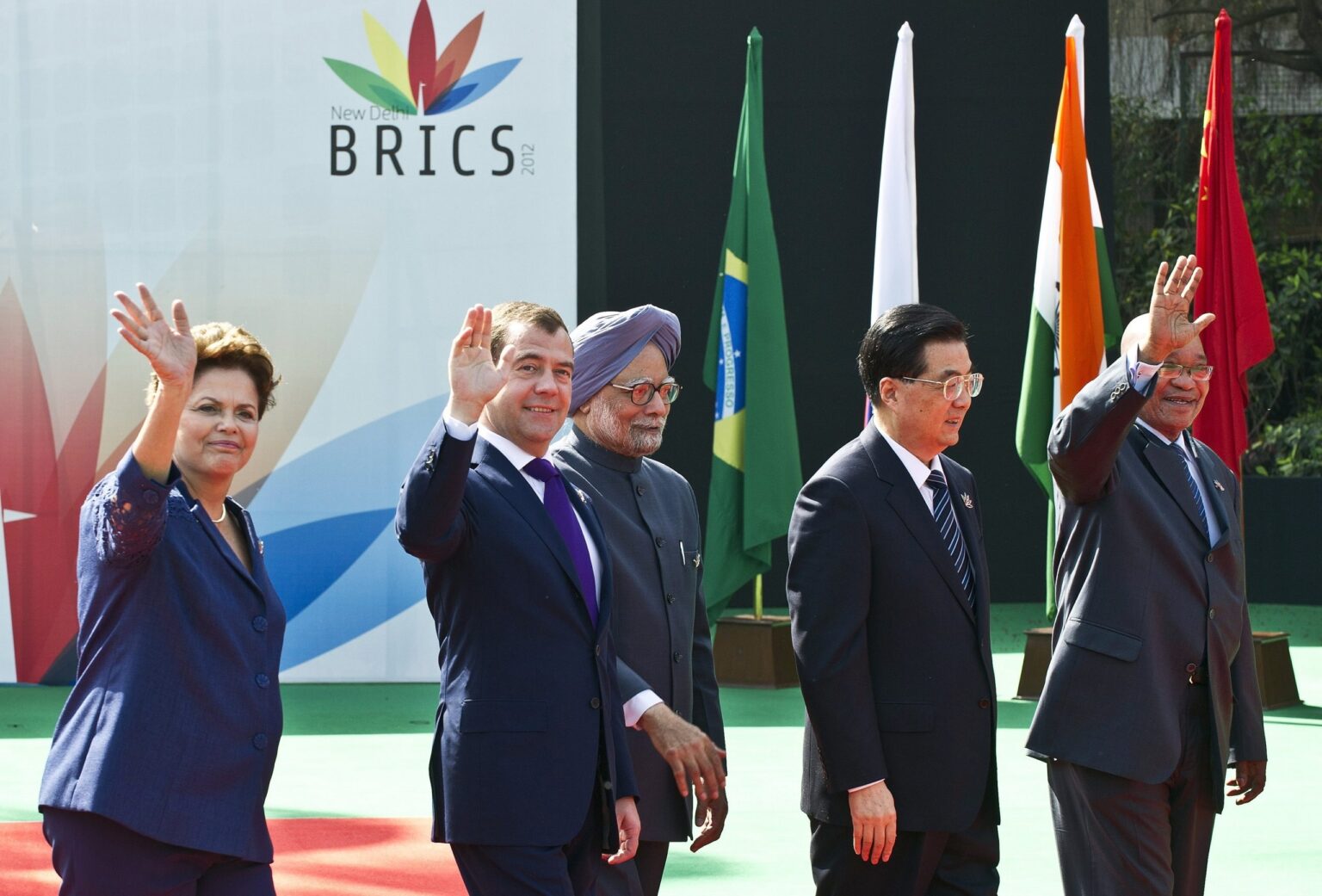
Just as the world’s economic centre of gravity is shifting North to South and West to East, and as traditional donors deal with a financial crisis that is impacting their aid assistance to Africa, the BRICS nations are developing a new focus on global health issues.
Last month, the Global Health Strategies initiatives (GHSi) published a major report on what it termed “the intersections between major growth economies and global health efforts”. This followed on from last year’s BRICS Ministers of Health meeting where a commitment was made to support and undertake inclusive global public health co-operation projects, including through South-South and triangular co-operation.
The BRICS group, an informal association of the world’s fastest growing developing economies, made up of Brazil, Russia, India, China and South Africa, are beginning to exert their ever-increasing influence in a number of areas, not just within the global economy.
At the 2011 meeting, the BRICS Health Ministers committed to use their organisation’s platform as “a forum of co-ordination, co-operation and consultation on relevant matters related to global public health”.
In a previous report that was distributed to heads of government at the 2011 G20 meeting, philanthropist Bill Gates expressed his excitement concerning “the potential for these rapidly growing countries [the BRICS] to form partnerships with poor countries to advance development”.
The GHSi, thanks to a grant funded by the Bill and Melinda Gates Foundation, prepared the Shifting Paradigm report, to give substance to Bill Gates’ enthusiasm. Published to coincide with the BRICS leaders meeting held in India’s capital New Delhi at the end of March, it provides a comprehensive analysis of the role that the five-member group is taking to improve global health.
The report was given little attention by the Western media who chose to focus on the BRICS’ plan to create a multilateral bank, providing a counterweight to the World Bank, and also the threat to withhold funding to the Bretton Woods institutions unless the BRICS were given a bigger voice in the mechanism of the World Bank and IMF decision-making procedures.
But as this report makes clear, the Delhi summit disclosed a commitment to a very important development – that the BRICS intend to support international development and will become important donors and health innovators.
As the GHSi report states, the BRICS are still developing countries, and as such they continue to face significant health challenges of their own. So their interest and goals in supporting global health and development efforts are tempered by their own domestic circumstances.
But all five countries have already made significant contributions to Africa’s health sector and development in general by financing programmes, capacity building and (perhaps most notably) through ensuring that Africans enjoy improved access to affordable medicines.
To highlight two developments that took place last year, China’s Ministry of Science and Technology announced a $300m partnership with the Gates Foundation to fund research and development for global health (and agricultural production). Russia also committed $36m to support a global response to non-communicable diseases.
It could be argued that the BRICS, as far as Africa is concerned, are in part filling a vacuum that has been left for far too long by the UN’s World Health Organisation (WHO). While the WHO takes Africa’s health issues very seriously, and indeed the region’s Brazzaville-based headquarters co-ordinates many important WHO interventions, the UN body issued its first and only report on Africa’s health sector more than five years ago.
That report concluded that the African region – in 2007 defined by WHO as its 46 member countries, i.e. African countries excluding Morocco, Tunisia, Libya, Egypt, Djibouti and Sudan – needed to build and reinforce their health systems as a platform to provide a broad range of essential healthcare services to their peoples. The WHO’s report, The Health of the People, stated: “There is no ‘one-size fits all’. These health systems must be tailored to the needs of each country, each region and each community — whether rural or urban, affluent or poor.”
The report continued: “Health systems must provide services that address key public health needs, and these must be delivered in an effective and accountable way.”
The WHO urged governments — in the African region and elsewhere in the world — to be more involved in research into the health problems that affect their people most and to be engaged in the quest for sustainable public health solutions to those problems.
Meeting the challenges
No one could really argue with this position; however, in the intervening years, the WHO has seemingly been constrained by funding problems of its own. But other funding has been secured, the most significant being President Obama’s Global Health Initiative (GHI), launched three years ago, that has pledged $63bn cumulatively to 2014.
The GHI is aiming to prevent millions of new HIV infections, reduce childbirth mortality, avert millions of unintended pregnancies and eliminate some of the world’s neglected tropical diseases.
For sub-Saharan Africa (SSA), health issues and the delivery of healthcare remains an especially challenging concern. Again drawing on WHO data, the region accounts for 11% of the world’s population, yet bears 24% of the global disease burden and commands less than 1% of global health expenditure.
Almost half the world’s deaths of children under five years old take place in Africa. And the continent also faces a severe shortage of trained medical personnel, with just 3% of the world’s health workers deployed in SSA.
Significantly, according to the World Bank’s International Financial Corporation, it is expected that the private health sector will grow faster than the public health sector in the next decade, and it is calling for investments in the range of $11–$20bn over the same period, believing the private health sector has the potential to deliver as much as 70% of healthcare capacity.
It is against this background that the BRICS are mobilising what resources they can to empower African countries, and indeed all developing countries, to best meet their health needs. Yet it is accepted that the BRICS have limited financial resources, so their interventions need to be intelligently targeted and complement existing donor mechanisms such as the GHI and the work of the Bill and Melinda Gates Foundation. South Africa, the newest member of the BRICS, officially joined the grouping in 2010. While its economy is significantly smaller than any of its BRICS counterparts, it has the largest economy in Africa and is the only African member of the G20, and for that matter the only African member of BRICS.
Furthermore, South Africa’s health services are undoubtedly the most sophisticated in SSA, if not the continent as a whole. So it follows that the country should be evaluated separately to the rest of SSA.
Over the last 18 years, more than 95% of the country’s foreign assistance has gone to other African nations. This approach has helped it build regional influence. Even so, South Africa’s foreign assistance programme is small compared to the other BRICS.
South Africa’s contribution
Yet the GHSi BRICS report cites three key examples of South Africa’s contributions to health innovations that could be defined as knowledge transfer rather than financial assistance. For example, the Technology Innovation Agency launched by South Africa in 2010 actively funds multiple health R&D initiatives within South Africa, including a new Drug Discovery and Development Centre, and it has supported several clinical research trials.
These clinical research programmes include the Centre for the AIDS Programme of Research in South Africa (Caprisa) 004 study, based at the University of KwaZulu Natal.
The Caprisa 004 study has developed a vaginal gel containing the combination therapy antiretroviral (ARV) tenofovir which helps prevent HIV transmission to women during sexual intercourse. This provided the first proof-of-concept that ARV-based microbicides, and ARV-based HIV prevention more broadly, are able to significantly reduce the risk of infection.
Designed and led by South African researchers, the Caprisa 004 study is widely regarded as a landmark in global efforts to develop HIV prevention methods that women can initiate themselves and will undoubtedly be beneficial to millions across the continent.
Along with the Caprisa 004 programme, the Orange Farm Clinical Trial of Male Circumcision (conducted in Orange Farm, a large township outside of Johannesburg) found for the first time evidence that male circumcision protects men against HIV infection.
Since then, circumcision has been proven to reduce men’s risk of contracting HIV by more than half, prompting high-burden countries from Botswana to Kenya to promote the procedure as an effective means of prevention. Countering the terrible spectre of the HIV/Aids pandemic is clearly high on South Africa’s health agenda, given the high rates of infection that are believed to predominate in the country. The country’s HIV/Aids epidemic is the largest in the world; approximately one-fifth of the population is thought to be currently living with the infection.
South Africa plans to launch its first-ever development agency, the South African Development Partnership Agency (SADPA), in an effort to assist fellow African countries to leverage its own experience and research and development achievements. As the GHSi report states: “South Africa’s response to HIV/Aids and TB has had a broad influence on global health, particularly in terms of clinical research, advocacy and policy.
“Since it is on the frontlines of efforts to combat these epidemics, South Africa has also become a proving ground for innovative tools and programmes and produced a cadre of dedicated researchers and policymakers whose efforts impact global approaches to treatment and prevention.”








