
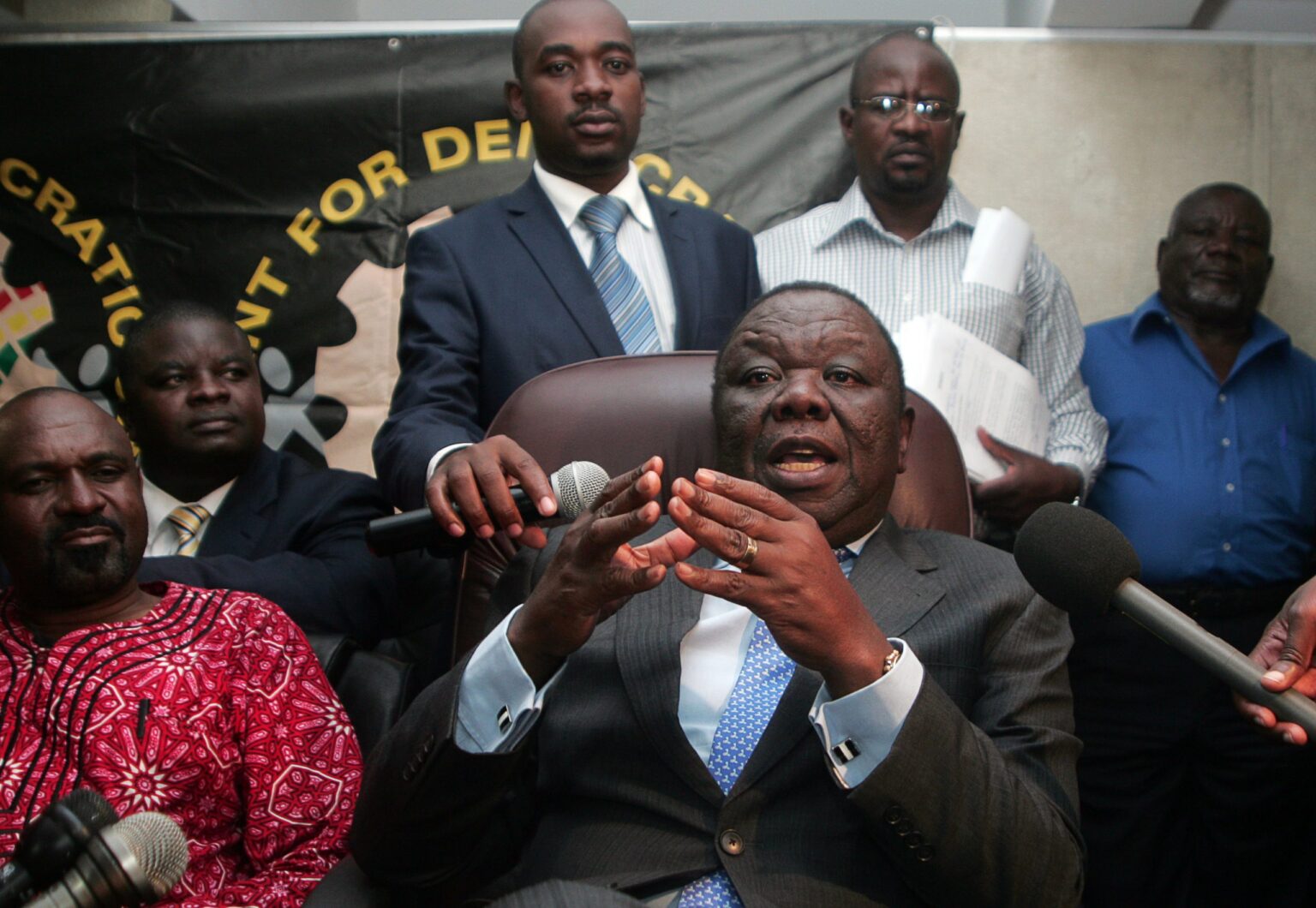
It would seem that losing the July 2013 general elections did much harm to the once- formidable opposition MDC-T in Zimbabwe, now split between secretary general Tendai Biti and its leader Morgan Tsvangirai. From Harare, Tichaona Zindoga examines the disintegration of President Robert Mugabe’s foes.
Since its formation in 1999, capped with a close victory in the 2008 elections, Morgan Tsvangirai’s Movement for Democratic Change (MDC-T) has given President Robert Mugabe’s ruling Zanu-PF party some torrid times, despite the fact that the opposition was walloped in last year’s elections, managing 49 out of 210 elected seats compared to Zanu-PF’s 160, and the fact that Tsvangirai won 31% of the vote compared to incumbent President Robert Mugabe’s 61%.
The results opened a season of discontent for Tsvangirai with senior members of the party calling for the party leader to step down. It started in September when Treasurer General Roy Bennett, a vital cog to the donor community in and out of Zimbabwe, questioned Tsvangirai’s continuing stay at the helm of the party after successive losses.
Bennett wrote on his social media site: “Mr Tsvangirai has served two terms and is nearly completing a third. Deep introspection needs to be undertaken by our national collective leadership, not for purposes of looking for scapegoats, but for our party to reinvigorate its leadership with a leadership which reflects the will of our people.”
The statement sent tongues wagging within the party but it was followed by another damning assessment by Ian Kay, another cog in the party.
“This is like a soccer team. If the coach continues losing, there is need for the technical board to sit down and deal with the issue,” Kay was quoted as saying in an interview with a daily.
He added: “There is need to plan ahead before the ship sinks, and if there is need to change the coach, then let it be. Or should I say it is like a rusty bolt? There is need for it to be removed and replaced with a new one rather than leave it like that.”
That was becoming too much and the handiest scapegoat was to point at the said men’s colour of skin.
Respected member and former Harare Mayor Elias Mudzuri outlined in a newspaper in November what needed to be done to the ailing party.
He presented five scenarios. Scenario Four was the most poignant. He wrote: “Morgan Tsvangirai is the godfather of the party. He steps down ceremoniously and a new leader is elected. He becomes a ‘Mandela’ of the party. Structures are re-engineered including the party constitution which will limit the future party president to two terms only.”
But the plot began to thicken. It was Deputy Treasurer General Elton Mangoma’s letter to Tsvangirai calling for “leadership renewal” in January that set off the real fight – literally and figuratively – in the MDC.
Mangoma wrote: “Leadership renewal is an inexorable truth that the party will have to confront lest it is plagued by the same succession conundrum affecting Zanu-PF. Since the outcome of the election, calls for leadership renewal have been made in different quotas and at different platforms.
“It is my unbending resolve that leadership renewal, at this juncture, could be the only avenue to restoring the credibility of the party lest it risk being confined to history. At a time when confidence is plummeting, there is need for the MDC to freshen up, create fresh impetus and rally its troops to remain united and focused.”
Tsvangirai’s supporters bashed Mangoma and also assaulted and denounced all those who were perceived to be in the so-called MDC-Renewal Team.
There followed suspensions and expulsions as Tsvangirai purged those opposed to him, including those in party structures across the country.
Tsvangirai suspended
Then the bombshell, as matters came to a head on 26 April when a group of senior members, led by Tendai Biti, who had hitherto lurked in the shadows despite being rumoured to be eyeing Tsvangirai’s post, met in Harare.
Biti and his group announced the suspension of Tsvangirai, his deputy Thokozani Khupe, Abednico Bhebhe, Morgan Komichi (Deputy Chair), Douglas Mwonzora (Secretary for Information) and Nelson Chamisa (Organising Secretary).
In suspending Tsvangirai, Biti spelt out that Tsvangirai “is clearly unsuitable and has disqualified himself as a fit and proper patriot with the legitimacy, credibility, ability, decency, or honesty for leading and executing the democratic struggle.
“We the democrats gathered here no longer recognise him or his associates in the standing committee in any capacity. We no longer recognise him or them in any capacity. We are, therefore, exercising our constitutional right of freedom of dissociation and we will now pursue our struggle with genuine credible fellow Zimbabweans until real victory over Zanu-PF and its dictatorship is achieved and attained in this country.”
The last election results opened a season of discontent for Tsvangirai, as party members called for the leader to stand down
He charged Tsvangirai with alleged financial impropriety, violating the party’s constitution and using violence against political opponents, among other things. Biti then rescinded the suspension and expulsions of Elton Mangoma, lawmaker and former legal advisor Jacob Mafume, Youth Secretary Promise Mkwananzi, and lawmaker Trust Maengahama, among others. But as a counterblow, the Tsvangirai faction convened a national council meeting (there are arguments as to the numbers of those attending rival councils) and resolved to expel Secretary General Tendai Biti and 10 MPs.
The battle for control then went to Parliament by the two sides. On April 28 Biti wrote to the Speaker of Parliament Jacob Mudenda, saying in part “…the MDC national council on Saturday 26th April 2014 suspended Tsvangirai and his accomplices and placed the party under the curatorship of the Guardian Council. Thus anyone purporting to act on behalf of the party will have to seek a court order to reverse the legitimate council decision of Saturday 26 April 2014.”
Tsvangirai’s faction wrote to Parliament through the party deputy president, intending to recall legislators aligned to Biti.
However, on 8 May, the Speaker washed his hands of the muddle.
He said in a statement: “In any case, neither the honourable president of the Senate nor the Speaker of the National Assembly has any authority and role to play in the internal disciplinary actions, disputes or differences within political parties, which matters may be appropriately dealt with by a competent court.”
Both factions seemed pleased with the outcome.
The Speaker, a Zanu-PF legislator, could be happy the cat is off his back as any misstep could have impugned his reputation, especially in light of some yet-to-be proved allegations of Zanu-PF’s hand in the MDC wars.
The hidden hand
Western embassies have been fingered as playing a huge role in all this as they are said to be behind the quest to remove Tsvangirai. They are also said to be freezing support and money they have been freely giving to the former trade unionist and now channeling towards the renewal lobby. Usually silent on everything bad about Tsvangirai, the western embassies have lately been condemning violence in the party, allegedly to be perpetrated by Tsvangirai.
Australia, the US, the European Union and Canada have spoken out strongly against violence, in a thinly veiled attack on Tsvangirai. Even Tsvangirai’s regional ally, Botswana President Ian Khama, reportedly phoned him and advised him to step down.
The infighting in MDC-T has come about mainly because the party lacks an ideology
Tsvangirai is unhappy. He has not taken the censures lightly.
At a rally in Harare he said: “We have our friends out there. We are surprised by people who say we want that one to lead the party. Is that the work of diplomats…We want to tell the diplomats that we are united as a party. What you can do is to help the people of Zimbabwe to have democratic change.”
He is feeling the bite of the aid freeze.
And he complained: “Money is dangerous. It’s time for Zimbabweans to underwrite their own struggle and not rely on donors. If you are proud people, underwrite your own struggle. Contribute 50 cents or a dollar like you do in church.”
He also urged his supporters to sell their belongings, like goats and chickens, to bankroll the party.
What has gone wrong in heaven?
University of Zimbabwe head of political science Dr Charity Manyeruke explained: “The infighting in MDC-T has come about mainly because the party lacks an ideology. That means they do not have a good foundation and a solid identity. Then there is the problem of a leadership crisis. There is no leadership in the party. The structures are fragile and the guardianship of the party is selfish. The camps are not being open-minded but defensive which is not helping the party. Without measures to contain this confusion the party will keep disintegrating till it is irrelevant.”
Midlands State University lecturer Christopher Gwatidzo agrees.
He said: “The basic problem assailing the MDC-T is lack of an ideology. It was formed as a hotchpotch of different individuals without a common basis except the desire to unseat Mugabe.
“There were disgruntled commercial farmers, lawyers, failed individuals and willing puppets all clamouring for Mugabe to go. Actually, there was confusion from the beginning, stirring peanut butter in okra if we may use the metaphor. The party has been consistently full of contradictions and if you consider the kind of splits that they have had for a party formed 14 years ago you can tell that the centre cannot hold. There is no clarity and sense of purpose as to their mission. The current circus is a fight for the control of donor resources and power.
On the future of opposition politics in Zimbabwe Dr Manyeruke says:
“With or without the MDC, I think there is still a possibility for a credible and vibrant opposition movement. All that is needed is to come up with brilliant ideas and strategies
and the time to mobilise the people.
“At the moment, we do not have an opposition that is defined by domestic interests. They are sponsored by developed countries who have different interests to pursue. The parties themselves are powerless. Donor funding is directed at specific projects. The agenda is also determined from outside the country. Selection of candidates is also open to external manipulation.”








