
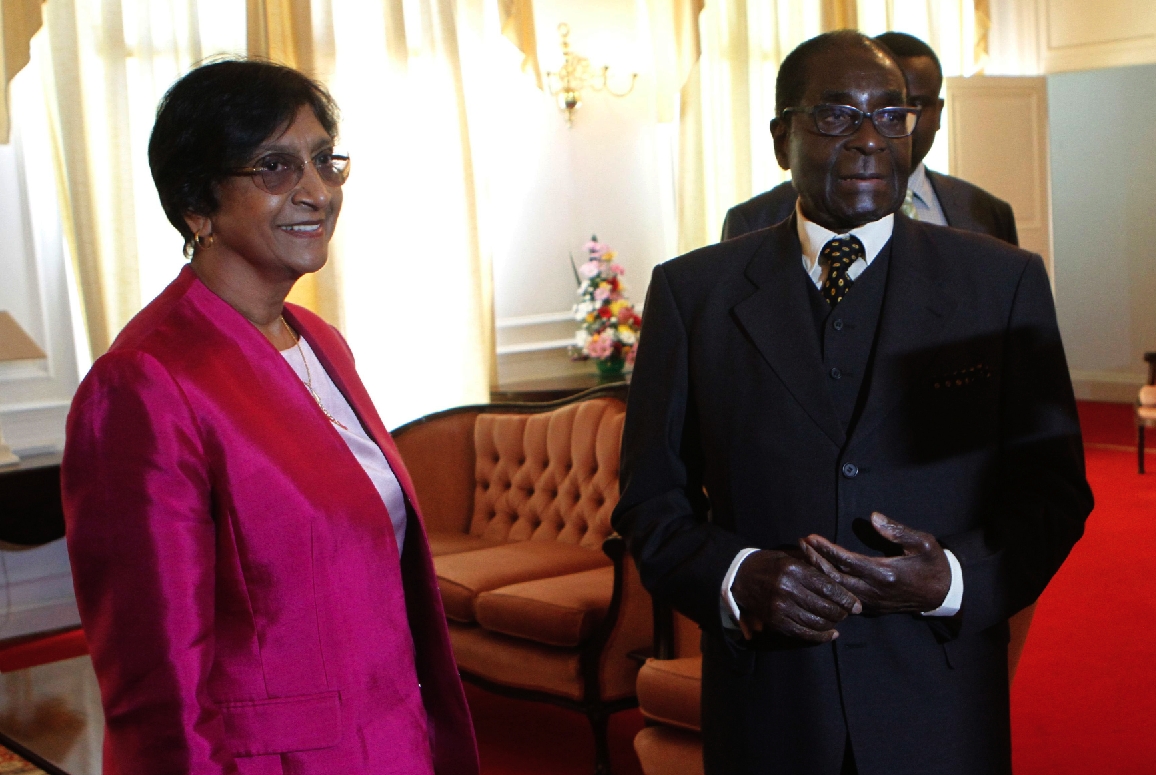
In May, the UN High Commissioner for Human Rights, Navi Pillay, visited Zimbabwe to see things for herself. She pronounced herself “happy” with land reform, but was “concerned” with political polarisation in the country. And then she said the unsayable: “Sanctions have had a harmful impact on Zimbabweans.” Tichaona Zindoga reports from Harare.
FOR THE LAST DECADE OR SO, Zimbabwe has been in the international spotlight for alleged human rights violations. The country’s detractors, or specifically those of President Robert Mugabe and his Zanu-PF party, usually want to use the appellation “gross” when speaking of the alleged violations.
Mugabe stands accused of directing state-sponsored violence towards the opposition Movement for Democratic Change party. (The parties themselves however conceded in the Global Political Agreement in 2008, that they were both culpable of violence, although the MDC usually likes to play the martyr).
The claims of human rights violations were used by the US and the EU to impose punitive economic sanctions on the Mugabe government in early 2002.
In 2008, Britain and America even came close to declaring war on Zimbabwe under the United Nations’ contentious “Responsibility to Protect” clause. But no official enquiry had been made in Zimbabwe by the international community concerning human rights violations, and the country certainly posed no threat to international peace.
So when at the end of May this year the United Nations High Commissioner for Human Rights, Navi Pillay, finally visited Zimbabwe, the stakes were high.
Ahead of the visit, in April, some MDC-aligned groups in South Africa had “won” a ruling by a judge there ordering the South African government to investigate and prosecute some unnamed top officials in Zimbabwe over “state-sponsored violence” in line with international law, which would eventually see the alleged perpetrators being taken to the International Criminal Court in The Hague.
With the agenda thus set, an “unhappy” Zimbabwe government responded to the South African ruling by saying “We told you so!”, as Justice Minister Patrick Chinamasa put it, when revealing that he had warned Navi Pillay beforehand not to have preconceptions when making her judgments.
Chinamasa said the South African ruling had brought South Africa’s judiciary “into disrepute”. He was supported by President Mugabe who said the South African courts were partly staffed by “residual Rhodesian elements” bent on avenging their defeat in Zimbabwe.
But when Pillay came and saw what was on the ground, she left Zimbabwe without particularly annoying or pleasing anybody. She met both Mugabe and Prime Minister Morgan Tsvangirai, the MDC-T leader. She also met representatives of civil society organisations.
In her report, read at a press conference at the end of the five-day visit, Pillay had no earth-shattering news to deliver on the country’s human rights situation.
Zimbabwe’s “violations” could not be gross, she said, but she was concerned by political polarisation and political violence in the country.
“This polarisation is acting as a major impediment on a number of fronts, including the advancement of human rights,” Pillay said. “Concern is also rising both inside and outside the country that, unless the parties agree quickly on some key major reforms and there is a distinct shift in attitude, the next election, due some time in the coming year, could turn into a repeat of the 2008 elections, which resulted in rampant politically-motivated human rights abuses, including killings, torture, rapes, beatings, arbitrary detention, displacements, and other violations.”
Chinamasa, who has heard similar claims before, was not pleased. He was quoted by the media as accusing Pillay of regurgitating unsubstantiated claims.
Pillay noted that it was “essential that a satisfactory new constitution with an entrenched Bill of Rights is in place soon, so that the referendum to confirm it and all the electoral reforms necessary for a peaceful, free and fair election can be carried out before people go to the polls”.
In an apparent balancing act, Pillay suggested that sanctions against Zimbabwe by Western countries should be “suspended” as they had direct and unintended consequences which could affect the human rights of the people.
“While it is difficult to disentangle the specific causes of Zimbabwe’s major social and economic ills,” Pillay said, “there seems little doubt that the existence of the sanctions regime has, at the very least, acted as a serious disincentive to overseas banks and investors…
“Taken together, these and other unintended side-effects will in turn inevitably have had a negative impact on the economy at large, with possibly quite serious ramifications for the country’s poorest and most vulnerable populations who have also had to cope with the political instability and violence as well as a severe drought.”
Then she added the unsayable: “Sanctions,” she said matter of factly, “have had a harmful impact on Zimbabweans.”
While this did not please those who have been obfuscating about sanctions – like The Zimbabwean newspaper which said it was “one thing that Pillay got wrong” – it was also of little cheer to the government, which has been saying for the past decade that sanctions must be lifted in toto.
Pillay also hailed Zimbabwe’s land reform programme, which saw thousands of previously marginalised blacks get access to arable land.
In a lecture at the University of Zimbabwe, she said she did “support the basic principle of land reform, and I am happy that many small farmers have now managed to acquire viable farms…”
On the other hand, Zimbabwe stood by its views regarding homosexuality as illegal in the country, something which Pillay decried.
At the end of the visit, not one stakeholder could stand up and say they stole the thunder with Pillay. But Obert Gutu, Zimbabwe’s deputy justice minister, said Pillay’s visit “was a welcome and historic visitation.” He told New African that the next stage would be for Pillay to issue a formal communiqué from her office, to be presented to the UN, capturing outcomes and outlining what she saw, her observations, assessments and recommendations where applicable.
Outside the country, however, some dissonant voices rallied against Pillay. The UK-based Zimbabwean columnist, Clifford Mashiri, wrote: “One would be excused for feeling short-changed by the UN human rights chief Ms Navi Pillay after she failed to press Mugabe on key issues, let alone travel beyond Harare.”
According to Mashiri, Pillay hardly mentioned the “diaspora vote” as a human right and the “outstanding” compensation for white farmers who lost their land during the land reform programme.
Whatever way one looks at it, more such visits would go a long way to disabusing the minds of people around the world, who have not had the opportunity of visiting Zimbabwe, but whose views of the country have been formed by the incessant negative reporting in the Western media.








