
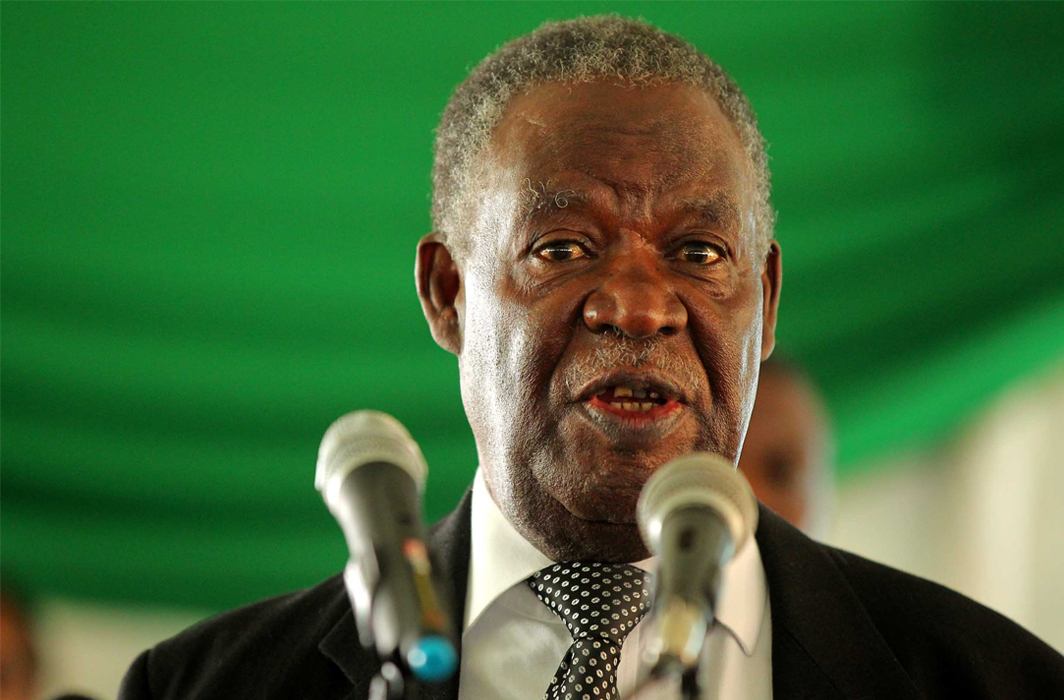
President Michael Sata’s sudden dismissal of Justice Minister Wynter Kabimba, who was widely believed to have presidential ambitions and his likely successor, has thrown Zambia’s succession battle wide open.
How factions get realigned will redefine and redraw the battle lines. But one thing is certain: with the diminishing role of the incumbent in the party’s politics, the ruling Patriotic Front will continue to be a mess of scheming factions. Reginald Ntomba reports from Lusaka.
The last week of August started like any other, with politics taking a large share of the country’s debates.Wynter Kabimba was in the North-Western Province campaigning for his party in legislative by-elections that were due last month (September). He was telling his various audiences that he was a bearer of a message from the president calling for unity and hard work in the party.
But indeed as in the famous words of James Harold Wilson (1916-1995) – who won four general elections and served twice as British prime minister – “a week is a long time in politics.” For by the end of the week, Kabimba was gone in an unceremonious, out-of-the-blue dismissal. Until his surprise sacking, Kabimba was widely considered to be in pole position to succeed Michael Sata as president of the ruling Patriotic Front (PF), and, by extension, of the country, if he managed to swing the national election in 2016.
He was justice minister and also held the influential position of secretary general of the party. He was third in line, after the president and vice president. His prospects had looked bright.
However, much as he was a close confidante of President Sata, whom he has known for decades (see NA, December 2013), the reality was that he was still considered a newcomer to the party. There is a group within the party that feels they are the founders and owners of the PF. This is the group that wields the real power and will have the final say on who the successor will be.
That is why even though Kabimba and his backers may have been upbeat, in effect they had not taken off and were simply being naïve and overestimating their chances. What compounded Kabimba’s problems was that he was backed by one local newspaper which many ruling party lords loathe for pouring scorn on them.
Despite publicly denying having presidential ambitions and consistently pledging loyalty to the president, activity on the ground seemed to suggest otherwise and his opponents were convinced he was clearing his path to the pinnacle. He had to be stopped.
A few days before Kabimba’s dismissal, Finance Minister Alexander Chikwanda, an uncle and close advisor of the president, warned that “there is no vacancy in the presidency” and those canvassing for the position would “injure themselves”. When the president fired Kabimba from his ministerial and party position, people quickly connected the dots.
If there were any doubts about who calls the shots in the party, it was now clear.
The future
For Kabimba it is likely that he will be pursued by investigative agencies. At the height of his power, he was summoned by the Anti-Corruption Commission for questioning over his alleged involvement in an oil procurement deal – but nothing came out of it and no reasons were given for the suspension of the probe. Experience has shown that such cases are resurrected when politicians fall out of favour. Already media reports claimed intelligence officers staged a pre-dawn raid at his home a day after his sacking.
Kabimba had not publicly reacted to his dismissal. His next move will be closely watched, given his former influential positions and what he knows about the party and government. Kabimba’s opponents celebrated his dismissal on the understanding that with him gone, they had succeeded in fending off attempts by people they consider to be ‘outsiders’ from getting the top spot.
Yet the succession battle is far from over even though the powerful clique at the base of the party has won round one via Kabimba’s departure.
But various factors and permutations will be at play.
First, there is no guarantee that within themselves they will all rally behind one candidate, if they identify one. Finance Minister Chikwanda, who was said to be the natural successor has said he is not interested because he is old (at 76 years). Therefore, the question of who the successor should be will provide yet another potential watershed moment. There remains a possibility of another faction or factions emerging to push a different agenda.
Second, the president himself, as seen in most cases in Africa, is supposed to have a hand in deciding on the successor. But his long absence from the politics of the party has compounded matters. At the time of writing, he had not been seen in public for almost three months due to alleged ill-health.
Therefore, with the president no longer the visible force he once was, aspirants will definitely exploit that weakness as they seek to gain advantageous positions. Repeated statements from the party that “there is no vacancy in the presidency” are unlikely to stop the jostling. Thus the party will be at the mercy of scheming factions.
Third, the party vice- president Guy Scott and the new secretary general Edgar Lungu, though close associates of the president, are unlikely to succeed in instilling discipline and holding the fractious outfit together. They have no base and the dominant northern force will easily undermine them.
Fourth, Kabimba’s sympathisers cannot just be wished away. If the party is to sustain the claim that it is all-inclusive, it will be shooting itself in the foot if it harasses such members based on their previous preference of successor.
For a party already dogged by accusations of being dominated by northerners, it could worsen the image crisis. Kabimba himself has previously openly accused his opponents in the party of being tribalists and the newspaper speaking for him has acerbically resurrected that line since his dismissal. Its thesis is that his dismissal was a triumph of tribalism.
Fifth, most tellingly, if the party bungles the succession and breaks up, they will play into the hands of the opposition who are already drumming a message of change, accusing the PF of failure to fulfil promises.








