
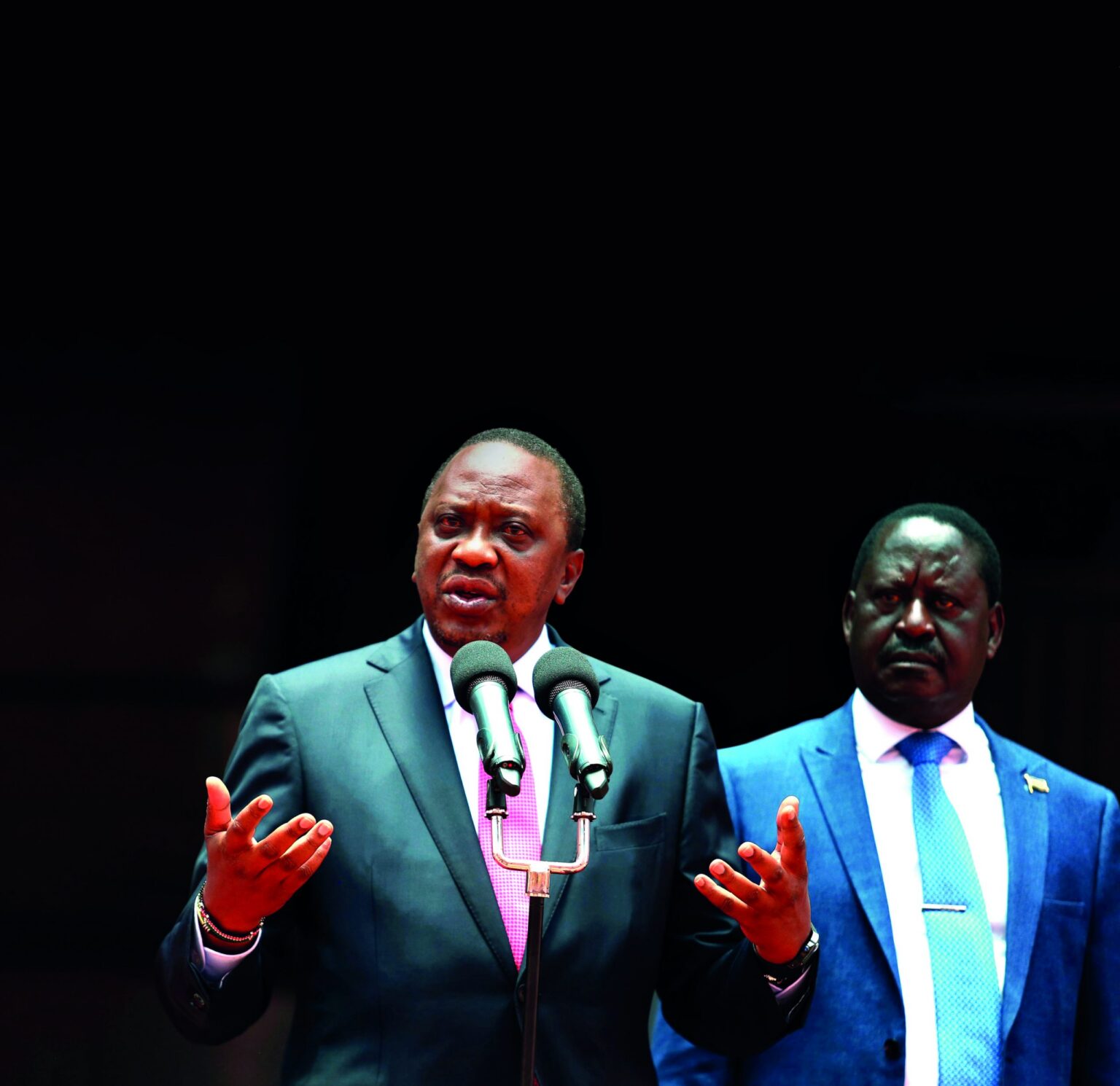
When Kenya’s firebrand opposition leader Raila Odinga publicly buried the hatchet with President Uhuru Kenyatta, a stunned nation was divided equally between joy and disappointment. But what are the real reasons behind this show of rapprochement? Analysis by Derek Otieno.
Early in March, Kenya’s stormy petrel, the opposition leader Raila Odinga, walked into Harambee House, where President Uhuru Kenyatta frequently operates from, for a meeting with his arch-rival. This was the first meeting between the generational rivals since the severe fall-out between the two following the Kenya presidential elections, which had to be held twice following a challenge from opposition party, the National Super Alliance (NASA).
To the shock, bewilderment and joy of the citizens depending on their points of view, the two erstwhile enemies walked out hand in hand and in the joint press briefing held immediately after, committed to working together to ensure the divisions Kenya is facing are bridged, while at the same time, offering to ensure the success of the Jubilee Party’s ‘Big Four’ pillars over its leader Kenyatta’s final lap as the country’s president.
The unity deal has shaken up the country’s political landscape like nothing else in the last 10 years since the National Accord Reconciliation Agreement (NARA) that stopped the bloodshed after the 2007 general elections.
Following the second presidential election, boycotted by the opposition and won by a landslide by Kenyatta, Odinga had refused to accept defeat and held an alternative ‘swearing in’ ceremony which some his most prominent colleagues had been conspicuously absent from. He had said he would hold ‘People’s Assemblies’ to challenge the government but would not try to oust Kenyatta.
With most of his alliance partners seemingly deserting him (See ‘Et tu Brute’, New African, March 2018), it has seemed that Odinga’s long and largely unsuccessful bid for the top leadership had come to an end.
But it seems Odinga has managed to pull yet another rabbit out of the hat. By agreeing to bury the hatchet and work with Kenyatta on the country’s development, he has thrown the country’s political landscape into chaos and may well have circumvented attempts from within his party to sideline him.
Kenyatta and Odinga, the children of the country’s founding President, Jomo Kenyatta and one-time Vice-President, Oginga Odinga respectively, claim they came together as statesmen.
Rare statesmanship
Kenyatta’s claim to statesmanship is that he reached out to his sworn political enemy. His office say this had not been easy, but that Kenyatta has proven that he always takes the moral high ground when faced with complex situations.
He did it in 2012 when he reached out to and partnered with current Vice-President William Ruto to bring peace to the Rift Valley. He is also reputed to have acted with rare statesmanship throughout the International Criminal Court process – where he had been charged with human rights violations following the 2007/8 post-election violence – when he submitted himself to a court he did not believe in.
He showed mature statesmanship again in 2017 when he accepted the Supreme Court’s nullification of his electoral win, despite strongly disagreeing with it. He has this capacity to operate outside his comfort zone when it is necessary to move Kenya forward.
However, as many are pointing out, the struggle for electoral justice, inclusive social and economic policies, good governance, human rights, freedom of the media, equitable development, an independent judiciary and oversight institutions, and an end to ethnic power contests and the ‘our turn to eat’ syndrome, will not end when the Kenyatta and Odinga families reconcile.
Odinga’s NASA co-principals, Kalonzo Musyoka of Wiper Democratic Movement, Moses Wetang’ula of Ford-Kenya and Musalia Mudavadi of Amani National Congress (ANC) have been crying foul about being left out of Odinga’s plans. At the same time, many of Odinga’s ODM acolytes seem to be shifting their loyalties from NASA to Kenyatta’s Jubilee Party, in a way not seen before in the last six years.
Odinga’s supporters claim he is a true nationalist who called a halt to hostilities because he felt the current situation was polarising the country dangerously. His spokesman and main strategist Salim Lone, says Odinga has championed the struggle for multiparty democracy, pushed for a new and progressive Constitution, accepted working in a coalition government and led a very aggressive opposition.
This is believed to have guided his decision to accept Uhuru’s request for them to unite, to slay the dragon of ethnic tensions that has plagued Kenya since Independence, and that reached its highest levels ever under their joint leadership of different sides of the political divide.
There is speculation that the surprise love-in could also have been motivated by both men thinking about their legacies. Uhuru is in his final term as President. He has a ‘Big Four’ economic programme he wants to secure. However this requires a stable, united country. The President may have decided that the Kenya he leaves behind must not only be well-developed economically but also cohesive, peaceful, united and stable.
Odinga, on the other hand, might be thinking that he does not want to be remembered as the man who spent his entire life fighting for a united Kenya, only to become the excuse used to divide it into ethnic bastions in his old age.
The biggest danger now is, with Odinga and his ODM brigade so keen to pick up crumbs from the Jubilee table, Kenya will be left without an effective counter-force to the monolithic Jubilee Party.
Co-principals left dumbfounded
Musyoka, Wetang’ula and Mudavadi say they are ready to drive the NASA agenda without Odinga but that sounds like a joke to many people. It appears they are angry not because Odinga reached an accommodation with Kenyatta, but because they were kept in the dark about the deal between the two.
They are now also demanding a meeting with the President. They seem not to realise that the Harambee House parley was between ‘co-presidents’ – without a retinue of deputy presidents, party leaders or coalition co-principals.
They would also do well to recall that, at the critical hour of need, they let Odinga down by avoiding his “swearing-in” as the “people’s president”.
But there was another reason, very personal to each of the two leaders, during that epic show of unity last week. It is a fact that they have proven beyond any doubt that they are their own men, leaders in their own right. They do not live in their fathers’ huge shadows.
Kenyatta and Odinga must certainly feel a sense of responsibility, carried over from their fathers, for the socio-political divisions that exist in Kenya today. The two scions of Kenya’s most famous political dynasties must have seen this as a divine opportunity to heal the wounds caused by their fathers and hand over a united nation to the next generation of Kenyans. It is important for every Kenyan to support this Uhuru-Raila unity pact – albeit with trepidation. If not interfered with, each leader will use his immense influence to help Kenya move forward, beyond current divisions. How they will do that, only time will tell. But it needs to be done.
If Kenyan politics is replete with betrayal and selling-out, then the NASA co-principals cannot point the finger at Odinga as they are past masters of the game. Back in 2002, Mudavadi betrayed the Odinga-led stampede from the Kanu dictatorship to win appointment as a Vice-President. Again, in the run-up to the 2013 elections, he abandoned ODM when he believed he would be the favoured successor to President Mwai Kibaki.
As for Kalonzo, he famously ditched Odinga in 2008 so that he could become President Kibaki’s deputy in the wake of the post-election violence. He only trooped back to Mr Odinga’s camp ahead of the 2013 elections on belatedly realising that he had no place in the Kenyatta-Ruto power play.
A case of just deserts? NA








