LAGOS STATE
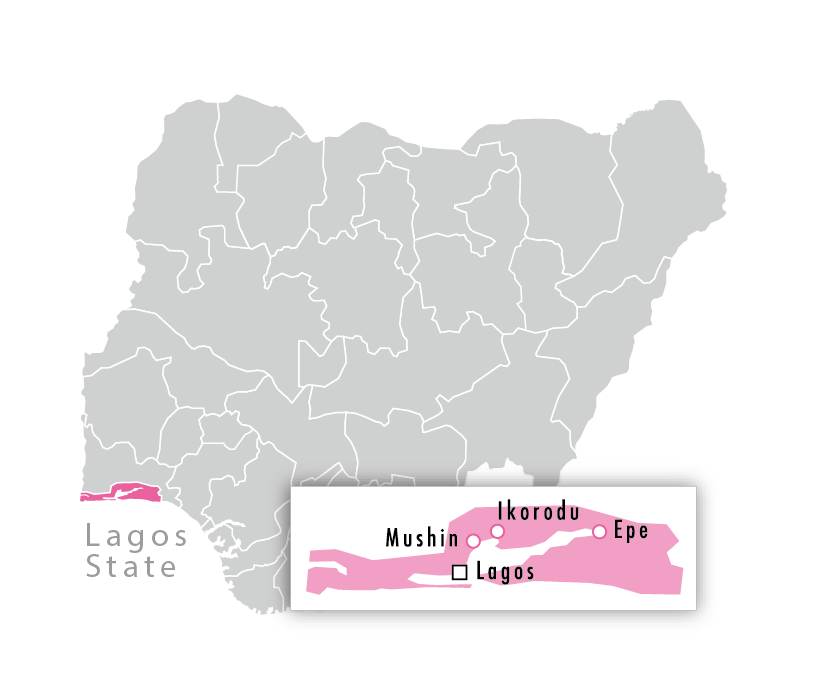
Lagos, Nigeria’s commercial powerhouse, would be competing with Ghana to be the second-largest economy in West Africa after Nigeria if it were an independent state. Representing a large percentage of Nigeria’s total non-oil GDP, and with the most – 5.8 million – registered voters, what happens in Lagos can’t be ignored by the rest of the country.
Since the return to electoral rule in 1999, the state has been a stronghold of the centre-left, Yoruba-based opposition. This dominance has grown at each election, and now the APC holds all the elected positions in the state from the State House of Assembly right up to the governor.
This dominance did not benefit the ACN presidential candidate, Nuhu Ribadu, in 2011. In that election, Jonathan won 65.9% on a 32% turnout; it is widely speculated that Bola Tinubu, the political godfather of Lagos State and the ACN, made a last-minute deal to tacitly give his support to Jonathan, rather than his own candidate, Ribadu.
This time round, Jonathan will face a much sterner task in Lagos; the Buhari-Tinubu alliance looks strong. Tinubu and his popular successor as governor, Tunde Fashola, should be able to get out the vote for their candidate. Despite the APC’s dominance in the state, it is not without serious pockets of PDP support, organised by PDP chieftains Musiliu Obanikoro, a former minister of defence and Bode George, a former governor of Ondo.
In the gubernatorial election, it is a straight contest between an associate of Tinubu, Akinwunmi Ambode and the PDP’s Jimi Agbaje. While the PDP’s candidate is popular – a previous campaign slogan was “everybody like Jimi” – Lagos State has done well under four terms of Tinubu and Fashola. Ambode, who has pledged to continue with their policies, should win the day.

RIVER STATE
Rivers State has the most registered voters – 2.5 million – in the oil-rich Niger Delta, the home region of President Goodluck Jonathan. In 2011, Jonathan stormed to victory with 98% on a high (76%) turnout. This time around, Rivers is not so much in the bag for the president.
Rivers’ governor is the popular Rotimi Amaechi. Originally elected under the PDP banner, Amaechi defected to the APC after a power struggle in the state with Patience Jonathan, the president’s wife – who was born in Port Harcourt, the capital of Rivers and Nigeria’s third city – and with the president over control of the powerful Nigerian Governors Forum, among other issues.
This political crisis in the state has been accompanied by low-level violence, including local lawmakers exchanging blows. But it is the threat of an increase in campaign-related violence and post-election violence that is most worrying. It may fare the worst of all the states in the three southern regions.
Amaechi is not running for re-election, having already served two terms, but he is playing a prominent national role as director general of the Buhari Campaign Organisation. Jonathan should still have enough support in the state to get over the finish line, but Amaechi will lend Buhari his sizeable support.
The election for Amaechi’s successor may be closer, with the APC perhaps having the edge. Former minister of education and ex-Amaechi chief of staff, Nyesom Wike hopes to claim the state for the PDP. Wike, like Amaechi, is from the upland part of the state. APC candidate Peterside Dakuku hopes he can build on Amaechi’s popularity and from a feeling that it is the turn of the riverine part of the state, from which he hails, to have the governor’s seat.
Jonathan is expected to win here, but not on the scale of 2011. Limiting the size of his victory could prove crucial nationally for Buhari. If the opposition candidate puts in a strong showing, the gubernatorial election, which is an APC-leaning toss-up, could give the APC its second elected State House in the South South region.

KADUNA STATE
Kaduna State is situated in the North West zone and is considered to be one of the more socially liberal states in the often socially conservative north. Elections in the state tend to be highly competitive and, with 3.4 million registered voters, the third highest in the country, both sides know how vital the state is to the nation’s electoral arithmetic. Elections here have added significance, as Kaduna is Vice President Namadi Sambo’s home state.
The 2011 elections were hard fought in the state. At the presidential level, Buhari narrowly won more votes than Jonathan (52 to 47%), but the PDP’s Patrick Yakowa took the governorship with 52% of the vote. Across the three senate seat races, the PDP narrowly beat the opposition, winning 50% of the vote. One seat was comfortably won by the PDP, one comfortably won by the CPC and one was so close between the two it had to be settled in court.
Buhari and the APC’s chances in the state are likely to be helped by their gubernatorial candidate, Nasir el-Rufai. The APC’s state flag-bearer is a highly respected technocrat and popular government critic. He served in the cabinet of Olusegun Obasanjo as Minister of Abuja Federal Capital Territory (FCT). In that role, he was lauded for his firm and effective carrying out of the Abuja Master Plan, even when it meant demolishing the house of the then chairman of the PDP, the party that both el-Rufai and his boss Obasanjo then belonged to.
El-Rufai will face off against incumbent governor Mukhtar Yero, who has been in the job just over two years. Yero replaced Patrick Yakowa, whom he served as deputy governor after Yakowa died in a helicopter crash in Bayelsa State.
If the APC is to emerge as the dominant force in Nigerian politics after this month’s elections, a strong performance in Kaduna will be required. The scale of the Buhari victory will have to increase, el-Rufai will have to take State House, two of the three senate seats will have to fall to them, and they will have to reverse the state of affairs in the current House of Representatives, where the PDP have nine members from Kaduna to the APC’s seven. This is achievable but one should not under-estimate the long-standing political machinery the PDP still possesses in the state to get out the vote.

KANO STATE
Kano is Nigeria’s second most populous state, with 5 million registered voters. While these elections will see the PDP pitted against the APC, in Kano, personalities matter far more than party.
Buhari will win the presidential vote here with ease. In 2011, he received 62% of the vote to Jonathan’s 17%. Ibrahim Shekarau, then state governor and candidate for the opposition All Nigeria Peoples Party (ANPP), scored 12%. He is now a Jonathan ally.
While some of Shekarau’s support may cross over to Jonathan, the state is broadly critical of Jonathan’s administration. The hugely influential Emir of Kano, Muhammadu Sanusi II, who was previously Nigeria’s Central Bank Governor, is a trenchant and outspoken critic of Jonathan’s government.
However, elections for governor and the National Assembly are far from being so clear-cut, with loyalties to political heavyweights counting far more than to parties.
The first governor after the return to electoral rule in 1999 was the PDP’s Rabiu Kwankwaso. He failed in his attempt at a second term in 2003, losing out to Shekarau, who proceeded to serve two terms. In 2011, Kwankwaso, still under the PDP flag, narrowly defeated Shekarau’s chosen ANPP candidate Salihu Sagir Takai by 46% to 43% of the votes.
Since 2011, the ANPP merged with the ACN and CPC to form the APC. Kwankwaso has defected from PDP to APC. And, Shekarau has defected to the PDP, joining Jonathan’s cabinet as education minister.
Neither Kwankwaso nor Shekarau can stand in the election, as both are term-limited. However, the election can be considered a proxy struggle between the two. Kwankwaso’s deputy, Abdullahi Umar Ganduje, has been selected as the APC candidate. Takai was selected as the PDP candidate. This year’s race is effectively a re-run of 2011 with the parties reversed.
All three senate seats and many of the state’s allocated 24 seats in the House of Representatives are highly competitive. The shifting alliances between key personalities make predicting each seat, especially as seats will be moving from three-party competition (PDP, ANPP, CPC) to just two parties (PDP and APC), difficult.
Kano’s elections should show that Jonathan’s political calculations should not be underestimated. Kano should be an all-round firmly anti-Jonathan state after Kwankwaso’s defection, but the shrewd alliance with Shekarau has kept this state’s elections alive.