
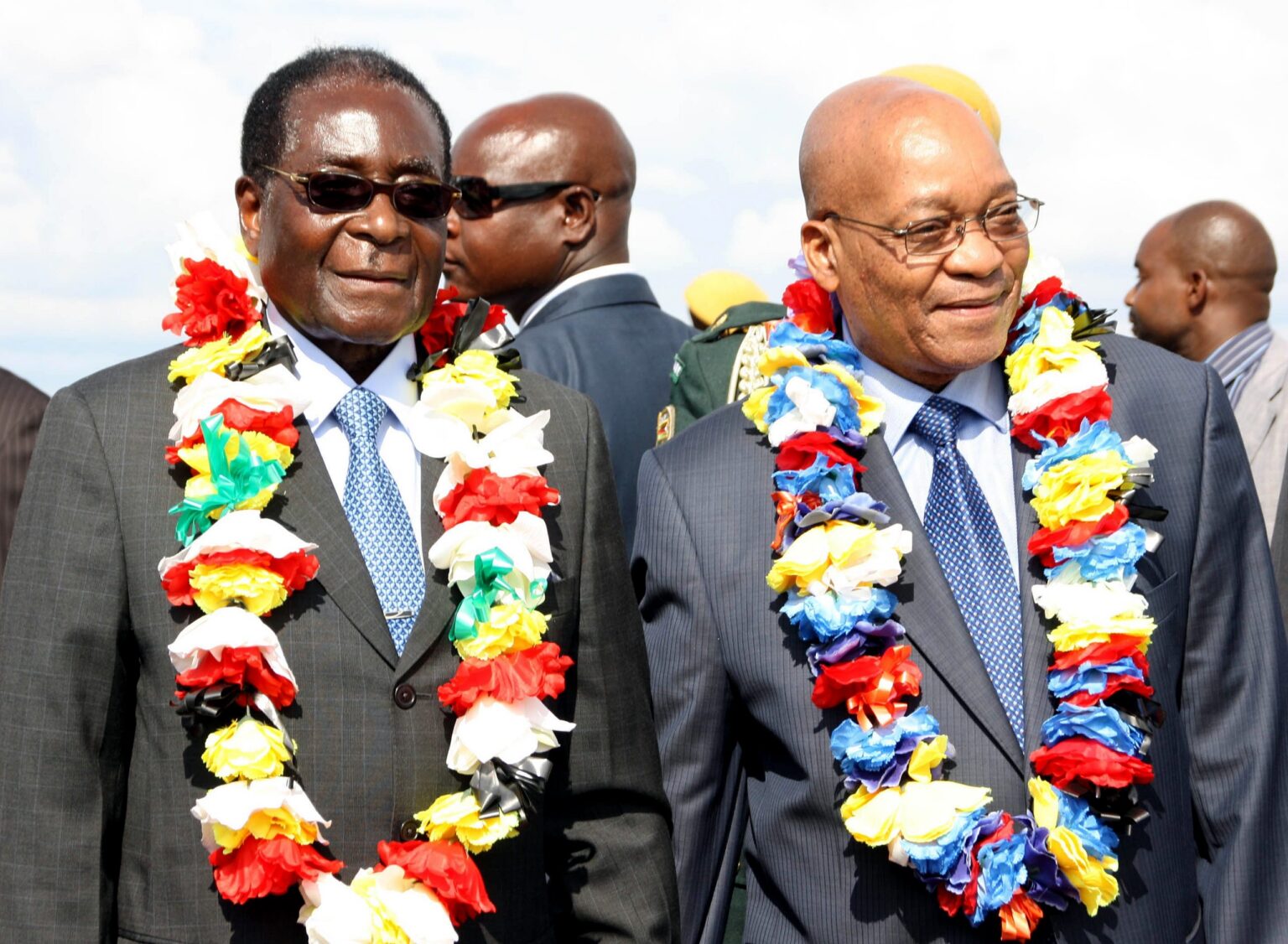
For the past 12 years, South Africa (especially under former President Thabo Mbeki) has been a strong supporter of Zimbabwe, particularly after Zimbabwe’s controversial land reform programme started in 2000. Now, as Tichaona Zindoga reports from Harare, the relationship appears to be going pear-shaped.
In many respects, Zimbabwe and South Africa, divided by the Limpopo River, make perfect neighbours – socially, economically and politically. Both countries have histories steeped in liberation struggles, and are ruled by former liberation movements. South Africa’s ANC and Zimbabwe’s Zanu-PF have 149 years of struggle between them.
The two countries are also big trading partners. However, lately, with turbulent politics in Zimbabwe, the relationship is becoming uneasy, especially politically. And it has much to do with the person of President Jacob Zuma of South Africa, and the internal and international dynamics of Zimbabwe’s politics.
In 2007, while criticising the then South African president, Thabo Mbeki, for being lenient with “dictators”, Zuma said (in reference to Zimbabwe): “It is even more tragic that other world leaders who witness repression pretend it is not happening or is exaggerated.”
This was despite Zuma’s earlier comments in 2006 rebuking the Western opponents of Zimbabwe’s President Robert Mugabe. “Europeans,” Zuma had said then, “often ignore the fact that Mugabe is very popular among Africans. The people love him, so how can we condemn him?” But, two years later, at a press conference in 2008, Zuma asserted: “We cannot agree with Zanu-PF. We cannot agree with them on values. We fought for the right of people to vote, we fought for democracy.”
However, after taking over the South African presidency from Mbeki in 2009, and in consequence taking over the political mediation process in Zimbabwe, between Zanu-PF and the two MDC parties, Zuma refused to bow to Western pressure to be “tough with Mugabe”.
He even criticised the West for imposing economic sanctions on Zimbabwe, and vowed to continue with the “quiet diplomacy” of his predecessor which he said had achieved much in Zimbabwe.
However, in the past few months, Zuma has ruffled feathers in Harare, causing President Mugabe and Zanu-PF to hint on several occasions that they could reject him as a mediator (between Zanu-PF and the two MDC parties).
Of particular concern have been the utterances of Zuma’s international relations advisor, Lindiwe Zulu, who is the spokesperson of a “facilitation” team that has been shuttling between Pretoria and Harare on behalf of Zuma.
Zulu, a former South African diplomat to the European Union, has tried to fashion herself as an “Iron Lady”, who, according to her critics, has perceptibly set herself against Zanu-PF.
The EU and the US, which have not hidden their dislike for President Mugabe and Zanu-PF, have often stated that South Africa is their “point man” on Zimbabwe.
In May last year, Zulu allegedly described Zanu-PF’s demands for an election in 2012 as “daydreaming”. She touched an even more raw nerve by claiming in an ANC publication that Zimbabwean negotiators “are concerned about the succession law should Mugabe die or retire before the adoption of a new constitution”.
This did not go down well with Zanu-PF whose national chairman, Simon Khaya Moyo, took the matter up with his ANC counterpart, Baleka Mbete.
In February this year, Zulu was at it again. Speaking at a South African liaison meeting in Pretoria, she said: “As far as the facilitator [President Zuma] is concerned, the environment must be conducive for free and fair elections. President Zuma does not want a repeat of what happened in the 2008 elections.”
Zanu-PF, which says elections should be held this year with or without a new constitution, is not quite happy with such statements, not least because it thinks they sound like they are being read from the script of the two MDC parties.
There is an understanding that the Global Political Agreement (GPA) that gave birth to the Inclusive Government (currently run by Zanu-PF and the two MDCs), may not be “fulfilled”, and that insistence on it will only serve to delay elections unnecessarily.
Interestingly, in March this year, another South African official, Foreign Minister Maite Nkoana-Mashabane, said there should be a new constitution before elections in Zimbabwe.
She said: “A committee is drafting a new constitution, after which a referendum and then elections should be held. Our government therefore expects that there would be no deviation from the provisions of the GPA.”
Her comments drew a sharp response from Harare. A Zanu-PF official, the former Information Minister Professor Jonathan Moyo, was even more stinging, writing in a newspaper column that: “This woman, as an official of the South African government, has no business whatsoever commenting on this thing. Zimbabwe has never been a province of South Africa, is not a province of South Africa, and will never be a province of South Africa.”
Additionally, Harare has been pointing out that “facilitation” is Zuma’s personal brief not a South African one. Meanwhile, on the international front, South Africa has come under fire in Zimbabwe for supporting UN Security Council Resolution 1973 that allowed the NATO countries to bomb Libya.
President Mugabe has been unsparing of what he calls “cowardly” African leaders who bend the knee to Western manipulation. The message is clear to South Africa on its role in Libya.
Now, as the uneasiness across the Limpopo becomes even more palpable, an authoritative columnist in Zimbabwe has warned South Africa to refrain from playing “midwife” to neocolonialism in Zimbabwe.
According to the columnist, “sensitive sovereignty cannot be surrendered or denuded through coercive diplomacy or to a neighbour who might think they wield a trump card over Zimbabwe, in whatever form. Those high-handed politics do not fly here”.
He continued: “The region has a precedent of a mediator who got rejected for pushing matters outside goodwill and consensus. Even if there wasn’t, Zimbabwe would not hesitate to provide one such precedent once she felt that her sovereignty was being offended, was being ridden over roughshod in the name of facilitation.”
South Africa was reminded, by the columnist, that “in terms of statecraft and international diplomacy, she is the youngest state in the region, one to whom illusions of greatness are imparted from an economic prowess it is yet to incorporate into her overall post-apartheid apparatus, both for the benefit of her own people and her own region”.
Yet Zimbabwe and South Africa still have a lot in common that cannot be risked by the current uneasiness in relations.
As such, Zimbabwe expects that South Africa will not be used to reverse the black empowerment drive in Zimbabwe.








