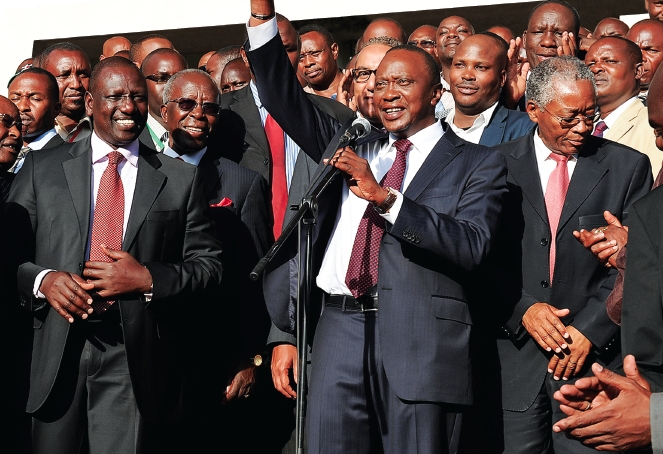
Kenya’s new president was born a Catholic, grew up a Catholic, and was helped by the Catholic Church behind the scenes to win the 4 March presidential election, reports Wanjohi Kabukuru.
On 21 October 1961, the executive officer of the Kenya African National Union (KANU), Mwai Kibaki, and his bosom friend Njenga Karume, accompanied the country’s founding father, Jomo Kenyatta, to his home in Gatundu in Kiambu County on the outskirts of Nairobi. This visit was special, as narrated by the late Karume in his book From Charcoal to Gold. Kenyatta’s fourth wife, Mama Ngina, had just delivered a son. According to Karume, it was Kibaki who suggested that the young boy be named Uhuru (Swahili for freedom) as Kenya was then poised to become an independent republic.
Old Jomo had remained true to his Gikuyu customs in terms of religion, but his wife was from a strict Catholic family. But the Old Man had no objection to his son being led into Catholicism, and as Kibaki also came from a strict Catholic background, he became Uhuru’s godfather. The young Uhuru attended the highbrow Catholic academy, St Mary’s School, before going to the USA for his economics degree. Duncan Ndegwa, the first African governor of the Central Bank of Kenya, brings out these facts in his book, Kenyatta Struggles. Kibaki was not the only Catholic figure in the young Uhuru’s life. The second figure was the former internal security minister, John Michuki, who not only gave Uhuru his first job at the Kenya Commercial Bank where the young man worked as a teller, but also lobbied for Uhuru to be made finance minister in the Kibaki administration. Michuki was President Kibaki’s “enforcer” and is credited as being the man who brought order to the chaotic Kenyan public transport system. Michuki was also the one who set the ball rolling for Uhuru’s presidency when he endorsed him two years ago. Many believe that Michuki did so at Kibaki’s bidding.
The third Catholic figure in Uhuru’s life was his maternal uncle, George Muhoho, a Catholic priest, who had studied Canon Law at the Rome-based Collegio San Pietro. Muhoho rose to the rank of monsignor and was the first black priest to become a Vatican diplomat attached to the European Union headquarters in Brussels. The former priest (who speaks more than five European and multiple African languages) was instrumental in activating the resourceful Catholic network and an interfaith campaign to make sure Kenya’s fourth president is a Catholic. The venue for Muhoho’s strategy was Gatundu Stadium in Kiambu on Sunday, 3 April 2011.
On that day the reality began to dawn for how Kenya’s politics would play out in the next 22 months. On that day, the entire former First Family, led by the matriarch former first lady, Mama Ngina Kenyatta, held an open-air special service for both her son Uhuru and William Ruto, who four months earlier, had been named by the International Criminal Court (ICC) as “bearing the biggest responsibility” in the 2007-2008 post-election violence. In just under a week, the two were set to make an appearance at the Hague.
Kenyatta’s cousin and former legislator, Ngengi Muigai, set the campaign plan in motion when he equated Uhuru’s ICC tribulations with those of his father under the British, and zeroed in on the pain that Mama Ngina was undergoing: “How much can a wife and a mother bear?”, Ngengi asked the congregation. “First, it was her husband’s tribulations from the British colonialists, and now it is her son from the same colonialists.” When Mama Ngina took to the podium, she reminded the congregation that “the colonialists gave us problems and it is now clear they never relented.” The imagery was clear. they did not agree with the ICC process. It had serious loopholes and the entire ICC “charade” was not about justice but a cover-up and settling political scores, she insinuated. In the unscripted and solemn ceremony that followed, Mama Ngina laid her hands on her son Uhuru and his friend Ruto, and fervently prayed. The bonding was total. Tears flowed Kibaki had dispatched his vice president, Kalonzo Musyoka, to various capitals to lobby for a deferral of the Hague cases. Kalonzo was asked to present Kenya’s case to the UN Security Council. “All we want is for the UN Security Council to consider positively the African Union resolution endorsing Kenya’s request for a 12 -month deferral to allow us to complete reforms and embark on local trials,” Kalonzo noted at the time. Raila Odinga and his side of the coalition government opposed this move.
Exactly three weeks after the Gatundu ceremony, the secretary general of Odinga’s ODM party, Peter Anyang Nyong’o, wrote to the ICC giving reasons why the court must reject the “admissibility challenge” led by the Kenya government. “I verily believe that the prosecution of the Kenyan cases at the ICC does not pose any threat to international peace and security,” Nyongo’o a davit said in part. “To the contrary, failure to bring to justice the perpetrators of post-election violence poses grave danger to Kenya’s internal peace and security.”
It is this double-speak by Odinga’s lieutenants that was hyped during the election campaign to build a perception that Odinga was the one who betrayed Uhuru and Ruto. When Western ambassadors in Nairobi joined the fray and opposed Uhuru and Ruto’s candidacy, they simply fell into the trap and were presented as Odinga’s “masters”. Odinga and the diplomats apparently lacked the foresight to see the hidden hand of the Catholic Church and the inter-faith in influence on the elections. The damage to their reputations is beyond words.