
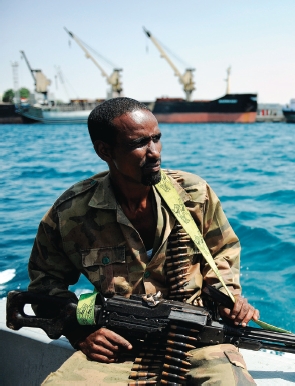
Judging by recent reports, the Gulf of Guinea, which spans the length of the Atlantic Ocean between Cape Palmas in Liberia and Cap Lopez in Gabon, has become “the new danger zone” of piracy, disturbing international navigation and trade, especially oil shipments. Apparently the danger is great enough to warrant the attention of the UN Security Council. As a result, this month, there will be a West and Central African ministerial meeting in Benin to prepare the ground for a heads of state “piracy summit” to be held in Cameroon in April. So how big is the problem? And why is it causing so much angst? We devote our cover story this month to unravelling the conundrum.
When people hear about African piracy these days, their thoughts immediately turn to Somalia and the Gulf of Aden. Piracy in that part of Africa has been a serious enough issue since 2007 to attract the attention of world governments, which have dispatched their big navies to deal with the problem. By and large, they have succeeded in dousing the threat sufficiently (though not completely) to allow international seaborne trade to go on unharmed. Apparently, while all this has been going on off the Somali coast and the Gulf of Aden, another group of pirates (mainly operating from Nigeria) has been rampaging the waters of the Gulf of Guinea and endangering international navigation and trade in that region.
The threat is such that some maritime experts have described the Gulf of Guinea as “the new danger zone”. In fact, on 29 February last year, the UN Security Council unanimously adopted Resolution 2039 expressing “deep concern” about the threat that piracy and armed robbery at sea in the Gulf of Guinea “pose to international navigation, security and the economic development of states in the region”, and requested the UN secretary-general, Ban Ki-moon, to support a summit on the issue through the UN offices in West and Central Africa.
The resolution asked countries in the region to “act with dispatch to counter the scourge at the national and regional levels”, and encouraged “international partners to provide support for regional patrols, co-ordination centres, and the implementation of a region-wide strategy”. The Security Council wanted the “piracy summit” to be convened “as soon as possible” through the UN offices in West Africa and Central Africa (known as UNOWA and UNOCA respectively) “to develop a common maritime security strategy that includes a legal framework for prosecution of persons engaged in piracy”. However, unlike piracy in the Gulf of Aden and off the Somali coast, the Security Council pushed the “primary responsibility” of combating the piracy in West and Central Africa to “the states of the Gulf of Guinea”. This, perhaps, is why the bottom fell out of the whole enterprise – because only a few of the states along the West and Central African coast have the military capability to fight the threat.
Which is regrettable, because Resolution 2039 came on the back of a report submitted by a team sent by the UN secretarygeneral to West and Central Africa between 7 and 24 November 2011, to assess how big the problem of piracy was in the region. The report contained enough to frighten the high and mighty at the Security Council to pass Resolution 2039, but then, besides pious words, the Council appeared to wash its hands of the problem by pushing it onto the states in the region.
Which is even more of a shame, because in July 2011 President Yayi Boni of Benin had written to the UN secretary-general about the threat posed by piracy to his country and the region as a whole, and wanted international help to fight the menace. His letter put West African piracy onto the UN agenda, which eventually led to the passing of Resolution 2039 in February 2012. But the “international help” that Boni requested did not come, instead the Security Council shirked the responsibility and pushed it back firmly into the court of the Gulf of Guinea states.
International dimension
Yet, according to Rick Nelson, director of the homeland security and counter-terrorism programme of the Washington-based Center for Strategic and International Studies (CSIS), and his colleague Aaron Ware, who wrote a paper in August last year on the piracy threat in West Africa, “the Gulf of Guinea is, in many ways, a perfect incubator for piracy, providing both resources and safe haven. Surrounded by some of Africa’s leading oil producers, Including Nigeria, Angola, Gabon, Ghana, and Equatorial Guinea, the Gulf is a major transit route for oil tankers on their way to international markets. These tankers have proven valuable prey for pirates.”
According to Nelson and Ware, “unlike Somali pirates who focus on the ransom of captured crew members, pirates in the Gulf of Guinea derive much of their income from the theft of oil. These pirates will frequently hijack a tanker, siphon the oil to another vessel, and later re-sell it on the local black market.”
The pirates also hijack cargo ships containing goods such as cocoa and minerals, and this, in addition to stolen fuel from oil tankers, provides pirates in the Gulf of Guinea with a lucrative source of income. Nelson and Ware pointed out that because pirates in West Africa derived their profits from the sale of stolen oil and other goods, they have proven to be significantly more violent than their Somali counterpart.
“Vessels are frequently sprayed with automatic weapons fire, and the murder of crew members is not uncommon,” said Nelson and Ware. “Recent events indicate that these pirates are even willing to attack vessels with security personnel aboard, evidenced by the recent killing of two Nigerian sailors guarding an oil barge. Given that pirates are now adopting heavier weapons and more sophisticated tactics, this violence is only likely to increase.”
The danger does not stop there. “Beyond the bloodshed,” the two authors reported, “the expansion of piracy in the Gulf of Guinea poses a dire threat to local economies, potentially undermining what
little stability currently exists in the region. Oil revenue, which many countries in the region rely upon, is seriously threatened by pirate activity – 7% of Nigeria’s oil is believed lost due to such criminality.
“Additionally, instability in the Gulf has sharply decreased revenue collected from trade: Benin, whose economy depends on taxing ships entering the port of Cotonou, has experienced a 70% decline in shipping activity due to piracy. Furthermore, as piracy drives up insurance premiums for international shipping companies, the price of imported goods in the region could spike, further imperilling economies. If these local economies falter, development and stability in the region could quickly deteriorate.”
And then came the rub: “The effects of piracy in the Gulf of Guinea,” Nelson and Ware said, “could well extend far beyond Africa, with potential ramifications for the larger global economy, and the US in particular. The estimated three million barrels of oil produced daily by the nations of the Gulf of Guinea ultimately feed the North American and European markets. Nigeria alone is the fifth-largest supplier of oil to the US, and by 2015 could account for a quarter of US oil consumption. However, given the rate at which attacks on oil tankers are increasing, the ability of these nations to reliably provide oil to the international market could be in question. Early 2012 saw a doubling in the number of attacks on oil tankers, with as many as eight hijackings in a month. If this dramatic trend continues, the flow of oil from the Gulf of Guinea to the US and the West [in general] could slow considerably.”
More gloomy figures
If Nelson and Ware did not frighten the West and Central Africans enough, the Brussels-based International Crisis Group (ICG) had a further concern for them. Combined, the Gulf of Guinea states supply around 40% of Europe’s oil consumption and 29% of the USA’s. But the ICG’s latest report on piracy in the Gulf of Guinea, issued on 12 December 2012, had ample food for thought.
“Within a decade,” the ICG said, “the Gulf of Guinea has become one of the most dangerous maritime areas in the world. Maritime security is a major regional problem that is compromising the development of this strategic economic area and threatening maritime trade in the short term and the stability of coastal states in the long term. Initially taken by surprise, the region’s governments are now aware of the problem… [So] in order to avoid violent transnational crime destabilising the maritime economy and the coastal states, as it has done on the East African coast, these states must fill the security vacuum in their territorial waters and provide a collective response to this danger. Gulf of Guinea countries must press for dynamic cooperation between the Economic Community of Central African States (ECCAS) and the Economic Community of West African States (ECOWAS), take the initiative in promoting security, and adopt a new approach based on improving not only security but also economic governance.”
But, as the ICG knows, that is easier said than done, especially when, apart from Nigeria and possibly Ghana and Côte d’Ivoire, coastal states in the Gulf do not have any really strong navies to do the job. Nigeria, it is said, is the only country in the region that has a frigate, corvette, and aerial surveillance capabilities, even though Ghana’s chief of naval staff, Rear-Admiral Quarshie, said on 5 February 2013 that the Ghana Navy, which was recently beefed up with six new fast patrol boats, was now in a position to fight against piracy and other crimes in Ghana’s waters. So, if this is the state of the navies in the region, how do the Gulf of Guinea countries expect to be able to fight the pirates without international
help? Why didn’t the international community ask the same from the coastal states in East Africa and the Gulf of Aden when Somali piracy was at its height in 2007? Why did all the world’s most powerful navies combine to fight the piracy in that region? Is the UN Security Council being fooled by the latest figures on global piracy (including in the Gulf of Guinea), which shows a slight decline?
According to James Bridger, a Vienna-based maritime security consultant and piracy specialist, writing on 1 February 2013, “the top story is that global pirate attacks have hit a five-year low – [this is] explained by a sharp decline in the activities of Somalia’s notorious marauders. When this trend is reported, it is almost always followed by the caveat that a ‘new’ piracy epicentre has ‘emerged’ in Nigeria and that the criminal enterprise is now increasing and expanding across the Gulf of Guinea… The 27 pirate attacks reported in Nigeria in 2012 represents an increase over the past two years, but falls well short of the 42 attacks the International Martime Bureau [IMB] recorded in 2007.”
Bridger warns that one must be careful about reporting an absolute “increase” in the total number of pirate attacks in West Africa over the past year. “The IMB’s figures,” Bridger says, “display a clear trend: attacks off Nigeria increased from 10 to 27, while those for the region as a whole rose from 44 to 51. These numbers are incomplete, however, as they only include incidents that were directly reported to the IMB; whereas an estimated 50-80% of pirate attacks go unreported.”
Viewed against data published by the Danish consultancy firm, Risk Intelligence (which revealed a decrease in Nigerian and West African piracy in 2012 – Risk reported 48 attacks in Nigerian waters), the ICG’s 12 December report appears to dwell a bit on hyperbole. Putting the two reports in context, Bridger writes: “The expansion of pirate gangs into the waters of neighbouring states explains why attacks may have decreased in Nigeria, but it is also noted that the total figure of attacks in West African waters has fallen from 116 in 2011 to 89 in 2012.” But then Bridger adds a caveat: “An overall decline in the total number of pirate attacks in the Gulf of Guinea does not mean that the problem is being solved. The 16 January [2013] hijacking of the Panamanian-flagged product tanker, Itri, off the port of Abidjan, Côte d’Ivoire, attests that the threat remains high, but has shifted in terms of its targets and scope…
“One manner in which this is evident is target selection. Attacks against support vessels operating close to shore have declined over the last five years (and with them, the total number of incidents), but this has coincided, since 2010, with a surge in tanker hijackings. According to the records of one corporate security manager operating in Nigeria, there were 42 attacks against supply vessels in 2008 (one of the worst years of the Niger Delta insurgency), but only 15 in 2012. Conversely, there were just eight attacks against tankers and cargo ships in 2008, but 42 in 2012. In total, Risk Intelligence has recorded 78 attempted attacks on product tankers and 27 shortduration hijackings since December 2010.”
This shift in targets, according to Bridger, might explain why commentators incorrectly refer to rising levels of piracy in the Gulf of Guinea, because the hijacking of tankers owned by international companies gets far greater media attention than the robbing of supply ships, even though supply ships are attacked more frequently than tankers. Bridger, however, explains that “while boarding a supply vessel and robbing it of valuables is a relatively low-tech affair, hijacking a product tanker and pilfering vast quantities of fuel over several days requires a high degree of organisation and sophistication…
“According to one testimony, Nigerian criminal syndicates are ‘sponsored by powerful people’, including government officials and oil industry executives, who provide advanced payment and information about the cargo, route, and security details of ships that have been targeted. These intelligence-led operations have become increasingly multinational with gangs based in Nigeria planning attacks off the coasts of Benin, Togo and Côte d’Ivoire, often with the assistance of nationals of these countries.”
Bridger adds that “once the ship has been hijacked, pirates have been known to go to great lengths to make sure that the ship ‘disappears’ while preparations are made to offload the cargo. For example, the gang that hijacked the Panama-flagged product tanker MT Anuket Emerald on 25 January 2013 off Togo, made sure to damage all the ship’s communication equipment and loading computer, repaint its funnel, change the tanker’s name, and remove its IMO number. The offloading and black market sale of stolen products is equally complex, requiring a network of ‘oil mafia’ insiders who facilitate fuel storage at numerous depots across Nigeria and then organise for onward distribution.”
According to Bridger: “Though fewer ships are being attacked, the current crop of West African pirates (and their financial backers) are seeing greater returns. The group that recently hijacked the Itri was able to siphon off the ship’s entire cargo of fuel, valued at $5m. Captured pirates involved in tanker hijackings claim that pay-offs range from $17,000 for new recruits to over $60,000 for ‘commanders’. The value of large-scale oil theft exceeds many of the ransom sums made by Somali pirates and is acquired without months of hostage negotiations. Piracy in the Gulf of Guinea, notes piracy expert Martin Murphy, is now ‘the most lucrative in the world’.”
According to maritime experts, it is difficult to fight West African piracy because of graft in Nigeria, where most of the pirates are based, which assures that even if pirates are caught, they are unlikely to face serious consequences. “Bribes to [government] agencies, according to captured pirates, are set aside as an operational expense, meaning most suspects are released without charge,” Bridger reveals.
Thus, he adds, “in terms of numbers, overall pirate attacks may be declining in the Gulf of Guinea, but the gangs responsible appear to have increased both their operational sophistication and target selectivity. Given the increased value of each operation and the small risk of punishment, their crimes show no signs of disappearing.”
To be fair, the Nigeria government, working with its counterparts in Benin, has intensified patrols in the waters of the two countries in recent months. This has forced the Nigeria-based criminal syndicates to move westward to find easier pickings in the waters of neighbouring countries. As such, Togo, which has only 34 miles of coastline and no navy to write home about, has become West Africa’s piracy hotspot – the IMB recorded 15 attacks in Togolese waters in 2012. Ghana and Côte d’Ivoire too have seen an increase in attacks. In fact, Côte d’Ivoire now marks the furthest point the Nigerian-based pirates have expanded their activities.
The international connections involved in this criminal activity also make it difficult to fight it. Maritime experts say “bunkering has become part of a larger international web as Lebanese and Eastern European criminal interests reportedly arrange the black market sale of stolen crude oil and refined cargoes”. Recent attacks, the experts add, appear to be the result of “intelligence-led planning” where tankers are “targeted in very well coordinated and executed operations”.
“In this sense,” says Bridger, “maritime crime is now a transnational emergency in the Gulf of Guinea. Already spreading from Nigeria to Benin, Togo, and Côte d’Ivoire, it is likely that Liberia, Cameroon and Equatorial Guinea will come under increased stress from pirates and oil thieves this year.”
In 2012 alone, five incidents were reported off the Ivorian coast. And on 4 February 2013, a French tanker under a Luxembourg flag was hijacked off Côte d’Ivoire, although port authorities in Abidjan insisted that “the boat was hijacked in international waters”, 300km from the Ivorian coast. In another incident in January, the tanker MT Orfeas was hijacked off Côte d’Ivoire and then taken 600 nautical miles to Nigerian waters where the pirates siphoned off 3,000 tons of gasoline.
In total, Bridger estimates that piracy costs the littoral states of the Gulf of Guinea an annual $2bn in stolen cargo, rising insurance premiums, and other security costs. “As the menace expands,” he writes, “the export of oil, metals, cocoa, and agricultural products – vital to both local development and world markets – will also come under threat.”
It is clear that the Gulf of Guinea states, like their counterparts in East Africa and the Gulf of Aden, cannot fight the problem alone. It needs a coordinated international response.








