
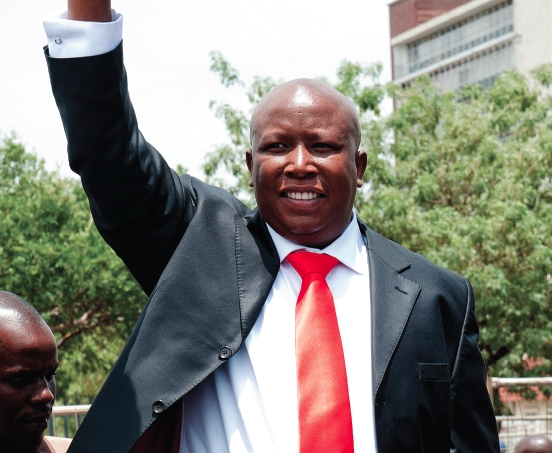
Was Julius Malema, South Africa’s “enfant terrible”, a champion of the poor, or just another self-seeking political entreprenuer?, asks Pusch Commey.
The pain of dereliction was all too obvious as Julius Malema, the conquering hero of the youthful masses, recounted his bitter experiences in an interview with the City Press. His “friends” have deserted him in droves. His phone calls go unanswered. Those who answer his frantic calls promise to get back to him in an irritated voice, and never do.
It has been a learning curve.With no professional qualification he has reverted to farming cabbages on land he purchased during his tenure as President of the African National Congress Youth League. Even that farm is about to be taken away from him. What stands between him and penury are lawyers. However, lawyers and slot machines are synonymous. No coin means “no play”.
The South African Revenue Service (SARS) has moved quickly to declare Malema insolvent, and has attached all his assets: farms, houses, luxury cars, bank accounts. They want R16m (US$1.8m) tax arrears. It is the Al Capone way. And some newspapers have been quick to declare him homeless. Already his household goods have gone to auction, including sofas and a piano. But how did a young upstart 31-yearold politician with 12 years of education, who as president of the ANC youth league earned no more than 50,000 rand a month ($6000), end up with so many assets to generate R16m rand worth of taxes?
Part of the answer will come to light when he pleads to various criminal charges of fraud, corruption, and money laundering. He is due in court next month (April) together with his accomplices. It will be a salutary case. If reports preceding the trial are accurate, his accomplices will be cutting a deal to align with the state’s prosecution of Malema.
Already, the ANC youth league on which he stamped his image, has taken pains to distance itself from its ex-boss. There is a new leadership in place, purged of his supporters and like a lizard’s tail substituted by his adversaries. Where previously he could count on vocal support from the league at his court appearances, he now walks alone. Malema, it seems, was not a good student of the history of African politics. In essence, when you are out of office, with no political influence, your phone number is quickly deleted from “contacts”.
Power corrupts. And Julius Malema to a large extent self-destructed, aided by the corruption of power, and the narcissism that comes with it.
He came into political prominence when in 2000 he organised a march as the president of the Congress of South African Students (COSAS). It was violent and received wide media coverage as a consequence. Malema subsequently worked his way into the ANC youth league. He was a talented organiser of violent protests and had even greater talent in articulating the frustrations of the youth, as well as racial economic injustice. Mostly he spoke the truth when it came to the tribulations of the dispossessed black majority. Though what he said was nothing new, it was the way he said it that made the difference – bluntly. He never minced his words, and the shock effect of it had the media feeding on his utterances.
His stock rose when as the president of the ANC youth league he pitched his tent with a troubled Jacob Zuma, facing potentially career destroying corruption charges instituted by the government of Thabo Mbeki. Zuma won, and Malema won big. Their subsequent fallout is now history. Malema’s chutzpah led him to foolishly call for the replacement of Jacob Zuma as ANC president. The result was a shootout between the president of the ANC and the president of the ANC youth league. The impatient kid lost. Like Thabo Mbeki, Malema had seriously underestimated his opponent. Now he is walking the plank.
“Never leave an enemy behind” was the maxim of the great Zulu king, Shaka ka Sezangakhona. And Zuma is a traditional Zulu. When he is finished with Malema, the chilling prospect is that there will be nothing left of him. The old saying holds true. If you shoot at the king, you don’t miss.
At the height of Malema’s powers the myth of him being a kingmaker gained currency. After all he had led from the front to dethrone the feared Thabo Mbeki by boldly announcing his removal long before the fact. Subsequently his pronouncements became gospel. That was when Malema became intoxicated with power.
As a kingmaker, ambitious politicians courted his favours. He fell for the luxury that came with money, and was spotted wearing a Breitling watch worth R250,000 ($30,000), guzzling expensive booze, and strutting lavish parties, while the poor, hungry and homeless froze to death in cold winter. And all he had for them was words, political claptrap.
The main criminal charge he faces is that he and his friends in his home province of Limpopo connived to win a tender worth 52 million rands ($6.2m). Malema used his political muscle to secure the deal. The company that won the tender, On Point Engineering, allegedly had no qualification or experience to execute the tender and falsified documents to claim a nineyear track record, even though it had been newly formed for the purpose of the bid.
Malema registered a trust which had shares in On Point Engineering. When the tender was won, sums of money were paid into the trust. More money, it is alleged, was used to buy a R3.1m farm for Malema. It was a recipe for personal disaster, as Malema has recently discovered. What does the future hold for Julius Malema, outside the ANC? Practically zero. He is disliked by whites, who hold economic power, because of his vociferous agenda, in which he has advocated the nationalisation of mines, financial houses and other key sectors of the economy.
He is spurned by other racial groups because of his narrow Africanist agenda, seen as a threat to minorities. He has been spewed out by blacks who hold political power because of his arrogance, disrespect and his attempt to usurp power through the platform of the youth league. The one who advocates change has been short-changed by the powers that be.
He is being squeezed by the government machinery to extract every coin from him, and despatch him to jail. His hopes of a political solution to dissolve criminal charges, by supporting Zuma’s adversaries at the election of the ANC president at Mangaung in December 2012, have gone up in smoke. In desperation, and before Mangaung, when the writing was on the wall, Malema exhibited his reckless best by exploiting the Marikana incident to incite miners, and then disgruntled soldiers, to rise up and throw the country into anarchy.
The government would have none of it. At the Marikana platinum mines, where last year 34 miners were mowed down by police over demands for a wage increase, a heavy contingent of police apprehended and escorted him back to the highway, all the way to Johannesburg, some 200 kilometres, complete with helicopters.
He may have hidden some of his tender money, but soon lawyers will take everything in legal fees. If he ends up in jail, which is most likely, others will feast on the carcass of his hidden assets.
The hangover has been rather severe. Will he be able to make a comeback? Don’t bet on it. All things being equal, the ANC is poised to win the 2014 elections with Zuma at the helm till 2019.
He is likely to be replaced by Cyril Rhamaphosa who chaired the disciplinary hearing which eventually expelled Malema from the party. The media attention he thrived on, and which fed his myth, has fizzled out, except stories about The Fall. With friends deserting him in droves, Malema is in freefall.
Central to his self-destruction was a violation of a fundamental African value system: respect for elders. His gratuitous insult of people old enough to be his parents and grandparents irked everyone. In his political intoxication, he showed no respect for the office of the president and the office of ministers. Zuma warned him repeatedly about the African value of showing respect to your elders. He did not listen, and now the chickens have come home to roost.








