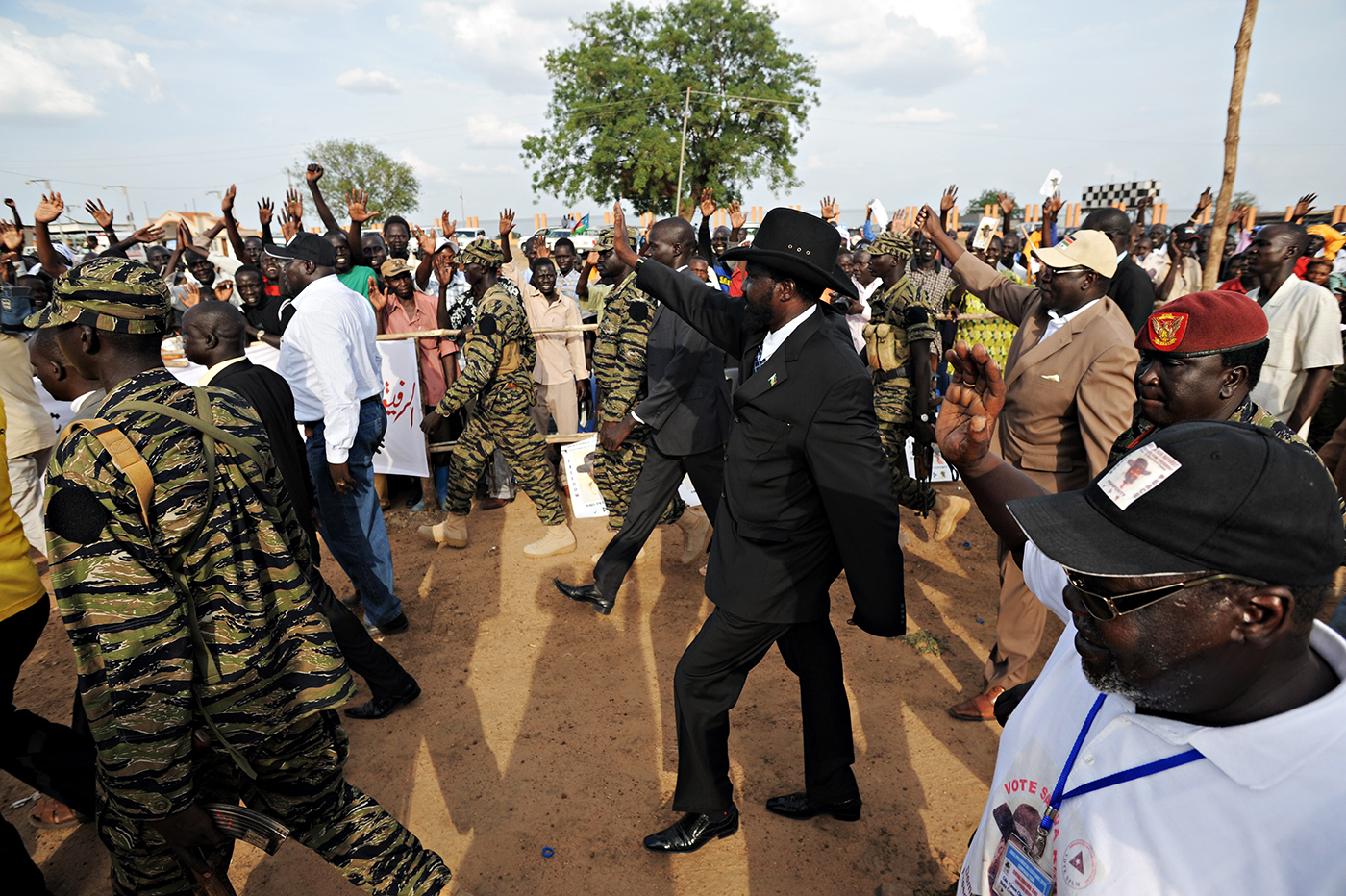
From the outside, the conflict in South Sudan appears very much a local issue but the fighting itself has petered out into a kind of war of attrition, affecting three of the country’s 10 states. The rest of the country is absolutely peaceful. From the inside, however, at least from the vantage position of the government in Juba, one sees the hands of powerful outside forces hiding behind the scenes and stoking the fires, thereby making it not a local issue at all. Our editor, Baffour Ankomah, just back from South Sudan’s capital, Juba, reports.
Around the world an image has been created of a South Sudan of never-ending wars. This is true to an extent. From as far back as 1947, the South had made its intentions known that it did not want to join the North in a unitary state after independence as the colonial overlords, Britain and Egypt, were adamantly pushing the two hitherto differently-administered territories into.
Because of the rejection of the Anglo-Egyptian unitary policy by the South, war broke out in August 1955, four months before Sudanese independence in January 1956, and it continued thereafter for 17 years.
Thus in a period spanning 50 years between 1955 and 2005, only 11 of those years were peaceful in the South (from 1972 to 1983, when a peace agreement was observed). A good 39 of those 50 years were veritable years of war, debilitating wars in fact, that claimed an estimated one million lives.
South Sudan is at a crossroads – perhaps what is required is genuinely sincere and disinterested outsiders to point them in the right direction
For South Sudan, which finally broke away from the enforced union with the North in 2011, this means the vast majority of its youthful population have known nothing but war throughout their lives. They were born into war and grew up in war. In effect, war has become a way, or their way, of life!
As a newspaper proprietor in Juba brutally put it: “The long years of war mean that the only skill acquired by our people is the skill of war. And I shudder to think that these young men of war are now sitting under trees with nothing to do. The devil finds work for idle hands, and our idle hands are hands of war.
“It is a frightening situation which needs a quick resolution by the government, by way of job creation – and multitudes of them. Else who knows who will offer war jobs to these young men who have only one skill, the skill of war.”
From this standpoint, the situation is scary. But let no one believe for even a moment that war is in the DNA of these tall Dinkas or Nuers who form the largest and second largest ethnic groups in South Sudan. No, their DNA does not predispose them to war. It is the environment in which they grew and live. And sometimes this is exacerbated by outside pressures.
For sure, their liberation struggle took too long to bear fruit. It was by far the longest liberation war fought on the continent of Africa, incidentally to gain freedom from fellow Africans – not the usual Africans vs European colonisers/settlers dichotomy, but freedom from the Arabised Republic of Sudan, run by Africans who ideologically think and see themselves as Arabs.
The old hatreds
During the 39 years of war, the ruling elite of the North, seeking their own self-interest, employed divide-and-rule tactics to break the spirit of the South by recruiting some ethnic groups there into militias to fight against the liberation fighters of the Sudan People’s Liberation Movement/Army (SPLM/A), who were fighting for Southern independence. The divide-and-rule tactics led to frequent fighting among, and even between, the ethnic groups of the South, which contributed negatively to the progress of the liberation war.
These long years of war have surely left their footprints on the psyche of the people, which makes it easier for agent provocateurs to stoke the fires for their own purposes. If you grow up with the gun, nature says you develop no fear of the gun. You even acquire a fondness for it. And therefore it is easier to be pushed into a gun culture, or what one journalist in Juba tersely describes as “war jobs”, by men and countries of self-interest. This is what has happened, and is still happening, in South Sudan.
Unfortunately the vast resources of the country, especially oil, have much to do with it. Generally, the people of the South are grateful for the help extended to them during and after the liberation war by many countries and peoples across the world, especially the largest donors from Europe and America. Sadly some of these countries were not merely altruistic – they had their eyes on the huge resources of a future independent South Sudan.
One of these countries is the USA. Washington’s relations with Southern Sudan (which became South Sudan after independence on 9 July 2011) are quite ambivalent. It started with Washington not liking the SPLM/A in the 1980s because America’s geopolitical and strategic interests pushed it towards supporting a united Sudan, with the capital in Khartoum, because of the so-called “communist threat” posed by Ethiopia under Mengistu Haile Mariam, and America’s dislike for Muammar Al Gathafi’s Libya.
“However, with the Cold War’s conclusion and as [Khartoum] pushed Islamist extremism over the early and mid-1990s,” report Matthew LeRiche and Matthew Arnold in their 2012 book, South Sudan: From Revolution to Independence, “American support for Khartoum quickly slackened.” Southern Sudan now became the new darling of the US and the SPLM/A was the major beneficiary of Washington’s political, economic and military largesse.
“The best example of Washington’s approach,” according to LeRiche and Arnold, “was the 2002 Sudan Peace Act [passed by Congress], which authorised $100m a year from 2003 to 2005 for humanitarian relief in areas not controlled by Khartoum, and threatened economic pressure if [Khartoum] did not show itself as sincerely negotiating.”
In private, the elites of South Sudan talk about the huge war materiel, cash and political support that the USA and its many churches gave the South during the war years, especially from the mid-1990s when Washington switched its support from North to South.
Oil problems
The story is told of how the American oil giant, Chevron, was the first company to prospect for oil in the South, and in the process discovered that fish actually die of old age in the Sudd region of South Sudan. The Sudd is a huge 35,000 sq km expanse of wetland where 30 rivers converge as they flow into the River Nile from the six neighbouring countries bordering the South.
The Sudd contains huge amounts of natural fresh-water fish; so many that local people do not have the capacity to harvest them all – thus leaving many fish to enjoy a peaceful environment to grow in until they simply die of old age.
Today, however, there is not one US oil company in South Sudan’s oil industry. And Washington is not best pleased, especially after all the help they gave to the South during the liberation war. But, according to South Sudan’s president, Salva Kiir Mayardit, this is not the mistake of Juba, it is the mistake of Washington.
Before 2005, as the South battled to break away from the North, the US had their own problems with the government in Khartoum and its president, Omar al-Bashir, who became America’s bête noire.
Washington therefore pulled out its oil companies from united Sudan and imposed sanctions on al-Bashir. It so happened that the largest chunk of united Sudan’s oil resources happened to be in South Sudan; consequently, the American pullout mostly affected the South.
Which explains why there is no US presence today in South Sudan’s oil industry, which, interestingly, is now dominated by America’s new “economic enemy” from the East – China, and to a lesser extent by India and Malaysia via their oil giant, Petronas.
You can imagine how this state of affairs rumbles stomachs and minds in the corridors of power in Washington. Surely all the help extended to the SPLM/A by the US during the liberation war cannot be in vain. In January this year, at the African Union Summit held in Addis Ababa, Ethiopia, the situation in South Sudan and Central African Republic hijacked the Summit even though the advertised theme of the meeting was African agriculture and how to improve it.
In the hustle and bustle of the Summit, many delegates voiced concerns over how the Americans were allegedly stoking the fires in South Sudan for their selfish ends. This was a reference to oil production and America’s urge to get its share of the huge revenues that accrue to the foreign oil companies operating in South Sudan.
The AU delegates alleged that the Americans wanted to break the dominance of, if not completely dethrone, the Chinese from the oilfields of South Sudan, and thus Washington was behind the political conflict that led to the breaking out of war in Juba on 15 December 2013.
These allegations were being made a mere six weeks after the fighting broke out. Six months later, on 24 June 2014, President Salva Kiir confirmed the allegations in an extensive interview held in his office in Juba.
From the horse’s mouth
Kiir’s take is that his former vice president, Dr Riek Machar Teny Dhurgon, has assured the Americans that if they help him to become president, he would drive out the Chinese and the other Asian oil companies from South Sudan and hand everything over to the American companies. “And they believe him,” Kiir said, his words dripping with sarcasm.
In the interview, Salva Kiir clearly states America’s alleged attempts to overthrow him:“… There are people who are looking for resources and they see South Sudan as a country full of resources, especially the oil. With my government, they see that they cannot loot these resources.
“But if it is Riek Machar, they can play around with him and then take over. And so it is the situation of Iraq that they want to happen here. These are strong nations, they can come in, throw away the elected government, and then install one of their stooges.”
Asked why the Americans would do that after supporting the SPLM/A during the liberation war, Kiir said: “They say the government in Juba has ignored them, it has turned its back on them.” This is in connection with the oilfields and the Chinese role there.
“They say that their companies are not allowed to invest in the oil industry here. But it is not our mistake. When we signed the Comprehensive Peace Agreement in 2005, we wanted to review the oil agreement that had been signed by Khartoum and China. The Americans refused …
“So we left the existing agreements alone. And the Americans went on to impose sanctions on President Omar al-Bashir and pulled out their companies from South Sudan. I appealed to them to bring back their companies when I became the First Vice President of Sudan.
“I said [to them]: ‘those companies that were operating in the oil fields in South Sudan, let them come back’. They said, ‘no, if this is done Bashir will benefit from this money. So we are not coming back’. They wanted Bashir to fall. But Bashir cannot fall because he is with his people.
“Now when South Sudan became independent in July 2011, I called the Americans again. ‘Let your companies come, so that if there are oil blocks that have not been awarded to any companies, I will give them to you, including Block 5B which was awarded to an American company that later pulled out. Up to now that block is still not awarded to anybody.’
“So I called them but they said no. Riek Machar had told them that, ‘If you help me to become president, I will chase away the Chinese and the other Asian oil companies in South Sudan, and I will give everything to you.’ And they believe him. So this is my crime. I haven’t offered them what Riek has offered.”
In effect, the Americans want him out of power and they are using, according to Kiir, the mediating efforts of the East African regional group, the Inter-Governmental Authority on Development (IGAD), to push through their regime change agenda. Therefore, the demand by IGAD in June for a transitional government to be established in Juba in 60 days was just a “smokescreen … to get me out of power”, Kiir added, a bit sadly.
Denials all around
Of course, the Americans will deny this, and definitely the man said to be enjoying their political and other largesse, Riek Machar, vehemently denies Kiir’s allegations. A former army general, Machar told an American interviewer in February this year that he learned strategy and tactics from the American Special Forces, the First Group, when he was with them “during the liberation war”.
Machar also rejects Kiir’s claim that he attempted to seize power on 15 December via a coup d’état that failed. “We wanted reform,” Machar insists. “I said I wanted to contest presidential elections, but because he [Kiir] knew he was going to lose, he created this conflict … Now the wrath of Salva Kiir is being expressed on the Nuer.” Machar is a Nuer, and Kiir a Dinka. Machar now demands that “Salva Kiir needs to account for the ethnic cleansing that happened in Juba.” This is a reference to allegations that the Nuer were deliberately targeted and a thousand or so of them were killed in Juba during the December fighting. Kiir denies this allegation.
Machar then ups the ante by saying: “My president, Salva Kiir, has been corrupted by power. He wanted to create a dictatorship. We want to create a democracy.” But that is what Machar said 23 years ago when he rebelled, again, against the then SPLM/A leader, John Garang de Mabior. “Garang didn’t want democracy, we want democracy”, Machar said during his rebellion in 1991. Which led Garang to say: “They [Machar and his group] will be known in history as people who stabbed the movement in Southern Sudan in the back.” During the fighting that followed the 1991 rebellion, Machar’s “White Army” (a ragtag band of civilians who smear themselves with white powder and claim to fight under spiritual inspiration) deliberately targeted Dinka civilians in Bor and massacred 3,000 of them. That incident still stands as one of the darkest moments in South Sudan history.
But Machar does not refer to 1991 in the current discourse. Instead he turns to the vexed issue of corruption, and Kiir’s accusation of him and his group being the linchpin, and says: “You know, Salva has been talking loudly about corruption. But I believe that he is the centre of corruption itself. And to prove it, I commissioned a World Bank programme which restores stolen property to conduct forensic accounting covering over 2,000 contracts on [our] grain reserve when it was availed to the public.
“The people who were involved in the process were predominantly from the state where Salva Kiir comes from, they were very close to him. Actually, the day before I was dismissed [as vice president], I had asked the minister of finance through the World Bank to do another forensic accounting on the contracts for roads. The minister of justice was asked to prosecute those who were involved, [but bizarrely] the minister of justice was arrested and jailed instead.”
Beware the Iraq/Libyan situation
In all this, the major concern at the back of everyone’s mind is that if the superpower politics that is allegedly stoking the fires in South Sudan has its way, and, for example, Kiir and his government are unlawfully removed from power, it might lead to an Iraq or Libyan situation where political conflict and old ethnic hatreds merge and deepen – and tear the country further apart.
The Americans were supposed to have brought “liberty and democracy” to Iraq, while the Europeans and NATO said the same in Libya as they battled to overthrow Muammar Al Gathafi. Today the worsening situations in both countries have brought new definitions to “liberty and democracy”. And nobody should wish the same for the South Sudanese!
In fact President Kiir himself has sounded the alarm bells about the eventuality of South Sudan going down the same route. In the interview he states that he had mentioned to the IGAD mediators in Addis Ababa, who are asking for a transitional government to be established in Juba in 60 days, that: “If you talk about the removal of the elected president [or the elected parliament], it is a red line to us. [So] if you don’t want grudges and the conflict to deepen in South Sudan, leave these two institutions untouched – Parliament and the Executive.”
From Machar’s side, the same warning has been ringing loud and clear. Machar’s current wife, Angelina Teny (his first wife, Emma McCune, a British aid worker, died in 1993 in a car crash in the Kenyan capital, Nairobi, while pregnant), is a politician in her own right who served as energy and mines minister in the government in Khartoum.
Angelina said ominously in February: “The country is in crisis, serious crisis. That’s why I am hopeful and confident that we will resolve the crisis through dialogue, because if we don’t move upwards and we move downwards, we would be worse than Somalia.”
This warning should not be taken lightly as one of Machar’s generals in the strategic town of Malakal in the north has put it even more starkly than Angelina: “War must be the way because the dictator does not want to give up power,” he told an interviewer in February.
Machar himself appears to share this view. He said in an interview in Addis Ababa in June: “… Frankly, I didn’t start this war. I don’t want it fought. I don’t want anybody to die, but the people are forced to fight this war, even the White Army joining us in the fight. These are civilians. Why would civilians volunteer to fight against the government? This is because there is something wrong, there is disgust at what is happening in Juba.”
“The people are forced to fight this war” indeed – which gives the impression that the many thousands of “civilians” who are fighting for him just picked up arms by themselves without any prodding or organisation. That is being economical with the truth.
The deeper truth, however, is that the conflict and the old ethnic hatreds in the country can become even more entrenched, and South Sudan could easily become another Iraq, Libya or Somalia if the alleged manipulation by outside powers wins the day and the mediators in Addis Ababa do not let justice prevail. The consequences do not bear thinking about.
South Sudan is indeed at a crossroads – perhaps what it required is genuinely sincere and disinterested outsiders to point them in the right direction.