
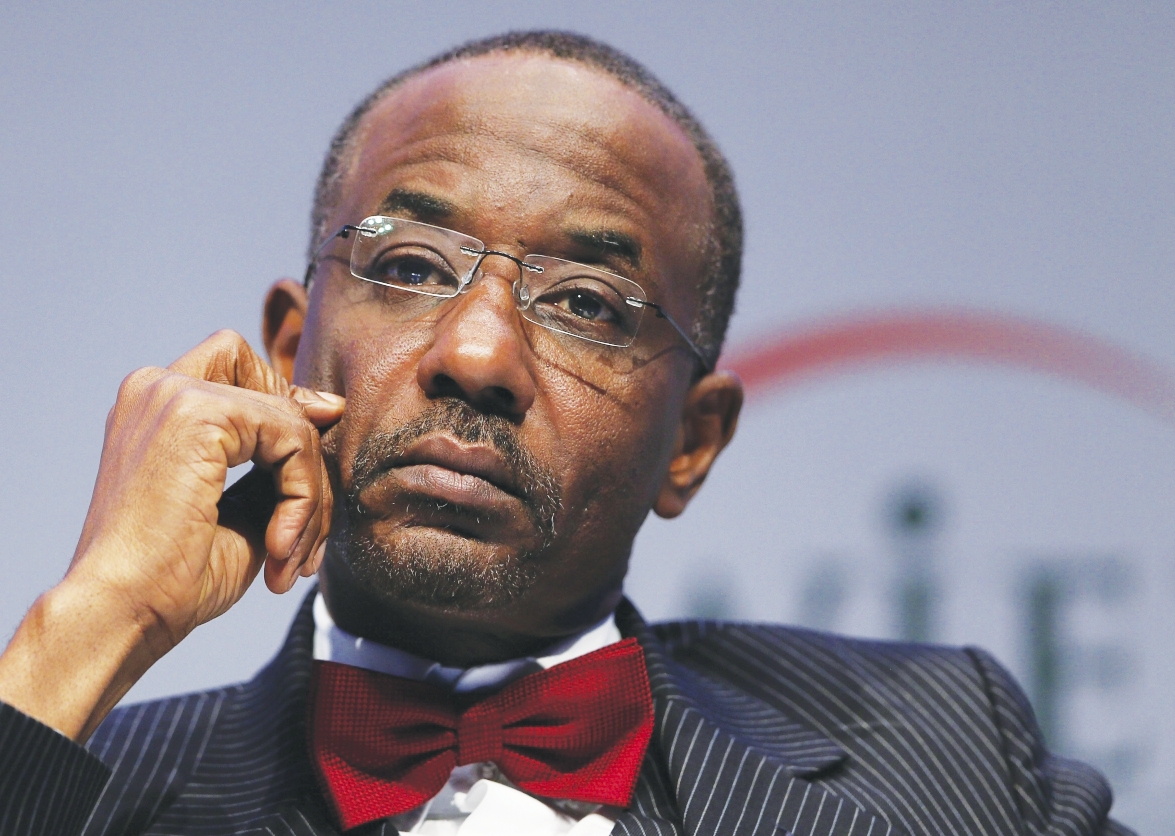
President Goodluck Jonathan’s government claimed in February that it had merely suspended the governor of the Central Bank of Nigeria, Sanusi Lamido Sanusi, and yet the government went ahead in appointing a replacement for him. Since then two high courts in Lagos have ruled in Sanusi’s favour against harassment by the security services, and investigation by the Financial Reporting Council of Nigeria. But, as Peter Ezeh reports, Sanusi’s woes will just not go away.
In the 55-year history of the Central Bank of Nigerian (CBN), Lamido Sanusi, its governor whom President Goodluck Jonathan’s government placed on suspension in February, recorded a number of firsts, two of which will not be forgotten easily. He was the first governor of the CBN to voice concerns on public accountability. Second, for his pains in this regard, Sanusi had the unsavoury experience of being the first holder of that office ever to be suspended.
When the government removed him in late February, it denied that the removal had anything to do with Sanusi’s queries on the handling of billions of dollars of public funds. The government also termed Sanusi’s lot “suspension”, technically meaning that he was not being sacked before the end of his tenure, but by late March it became clear that the play with words was as good as saying six or half a dozen.
The government had named Godwin Emefiele (right) managing director of one of Nigeria’s major commercial banks, to succeed Sanusi and the Senate had approved the appointment.
Those developments seemed to bear out the speculations that Sanusi would not be called back when his five-year tenure that began in 2009 ends in June this year. A Lagos-based newspaper described it as a “long walk to the exit door”. The government’s action is, as it were, sacking the premier banker without sacking him. The country’s laws protect him from an outright sacking until his tenure formally ends on 3 June 2014.
The Department of State Services (DSS), more or less Nigeria’s equivalent of Britain’s MI5, promptly seized his passport. The banker sued to ask the court to restrain the security agents from harassing him. The DSS told the court that they were simply investigating the banker for alleged funding of terrorists. Sanusi denied the accusation.
The court found for him in early April, ordering the security personnel to return his passport. Justice Ibrahim Buba, sitting in the Federal High Court, ruled that Sanusi acted correctly when he brought the suit on the violation of his fundamental rights as a citizen.
Besides ordering that his passport should be returned, the judge also awarded Sanusi N50m (about US$312,500) in damages, to be paid by the federal government. He also ordered the security agents not to infringe on Sanusi’s fundamental human rights in any other form.
Two days afterwards, a different court also made an order in favour of the suspended governor, who had filed another suit to challenge the powers of the Financial Reporting Council of Nigeria (FRCN) to investigate him. After refusing to appear before the council for a new investigation, Sanusi said that he suspected bad faith and could only appear before an impartial authority.
The second Lagos high court issued an order protecting Sanusi from being investigated by the council until the main suit before it had been determined.
But the rulings of the courts did not touch on the suspension of the banker as such. In the first suit, Sanusi only sued in protection of his fundamental human rights based on events that occurred after he was suspended.
He was attending a meeting in the neighbouring Niger Republic when the suspension was announced, and when he returned to Nigeria, security operatives briefly detained him at the airport but released him the same day after seizing his passport. He then brought the suit asking the court to restrain the police or the DSS from arresting, detaining, or otherwise harassing him.
Before the legal interventions, the government had said that the reason it suspended Sanusi was because he had not followed due process in handling some of the CBN’s affairs.
Allegations upon allegations
The government said it only acted in the public interest in suspending Sanusi because the FRCN, that scrutinises financial transactions involving public funds, found that Sanusi, as CBN governor, carried on without regard to the rules relating to official expenditure.
Part of the report on which the government based its decision to suspend Sanusi said: “It is inexcusable and patently unlawful for any agency of government to deploy huge sums of money as the CBN has done in this case, [inappropriately…]and outside the CBN’s statutory mandate.”
Some of the areas where Sanusi was alleged to have overshot his mandate include the alleged purchase of shares for the CBN in a Malaysian Islamic bank, unsatisfactory claims for the cost of printing the local Naira currency notes, unconscionable amounts spent on buying newspapers, security and public relations.
In one particular instance, Sanusi was said to have donated N100m (about US$625,000) for the establishment of an Islamic bank in Nigeria.
He denies all the allegations and argues that he could only have been suspended in bad faith, since the action came in the wake of the queries that he raised about the manner in which the finances of the Nigerian National Petroleum Corporation (NNPC) – the country’s economic cash cow that contributes 95% of its foreign earnings, and 80% of government funds – had been handled. Sanusi said that the money he donated had been authorised under the activities of the central bank.
His complaints about the handling of the NNPC’s account came in two phases, both in 2013. First, in the last quarter of last year, he declared that the NNPC had not lodged nearly $50m of public funds that it was supposed to deposit with the central bank. At a meeting among agencies of the government to investigate the matter, Sanusi could not support his figures.
Soon afterwards, he bounced back saying that the missing money was around $20m. Public opinion, which was initially undivided in making him an instant pro-accountability hero, immediately split. Some saw the inconsistency as a sign of a lack of seriousness or bias.
Many accused him of being in sympathy with the opposition and therefore using the apparent anti-corruption stance to embarrass the ruling People’s Democratic Party (PDP) of President Goodluck Jonathan in the run-up to the general election due early next year.
One of the foremost businessmen in Nigeria, Chief Ovedje Ogboru, told journalists in Lagos that he saw Sanusi as a politician, and not a banker. “You cannot combine politics and activism with banking and expect things to be alright,” Ogboru argued.
But an accountant, Chidi Obasi, said that despite the inconsistency in the figures that Sanusi cited, the important thing was that some amount in the public fund was unaccounted for. “It doesn’t really matter if it is one dollar or one trillion dollars. What matters is that some money that belongs to the public has not been accounted for,” Obasis said.
An economist and writer, Dr Dele Sobowale, blamed the government for playing into critics’ hands by the timing of the action it took against Sanusi. “Even if Sanusi is guilty as charged,” he wrote in his column, “the timing of the president’s response has given ample room for those who now accuse him [the president] of an action which is regarded as illegal, malicious, ethnic, political, and personal.”
Sanusi denied being spurred by political interest. “I have no links with the opposition party,” he said. “I don’t have a membership card of any political party. I do not attend any party meeting.”
However, his troubles just will not go away. Instead more seems to be in the pipeline. The DSS has said it will appeal the ruling that the Court gave in favour of Sanusi’s fundamental rights. Among the first public statements by his successor, Emefiele, was that he too would investigate the man’s time in office.








