A two-day high-level debate on the various issues of the commodities markets took place in April at the Palais des Nations in Geneva, under the aegis of the UNCTAD Global Commodities Forum. Stephen Williams report.
Opening the fifth edition of the UNCTAD Global Commodities Forum, UNCTAD’s Secretary-General, Dr Mukhisa Kituyi, commented that his organisation’s objective had always been to “identify solutions that transform the commodity sector from a poverty trap to an engine of growth”.
To this end, the UNCTAD Forum determined that this year’s themes (in the year that UNCTAD celebrates its 50th anniversary), would be “Global value chains, transparency and commodity-based development”.
These themes incorporate two interlinked concepts that are highly topical in current trade and development discourse: global value chains and transparency.
The Forum’s participants listened to more than two dozen speakers over the two days of proceedings – far too many and too complex to summarise in detail here, but there were a number of stand-out presentations.
One such presentation was a paper prepared by Samuel K. Gayi, Head of UNCTAD’s Special Unit on Commodities. The Forum placed a great deal of emphasis on how good governance and transparency are a prerequisite for commodity- dependent developing countries (CDDCs) if those countries are to truly benefit from their own resources.
Gayi is of the view that the much-applauded Extractive Industries Transparency Initiative (EITI), considered a primary component of the commodities governance movement, is perhaps not meeting its full potential.
Despite Peter Eigen, the founding chair of EITI – as well as the founder of Transparency International and a member of the Africa Progress Panel – having been invited to deliver one of two keynote speeches (the other was given by Stefano Ponte, of the Copenhagen Business School), Gayi was gently critical of EITI’s performance.
“So far, the scope of [EITI’s] monitoring is limited to the extractive function,” Gayi writes, “meaning that its principles are not necessarily enforced throughout the rest of the value chain, and that its work remains isolated from end users, whose consumption choices can have an important economic and political impact on the success or failure of market-based governance initiatives.”
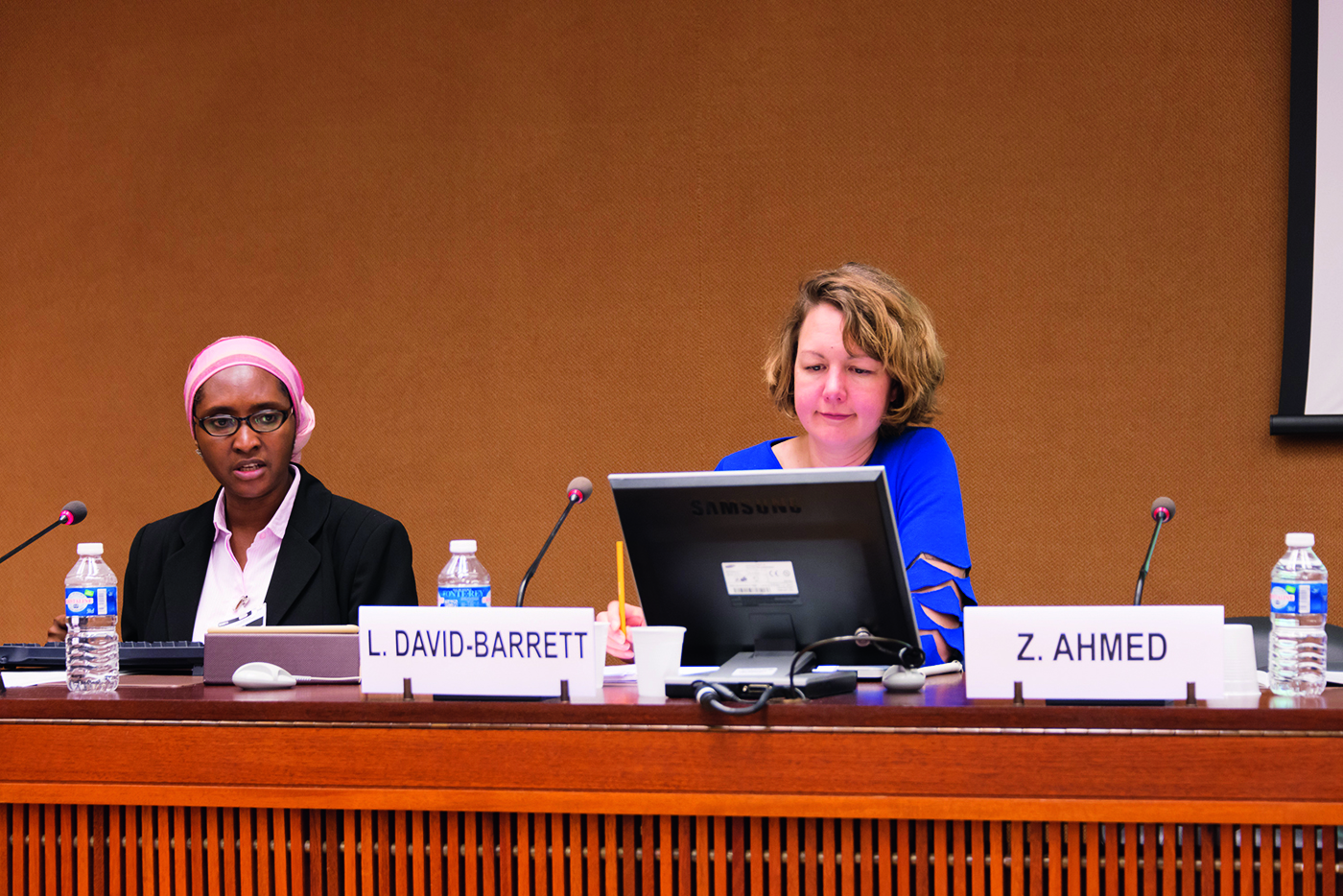
Nevertheless, EITI’s principles were examined in detail during the Forum, drawing on the work of Liz David-Barrett, a Research Fellow at Said Business School, Oxford University, UK who discussed EITI’s role as a tool for reducing corruption; and Ms Marie Gay Alessandra Ordenes, the national coordinator of the Philippines Extractive Industries Transparency Initiative; and Ms Zainab Ahmed, the executive secretary of Nigeria’s Extractive Industry Transparency Initiative.
David-Barrett asked the critical question of whether the implementation of EITI improves accountability and curbs corruption?
Answering her own question, David-Barrett gave both sides of the argument: “yes”, because it builds expertise among intermediaries, improving their ability to access and evaluate data; it institutionalises dialogue with civil society; its methodology has spill-over effects in other policy areas; and it prompts donor support for accountability initiatives.
But, David-Barrett cautioned, the answer could be “no” as the EITI process tends to reduce corruption in countries with a more active civil society, and political and media freedoms; but has little leverage over highly corrupt, highly resourced countries such as where oil rents are high.
This was the perfect cue for Mrs Zainab Ahmed, the executive secretary of Nigeria’s Extractive Industry Transparency Initiative (NEITI), to deliver her presentation a few minutes later.
It is not generally acknowledged that Nigeria is something of an EITI pioneer, in that it was the first country to back the EITI process with an enabling law, and has become a reference point in advocacy, public agitation and demand for transparency.
The NEITI can point to the success of three major industry audits that it has conducted: the 2009-2011 Oil & Gas audit; the 2007-2011 Solid Minerals audit; and the 2007-2011 fiscal allocation and statutory disbursement audit.
These audits stimulated NEITI’s robust engagement with Nigeria’s civil society, parliament, government, companies, the media, activists as well as the general public.
Given that just six weeks before the UNCTAD Commodities Forum, the shock news broke that Mallam Lamido Sanusi had been suspended as the governor of the Central Bank of Nigeria (CBN) – shortly after Sanusi announced that there appeared to be a multi-billion shortfall in the coffers of the Nigerian National Petroleum Corporation (NNPC) – it seemed a perfect opportunity to ask Mrs Ahmed about the issues Sanusi had raised.
She explained to New African that, as NEITI had yet to audit the period that Sanusi had referred to in his accusation that some $20bn was missing (and presumably corruptly diverted) she could not really comment on the former CBN governor’s allegations.
But she did say that she had read Sanusi’s original document, outlining the missing revenues, and that he had made frequent references to the work of NEITI.
Ahmed had earlier talked about an increasing demand for transparency and accountability by the Nigerian general public and had listed a number of measures to achieve this – measures that were high on NEITI’s agenda.
These included the elimination of opaque transactions in the awards of oil production licences and their financing mechanisms; the inappropriate disclosures of oil and gas production figures and revenues; as well as corruption and unethical practices in the sector. General poor governance of the sector, she claimed, risked socio-economic crises in Nigeria.
These measures can be best executed, Samuel Gayi suggests, “if it is accepted that the governance of domestic actors in CDDCs will spring from each country’s legislation, and from multilateral initiatives related to equitable, transparent governance of resource wealth”.
But, as we all know, the commodity’s value chain is determined, to a large extent, by global market forces that producing countries have little influence over.
“The eventual commodities governance architecture that emerges will comprise, on the one hand, the various pieces of legislation in Northern economies that shape the behaviour of the transnational corporations (TNC) operating in CDDCs,” Gayi believes.
He goes on to state: “The ubiquity of capital and credit markets means that the sections in the USA’s Dodd-Frank Act related to extractive payments and the commodity trading activities of financial institutions, and their equivalents in the EU’s new disclosure requirements, will impact the activities of foreign companies as well.
“As a result, other Northern countries with important extractive activities overseas have already begun conforming to the US and EU rules, countries such as Norway, Switzerland, Canada and the UK.”
And these points lead us neatly on to a fascinating presentation made at the Forum concerning the shift in the financial landscape concerning the trade in commodities.
The presentation, by Eric Schreiber, who is described as a professional investor and commodity-trading expert, describes the impact of banking sector reforms on the commodity trading sector, and how those changes might affect the prospects for transparency-themed governance reform.
Schreiber makes the point that before the new millennium, most banks were not active in commodity trading (the exceptions were Goldman Sachs, Salomon Brothers and Morgan Stanley).
But from 1999 onwards, with the abolition of the 1933 Glass-Steagall Act in the US, there was a large-scale entry by banks into commodity trading, with two large investment inflows – between 2003 and 2005 and again, after the financial crisis, between 2009 and 2010.
There was an especially rapid growth in commodity derivatives. Schreiber told the Forum that these derivatives exceeded physical production by 20 to 30 times.
Just to illustrate that last point, Schreiber said that even now, the monetary value of financially traded gold contracts each day still exceeds the amount that is physically mined in a year!
The financial sector controlled 70% of the “open” interest in some commodity futures, such as the Chicago Board of Trade wheat trade between 2006 and 2012.
“Price swings in commodity markets became increasingly correlated to financial markets,” Schreiber points out, adding: “Financial investors increased and reduced their exposure to various commodities due to price rises and falls of previously unrelated equity and fixed interest markets.”
This led to a growing belief that it was the banks that were responsible for increases in food and energy prices, leading to food insecurity and social unrest.
But, following the financial crisis and the regulatory response to the banking meltdown, regulators moved to increase reporting requirements for all investment asset classes, including commodities, and pushed for increased transparency by moving “over the counter” trades onto exchanges and into clearing houses. There was also a move to increase capital requirements.
The result was the introduction of Basel III, to be implemented in stages until 2019; the Dodd-Frank Act in the US; and in the EU the Markets in Financial Instruments Directive, otherwise known as MiFID II, as well as the European Market Infrastructure Regulation.
The new, tougher regulatory environment placed great pressure on the banks to exit commodity markets. As eroding margins, decreasing market volatility, reduced customer flows, rising complexity and compliance costs, and increased capital requirements all impacted the banks’ bottom line, the annual revenues of the top 10 banks commodity operations slumped from a peak of $14bn in 2008 to just $4.5bn in 2013.
UBS and Royal Bank of Scotland fully exited commodity trading in 2009 and 2010 respectively. Deutsche Bank scaled back on commodity trading quite significantly; while Morgan Stanley sold its physical oil-trading business to Rosneft late last year.
As the banks left the commodity trading space, major oil companies and the world’s biggest trading houses entered. They found this attractive as non-bank entities are subject to lower capital requirements.
As Schreiber commented, many trading companies are privately owned and do not disclose financial results. And competitive advantages will accrue to these secretive trading houses as physical traders are able to glean non-public market intelligence derived from operating across the continuum of the commodity supply chain.
Bearing in mind Schreiber’s analysis of the commodity trading landscape, the challenge of achieving an equitable, transparent – but most importantly, accountable – governance architecture for the commodities value chain may, in fact, be a lot tougher than many might have imagined.