Once described by the US as a “Corridor of Terrorism” and home to the feared al-Qaeda in the Islamic Maghreb (AQIM), the African Sahel is increasingly becoming synonymous with extreme terrorism. But what is really going on? Professor Jeremy Keenan, a noted author and expert on the Sahara, takes a deeper look and points out some answers.
In January 2013, New African published an article by this writer entitled: “Mali Is Not Another African War”. Its penultimate paragraph read: “Unless something fairly miraculous can be achieved by the turn of the year, northern Mali looks like becoming the site for the start of a region-wide conflagration.”
Nothing miraculous was achieved. Rather, with what hindsight shows us to have been rather prescient judgment by New African’s editors, French land and air forces were launched into Mali days later for the start of Operation Serval, another geopolitically controversial military intervention of recent times.
Its purpose was to liberate Mali, a former French colony, from Islamist insurgents, who during 2012 had taken over all of northern Mali, a region known by the local Tuareg population as Azawad.
By early January 2013 they stood poised to advance on Mali’s meagre southern defences and even the capital, Bamako. The French force, which has most certainly had an impact on the Islamists, although possibly not what was envisaged at the outset, built up during the course of 2013 to some 4,000 troops.
Ronald Rumsfeld’s fabricated “corridor of terrorism” has become a self-fulfilling prophecy
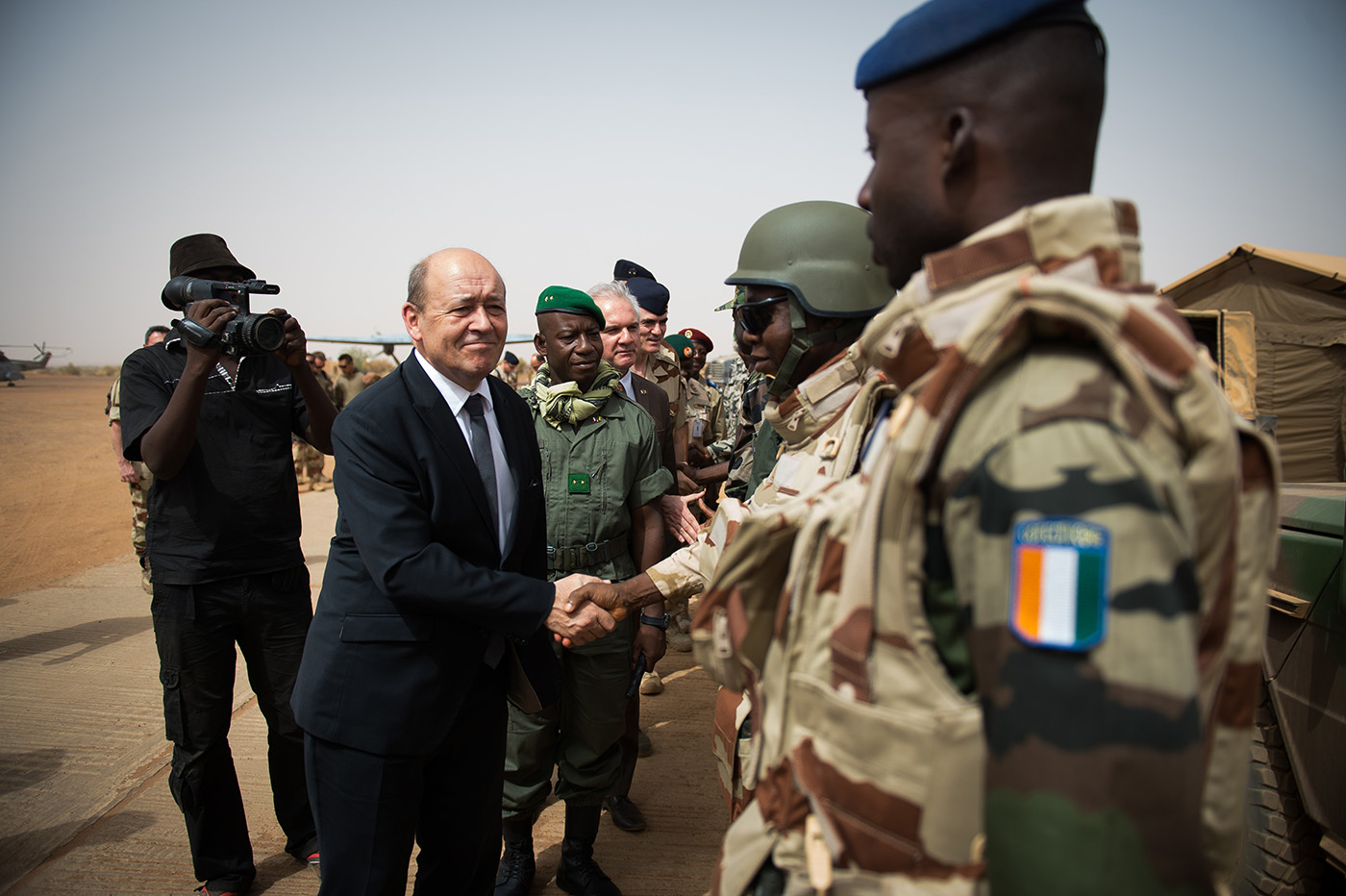
In addition, France’s assault force was assisted by a contingent of crack Chadian troops. France’s defence minister, Jean-Yves Le Drian, announced in May this year that France was to fight militant Islamists across the vast Sahel region, or what he referred to as the “Sahara-Sahel strip”.
French troops will be based in Mali, Niger, Chad and Burkina Faso, with more covert basing facilities available in Mauritania. In addition to its three major military bases at Gao (Mali), Niamey (Niger) and N’Djamena (Chad), as well as the use of Ouagadougou (Burkina Faso) if required, France is establishing a number of smaller bases, such as Tessalit, close to the Algerian border in northern Mali, Agades and Diffa in Niger, and Faya (Largeau) and Zouar in northern Chad, to be able to launch strikes across the entire Sahel – from Mauritania’s Atlantic coast to Sudan.
Le Drian described the Sahara-Sahel as “the danger zone, the zone of all types of smuggling [… and] key to the security of African states. But it is also for our own security […] France is therefore reorganising its forces to pursue counter-terrorism across several states.”
France’s new mission is reminiscent of President George W. Bush’s 2004 Pan-Sahel Initiative (PSI), which marked the launch of Washington’s Sahara-Sahelian or “second” front in its global war on terror (GWOT).
However, there are significant differences between Bush’s PSI and France’s new mission. First, Bush’s “invasion of Africa”, as locals called it, involved only some 1,000 operatives, roughly half US Marines and half US “contractors”.
The French operation is four times bigger. Second, whereas the PSI consisted mostly of “disinformation” and propaganda, being based on and legitimised by the notorious false-flag terrorism operation, with the knowledge of the US Pentagon, and the kidnapping of 32 European tourists in the Algerian Sahara, the French mission is based on “real terrorism”.
It marks the start of the region-wide conflagration that would be the outcome of Washington’s attempts to destabilise the Sahel.
When Donald Rumsfeld, the US’s extreme “neocon” Secretary of Defense, set out in 2002-3 to project the Sahara-Sahel as what his office called a “Corridor of Terrorism”, it was, in fact, one of the safest places in the world.
Today, it is one of the most dangerous, as Boko Haram’s recent kidnapping of more than 270 schoolgirls in north-east Nigeria has made self-evident. How has this grotesque transformation come about, and where is it going?
The simple answer to the first part of this question is that the French drive across northern Mali, and finally into the militant stronghold of the Ametetai Valley in the Tigharghar mountains of the Adrar-n-Iforas massif in the extreme north of Mali, killed, according to French military information, at least 600 “jihadists”, possibly more. However, as there were well over twice, possibly three times, that number to start with, what happened to the rest?
This is where intelligence information gets increasingly sketchy. It is clear that some have burrowed deep into hideouts in the mountainous, desert terrain, and are still being hunted down, while others have shaved off their beards and melted back into the local communities.
Le Drian is currently talking of the possibility of militants regrouping in northern Mali, suggesting Operation Serval has not been quite the military success that was originally anticipated.
France originally thought that Operation Serval would only last a few months and that French troop levels in Mali would soon reduce to a core of 1,000 men. That was over 16 months ago. It is also clear that many of the “jihadists” who were not killed by the Franco-Chadian assault in northern Mali scattered across much of the Sahara-Sahel. The majority headed eastwards, through Niger to the safe-haven of Libya from where they threaten most surrounding countries.
The result of Operation Serval, although heralded a success in some quarters, is that northern Mali is still not secure, while France is having to reorganise its forces to “pursue counter-terrorism” across several countries.
Few are likely to disagree with Le Drian when he said, “it is absolutely necessary to solve the problems and the dangers of trafficking and terrorism across the region,” but it is imperative for Paris to clarify the status, anticipated duration and method of this new mission. It is not enough for Le Drian to say: “Our role is to continue [fighting] against terrorism in northern Mali, northern Niger and Chad.” He has to define that “role”.
Although mandated to intervene in Mali, France has no mandate or formal authority, other than questionable military and security agreements with the Sahelian countries concerned. Thus, at the moment, the status of the operation, described by Le Drian as “regionalisation”, seem to be based solely on a number of opaque agreements with the individual countries concerned.
Although clearly getting the “green light” from Washington, France has no UN mandate for its new mission, nor have any regional organisations, such as the AU or ECOWAS, requested that France intervene.
More disconcerting was Le Drian’s statement: “We will stay as long as necessary. There is no fixed date.” Nor has France said anything about the methods of intervention and “counter-terrorism” that it will adopt.
There are inevitably suspicions about France’s intentions in the region. In Mali, President Ibrahim Boubakar Keita has not even visited the troubled north of the country. A pertinent question being asked by people in northern Mali is why the French military gave Iyad ag Ghali, the leader of the Islamists’ assault on southern Mali, effective free passage out of the region?
The question refers specifically to why French fighter-bombers did not strafe or otherwise block his retreating column as it fled eastwards along the main road to Gao and over the Niger River bridge, crossing to comparative safety.
This seemingly extraordinary benevolence by the French air force provided Iyad with the means to escape the French assault and to regroup his followers under the protection that a “foreign power” is now affording him.
Indeed, until the French military provides a satisfactory explanation as to why it let this hard core of Islamist fighters escape its grasp, questions about France’s longer-term intentions in the Sahara-Sahel will inevitably remain.
French motives in the Sahel
There are at least four reasons for France’s military expansion across the Sahel. Firstly, jihadists have not been entirely flushed out of northern Mali. In spite of Operation Serval, the presence of a UN peacekeeping force and the EU’s training of the Malian army, these “terrorist elements” not only still have a presence in the region, but may even be regrouping.
The result is that northern Mali, especially the Kidal region, is far from secure, requiring the continued presence of a substantial French force.
Le Drian has said that 1,000 French troops will remain in the region. In addition to the ongoing “Islamist”, “jihadist” or “terrorist” presence in northern Mali, serious fighting broke out again on 17 May in Kidal between Tuareg MNLA rebels and the Malian army during the visit of Prime Minister Moussa Mara to the beleaguered city.
Fighting between Tuareg rebels and Mali’s army recommenced when soldiers fired on civilians protesting the arrival of Mali’s Prime Minister Moussa Mara at Kidal airport. Some 36 people were killed as Tuareg rebels drove the army from town and took over all government buildings. Mara said: “The terrorists have declared war on Mali, so Mali is at war against these terrorists.”
On 21 May, the government mobilized 1,500 troops and launched an assault on Kidal. Within hours, the ill-trained Malian forces were in flight. By nightfall, Tuareg had taken control of almost all towns in Northern Mali other than Gao and Timbuktu.
With Mali’s government and army humiliated, UN Secretary-General Ban Ki-moon ordered a cease-fire while France announced a postponement of its eastwards deployment of troops across the Sahel. In the meantime, Washington said 80 US troops had been sent to Chad to help search for the Nigerian schoolgirls seized by Boko Haram.
Secondly, drug trafficking (mostly cocaine from South America) is once again flourishing. It is questionable whether it was more than even marginally disrupted by the Malian “crisis” of 2012. The net result is that drug trafficking, mostly through Gao and then eastwards through Niger and Libya, has again become a threat.
Thirdly, there are major and credible “terrorist” threats to destabilise Chad. These stem mostly from intelligence “chatter” that Mokhtar ben Mokhtar (MBM), the leader of the al-Mourabitoun “jihadist” organisation that emerged at the end of 2012 from a merger between the Movement for Oneness and Jihad in West Africa (MUJAO) and MBM’s own Masked Men Brigade, may be planning to open up “terrorist” operations in Chad.
There are at least four reasons for france’s military expansion across the Sahel
The fourth reason is the expanding threat posed by Nigeria’s Boko Haram to several other countries in the region, notably Niger, Cameroon and Chad. Boko Haram’s atrocities have been getting progressively worse since May 2013, when Nigeria’s President Goodluck Jonathan finally lost patience with Boko Haram, declared a state of emergency in the country’s three north-east provinces of Adamawa, Borno and Yobe and let the army off the leash, ordering it to crush the movement.
That has not happened. With each passing massacre, Boko Haram has shown up Nigeria’s ill-equipped and ill-trained army as not fit for purpose. Niger, northern Cameroon and parts of western Chad all face the increasing threat of instability and “terrorism” from the influx of both refugees and Boko Haram militants from northeast Nigeria.
In Niger’s eastern Diffa region, there were a number of border incidents and skirmishes in early May between Nigerien forces and suspected Boko Haram insurgents, with at least a dozen suspected Boko Haram members being arrested. So far, Niger’s policy has been to try and stop Boko Haram crossing into Niger rather than openly confronting them. According to UN sources, some 50,000 Nigerians have now sought refuge in Niger.
France’s militarisation of the Sahel looks as if it might herald the start, if it has not begun already, of the region-wide conflagration that it has long been predicted would overwhelm the Sahel. It could be ignited further at either end of the “strip” by the recommencement of fighting in the Kidal region between Tuareg rebels and the Mali army or by actions by or against Boko Haram further east.
There is insufficient space here to explain how this vast tract of Africa has descended into this catastrophic state of affairs. Nevertheless, a few determinant factors can be highlighted such as the kidnapping of 32 European tourists in 2003, to justify the launch of the GWOT in Africa. This has led to the destruction of thousands of local livelihoods.
Donald Rumsfeld’s fabricated “corridor of terrorism” has become a self-fulfilling prophecy, as more terrorist groups, notably AQIM, have implanted themselves more firmly in the Sahel.
Their “terrorist” activities, mostly hostage-taking for ransom and drug trafficking, were undertaken with the collusion and “protection” of high-placed elements in Mali. These activities exacerbated local political tensions and became increasingly entwined with local Tuareg unrest and rebellions in Mali.
The NATO-assisted overthrow of the Muammar Al-Gathafi regime in Libya in 2011 had dramatically damaging consequences for the Sahel, especially Mali, which were not foreseen by NATO.
In addition to thousands of long-term migrant workers and mercenaries in Gathafi’s army having to return to the Sahel, the region has become flooded with arms looted from Gathafi’s many arsenals leading, to a potentially unpredictable and dangerous situation.
*Professor Keenan, a noted author and expert on the Sahara, is a Professorial Research Associate at the School of Oriental and African Studies at the University of London.