
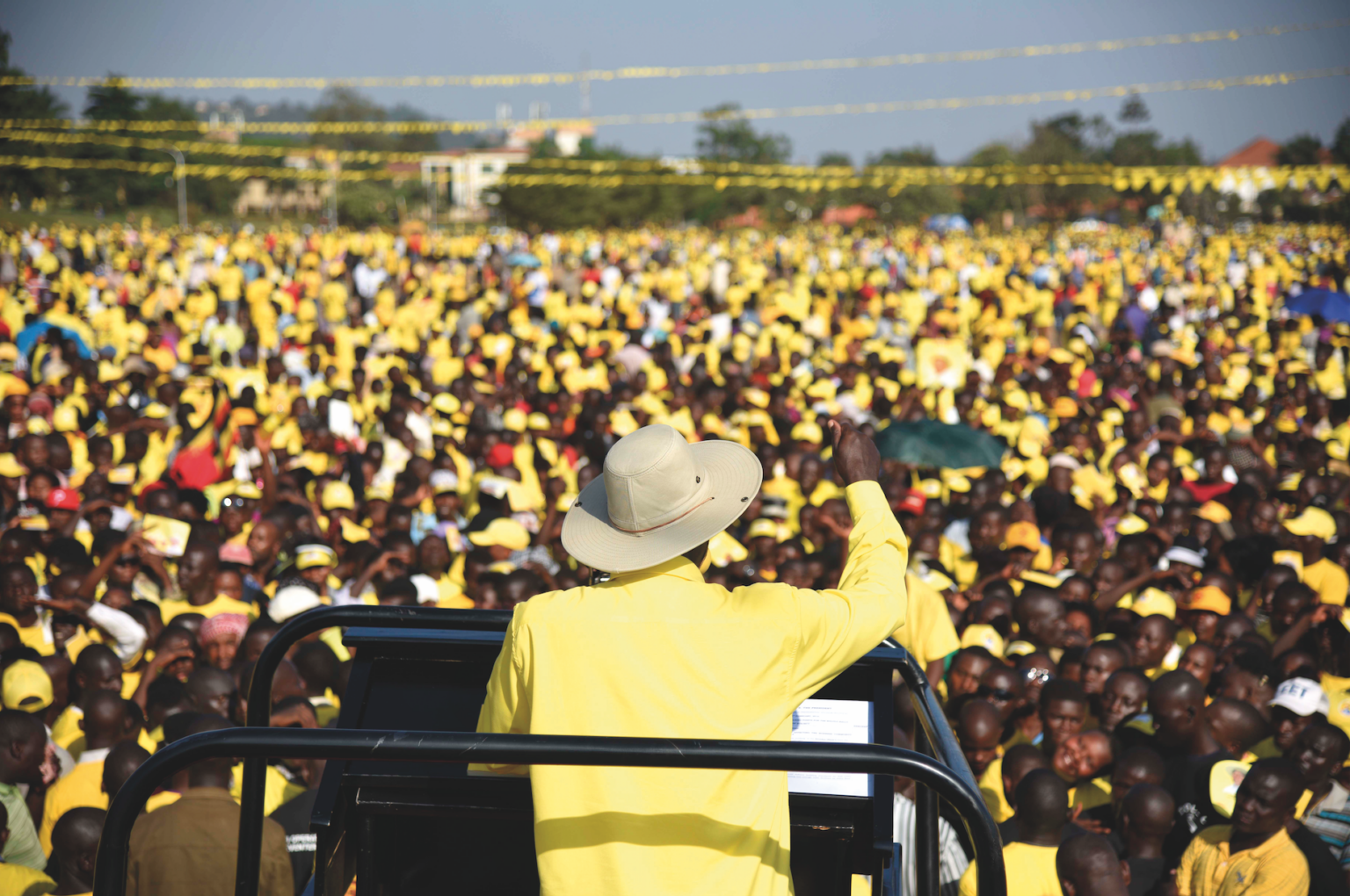
Uganda’s President Yoweri Museveni who has been in power for 31 years appears to be working on yet another constitutional amendment that will allow to continue to rule even after crossing the age threshold. Epajjar Ojulu analysis looks at how Museveni has managed to remain in power for so long.
When the current term of his presidency ends in 2021, President Yoweri Museveni will have hit the 75-year old mark and won’t be eligible to stand again under the constitution. But Museveni and his supporters have proved themselves past masters in the art of manipulating the constitution to provide him with yet another lease of life as head of state.
A parliamentary motion prepared by one of the MPs supporting him is seeking an amendment to the article in the constitution that bars anyone aged 75 years and above from contesting the presidency.
Opposition MPs were so enraged by this motion that they attempted to block it from being tabled, by heckling and causing mayhem in the House. They ignored Speaker Rebecca Kadaga’s order suspending them from the House for disturbing seating and for misbehaving. Kadaga ordered Special Forces to storm the legislature to bundle out the suspended MPs.
Fist-fighting broke out with defiant MPs using every item, including chairs, to hit back at the “invaders”. The MPs were eventually overpowered and severely beaten up, sustaining serious injuries, including broken arms.
While some opposition MPs were nursing their wounds, the ruling NRM party MPs were in the House deliberating on the proposed amendment of the constitution, which is widely expected to be passed in the coming months.
Museveni’s long tenure, making him among the top five longest-serving African presidents, is in sharp contrast to the rapid turnaround of national heads of state the country experienced during its often bloody first two and a half decades.
Uganda became independent from British rule in 1963 with Milton Obote as the prime minister and Kabaka Edward Muteesa II as president. The country’s slide to eventual anarchy was set into motion when Obote changed the 1962 constitution to declare himself president after storming King Muteesa’s palace in 1966.
Obote’s hopes for keeping hold of power were, however, cut short in 1971 when he was toppled by the British-backed army commander, Gen. Idi Amin, who declared himself Life President. Amin unleashed an orgy of brutality and ruthlessness. He murdered prominent leaders, including the archbishop of the Church of Uganda, Janaan Luwum, and Chief Justice Benedicto Kiwanuka, for criticising his regime’s brutality.
Amin himself was removed from power in 1979 by a combined force of Ugandans in exile and the Tanzanian army. Amin had attacked and annexed part of Tanzania in retaliation to President Julius Nyerere’s sheltering of the overthrown Obote and other Ugandans opposed to his regime.
Amin’s incumbency was succeeded by a series of short-lived reigns – those of Yusuf Lule, Godfrey Binaisa and Paulo Muwanga, before the controversial 1980 general elections returned Obote to power. The Democratic Party (DP), the main challenger of Obote’s Uganda Peoples’ Congress (UPC), became the opposition in parliament, while Museveni’s Uganda Patriotic Front (UPF) performed dismally in the elections, winning only one parliamentary seat. Museveni lost in his constituency and his political career seemed to have ended.
Riding on Obote’s unpopularity in the central Buganda region, the bastion of DP support, for dethroning their Kabaka, Museveni waged an armed rebellion against the Obote regime, which he accused of stealing the DP’s victory.
The rebellion was heading towards failure until Obote’s regime developed a big crack and fell apart after his army commander, Gen. Tito Okello, toppled him in 1985. Gen Tito sought dialogue with Museveni to stop the fighting. During the 1985 Nairobi Peace talks sponsored by Kenyan leader Daniel arap Moi, Gen. Okello agreed to share power with Museveni during an interim administration. But Museveni rejected the agreement and continued to fight, eventually toppling Okello in January
1986.
Speaking in 1986 after the official swearing in, Museveni promised Ugandans a “fundamental change” that would stop future leaders from clinging onto power and also usher in a period of badly-needed stability.
Countrywide elections were held for a new interim parliament. He also named a constitutional commission to give the country a fresh beginning. The constitutional commission recommended that elections be held countrywide for delegates to deliberate on the new constitution which was passed and promulgated in 1995.
Among the key components of the new constitution was the proviso that the president would serve a maximum of two five-year terms and be below 75 years of age.
At the time the new constitution was promulgated, Museveni had been in power for 10 years. Nevertheless, the new constitution allowed him to serve two more five-year terms.
Surviving against the odds
However, after his second five- year term, which ended in 2011, Museveni and his NRM party engineered an amendment of the constitution to remove the two-term limit and allow him stay in power.
His supporters argued that as long as there were free and fair elections, there was no need to keep to the two-term limit. The opposition and civil society activists, on the other hand, argued that it would be impossible to remove the president from power through the ballot box because he has the capacity to manipulate state institutions such as parliament, the judiciary, the army, the police and the civil service to his advantage.
Nevertheless, Museveni had broken the chain of violent changes of leadership that characterised Ugandan politics and the period of political stability had allowed the country’s economy to recover.
He had also put an end to the brutality that was the hallmark of the Amin and Obote regimes; and has enjoyed considerable popular support.
How has Museveni managed to survive as a leader for so long when his predecessors failed so abjectly? There is no doubt that over his 31 years in power, Museveni’s influence and dominance can be felt in every aspect of life in Uganda. He has created over 120 new districts, each with a woman representative in parliament.
His regime, through affirmative action, has seen women take on key positions in government and the civil service. He has strong support among women members of parliament. He has also patronised young people, urging them to challenge older people opposed to him to win parliamentary seats, a strategy which has enabled him to swell the number of his supporters in parliament and to have his way in the legislature.
He invited the exiled Ronald Edward Frederick Kimera Muwenda Mutebi II, the son of Kabaka Edward Muteesa II, to return to the country and take up his customary position and duties, thus earning enormous goodwill from the Baganda people.
Museveni has often carried sackfuls of money while on tour in rural areas, where he has handed out cash to women’s groups and individuals. He also contributes money for funerals and other social functions. He is loved by rural folk for his philanthropy.
Apart from the material world, Museveni has also invested in the spiritual arena. About 80% of Ugandans are Christians and the president, who has admitted to not being “very Christian” has made inroads into churches.
Every time a new bishop is consecrated in the Catholic or Anglican Church, he donates a prestige vehicle. He has massive support in the Pentecostal churches, which have mushroomed in the country and whose pastors purport to perform miracles. He often attends night prayers in Kampala’s Miracle Centre Cathedral led by renowned pastor, Robert Kayanja, who showers him with accolades for having “restored peace and freedom of worship” to the country.
He controls the army and has purged the old guard to pave the way for younger generals with unflinching loyalty to him. Generals of his generation, such as Gen. David Sejusa, who have attempted to challenge his grip on power, have long been dismissed.
Recently he appointed a young general, David Muhoozi, the sixth army commander since he came to power, to replace Gen. Katumba Wamala, who was appointed a junior minister.
Election results doctored?
The opposition has accused the Electoral Commission of being partisan and turning a blind eye or being complicit in the doctoring of poll results in favour of Museveni.
In the last election, in 2016, opposition leader Dr Besigye stormed a house in Naguru, a city suburb, which he claimed was a centre run by Museveni’s inner clique, where election results wired from all over the country were altered before being forwarded to the Electoral Commission for declaration. Besigye was bundled out of the premises by special forces guarding it and neither the Electoral Commission nor Museveni’s camp have explained what was being done in that house.
Museveni claims he is popular and challenges his opponents to go to court. But his opponents accuse courts too of being partisan and for ignoring glaring cases of election malpractices orchestrated by Museveni and his NRM.
The opposition has also accused the police, headed by an army general, Kale Kayihura, of working for Museveni and of harassing and intimidating them. In the last election of 2011, for example, Museveni’s main challenger, Dr Kizza Besigye, was arrested and detained eight times during campaigns.
Before the last election, a law was passed by parliament to allow the president access to 10% of money in the Consolidated Fund held by Bank of Uganda without the approval of parliament. As there are other budgets for the presidency and State House, overall the president has access to an estimated 30% of the national budget.
Those who had drafted and passed the new constitution in 1995 kept in mind that a sitting head of state is too influential and dominant to be defeated in an election. It is for that reason that term and age limits were introduced.
Museveni’s decision to cling to power has not surprised many Ugandans because he has declared that he is the only one with a vision for Uganda and has never alluded to the possibility of leaving power. He says he is “a revolutionary” and as the former Libyan dictator Muammar Gaddafi once told him, revolutionaries never leave power, they die in it. For Ugandans, though, the fear is that the history of violent handovers of power may repeat itself. NA








