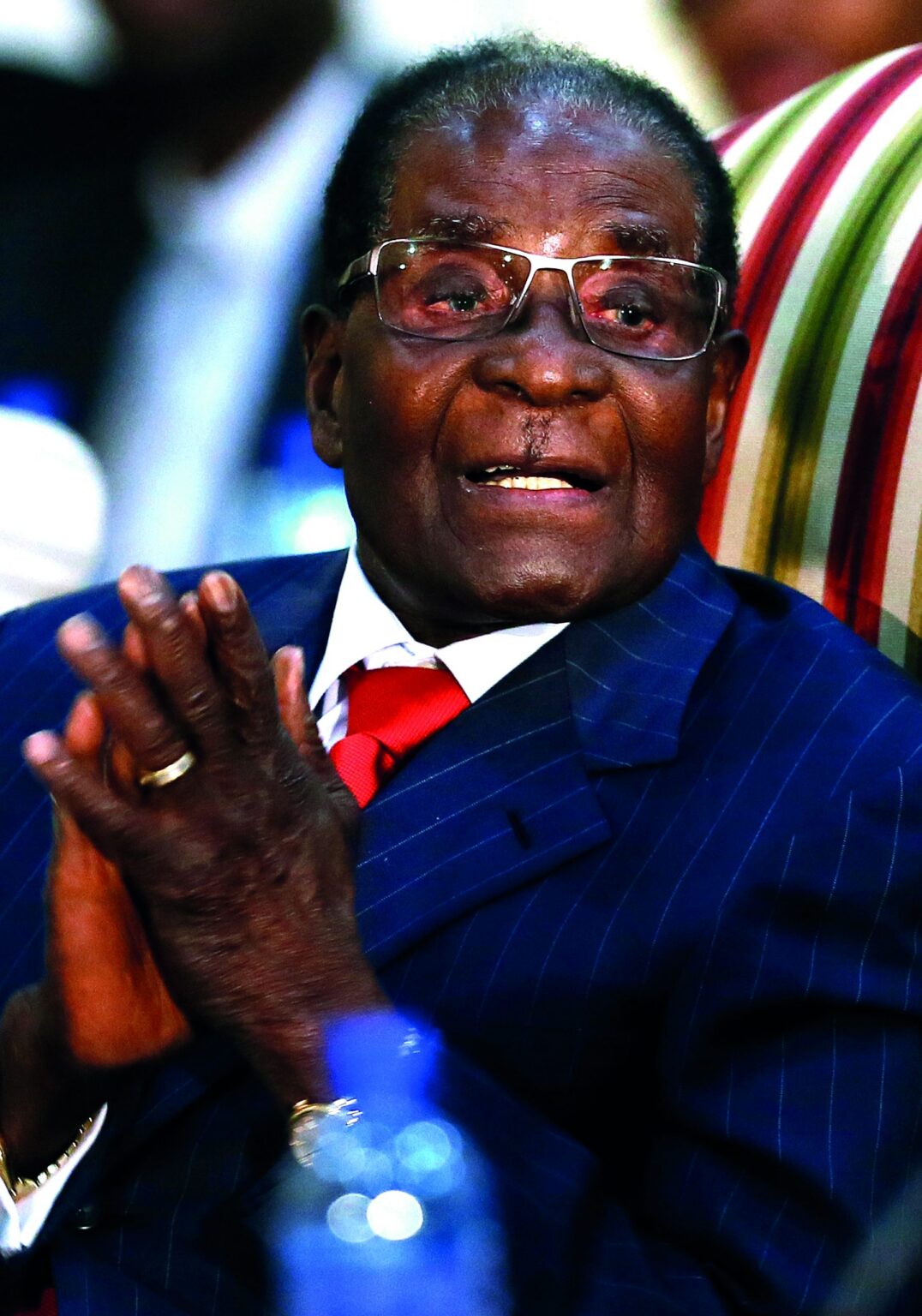
Robert Mugabe has found a way to get into the news once more – albeit in a negative context. He has complained of being badly treated by the new administration but in turn has incurred, for the first time in 32 years, the wrath of the party he once led as well as the state media. As elections draw near, writes Baffour Ankomah, which way Mugabe leans could prove crucial.
The unthinkable is happening in Zimbabwe: Robert Gabriel Mugabe, for 37 years the master of all he surveyed in the country, has come under attack by the state media, and Zanu- PF youths have chanted “down with Mugabe” slogans in front of the new President, Emmerson Mnangagwa, who had gone to address them at their national assembly meeting on 6 March.
If anybody had prophesied a year ago that such a ‘sacrilege’ could happen in the country, that prophet would have been laughed at. While in office, Mugabe and his wife, Grace, grew used to being attacked by the private media – almost daily. But never by the state media. And never at Zanu-PF rallies.
But four months out of power, Mugabe’s relationship with his former deputy, Mnangagwa, has taken a nose dive, and the state media and Zanu-PF Youth League are finding it proper to take pot- shots at the Old Man – a veritable indication that the mighty have indeed fallen.
Now 94, Mugabe lost power to Mnangagwa last November, after the military intervened to get rid of alleged ‘anti-revolutionary’ elements who had hijacked state power from Mugabe and were using it for their own selfish ends.
The manner in which he was pushed out did not please Mugabe, and that bad feeling has now congealed into bitterness, leading to a cold war that is creating all sorts of problems between Mugabe and Mnangagwa.
In fact, several things have not pleased Mugabe. The withdrawal of some of his security and domestic staff and state-provided cars has been part of his grievance. But the withdrawal is in line with the national constitution that prescribes, in the statutory retirement package given to ex-presidents, the number of staff and cars a former President can have.
So that should not be a problem for Mugabe. The crux of the bitterness, therefore, seems to be Mugabe’s perception that Mnangagwa has allowed the Zimbabwe Anti-Corruption Commission (ZACC) to persecute his wife Grace, whose doctorate in sociology obtained from the University of Zimbabwe (UZ) in 2014 has been a subject of investigation and court action since late January.
Though Grace herself has not been arrested, the UZ vice chancellor, Prof Levi Nyagura, has been arrested and put before court, accused of abuse of office in allegedly corruptly awarding the PhD to Grace Mugabe.
Insiders, however, say that Grace indeed satisfied all the legal requirements of the PhD, but under her maiden name Grace Ntombizodwa, rather than Grace Mugabe. So even though her thesis has been at the university library since 2014 and posted on the university’s website, her accusers have been looking for the entries under the name of Grace Mugabe and have not found them.
Deepening bitterness
The resultant public disgrace and feeling of persecution have not pleased Mugabe and his family, and this seems to have deepened the bitterness they feel towards Mnangagwa, to a point where the former President pointedly refused to invite Mnangagwa and members of the new government to his 94th birthday party, held at his private residence on 24 February.
Mugabe is said to have given a valedictory speech at the party, telling the audience that he and his family were being persecuted by Mnangagwa’s government.
“They say Mugabe is a legend. What legend are you talking about when you are busy taking away the vehicles,” one newspaper reported Mugabe as having told the audience at the party. “They say they want to protect my legacy, which legacy are they talking about? Doing the opposite of what we fought for.
“The boys and girls who used to work with us have been withdrawn, vehicles being taken from us. What legacy when they have expelled me from the party?
“This girl here, my wife, is no longer a member of Zanu-PF, so what legacy are you talking about? Why fear this girl. She is just young, but they took the tanks to fight her,” Mugabe is reported to have said before breaking into laughter.
Four days earlier, he had been reported telling the AU Commission chairperson, Moussa Faki Mahamat, who was on an official visit to Zimbabwe, that he was toppled by a military coup and that Mnangagwa’s government was unconstitutional.
In early March, Mugabe was again reported to have thrown his weight behind a new Zanu-PF splinter party, calling itself the National Patriotic Front (NPF), headed by retired Brig-Gen Ambrose Mutinhiri, a former MP and minister of state for the Mashonaland East province, who resigned from Parliament and Zanu-PF in late February to form the party. It is believed to be a front for Zanu-PF’s G-40 faction that was defeated in the military intervention of last November.
On 6 March, President Mnangagwa finally spoke out about Mugabe’s recent activities at a Zanu-PF Youth League national assembly meeting in Harare, telling the youths that there was an issue with the former President.
“Currently, we see in the media various speculations about his activities,” Mnangagwa said. “I have no doubt that in no time the facts and reality will be made known and we will only take a position when reality and the issues are known and if it is factual.
“But currently we are not happy with what the media is saying. We don’t know whether it’s correct or not, but it is an issue we are examining. The voice of the people is the voice of God. So if the voice of the people says this is wrong, then we also say it is wrong. If an individual or group of individuals goes against the current of the voice of the people, then we say you are lost. My message is that we must be peaceful, united and loving,” Mnangagwa added.
Earlier, the Youth League national chairman, Pupurai Togarepi, addressing the same meeting, had said the youths still wanted to revere Mugabe, “but if he is not responsible, we are going to look at him as a new enemy and we will go for him”. The youths then broke into slogans denouncing Mugabe, in front of Mnangagwa, something that was unthinkable four months ago.
Papers turnagainst Mugabe
Even worse, a week before the Youth League meeting, the state-state-owned daily, The Herald, that had supported and eulogised Mugabe for all the 37 years he was in power, scored a first by appearing to attack him in an editorial comment. “It now saddens many Zimbabweans that the former President seems to be attempting to rewrite history, and rewrite it in almost the exact words used by one of his ex-ministers, a bitter Twitter man who sees his own dreams of power dashed,” The Herald wrote. (This referred to Professor Jonathan Moyo, the former Minister of Higher and Tertiary Education, and lead member of the G-40 faction, who is now into tweeting anti-government broadsides from exile.)
“We now desperately hope that the retired President can preserve his own dignity and retain the affection of those who admire him … Everyone would be disappointed if he turned into a whining old man,” the paper added, sardonically.
The next day, one of the paper’s young columnists, Tichaona Zindoga, took up the chant in a column he headlined, “Ex-President Mugabe must face reality like all of us”, in which he told the Old Man that “his successor has been magnanimous with him” and that “Mugabe should be a grateful man” because “things could have been much worse. People like to conjure ugly images of Libya and the last days of Muammar Gaddafi. Or Ceauşescu of Romania.”
Zindoga went on: “That Comrade Mugabe is not one of the poor pensioners sleeping outside banks to get a pittance for a living should be demonstration enough of how he should count himself lucky … He has been treated rather too generously for what he tried to do in the last few months of his presidency that had been hijacked by a criminal cabal. That is why his legacy had to be restored.”
In mid-March, Mugabe’s last Foreign Minister, Walter Mzembi, and former Sports Minister Makhosini Hlongwane (who themselves have been a target of what many see as a ZACC persecution), took up the difficult challenge to mediate between Mugabe and Mnangagwa, but reports, at the time of writing, said Mugabe was being intransigent.
Crucially, with a general election looming in the next few months, Mnangagwa needs all the unity he can muster in Zanu-PF’s ranks. New parties splintering from Zanu-PF will not help his cause. Thus peace with Mugabe is critical, otherwise the current divisions in the Zanu-PF family might open the door for the main opposition leader, Nelson Chamisa of the MDC-T (who was confirmed as the substantive leader and Presidential candidate by the party’s National Council on 1 March) to sneak through to what will be a historic electoral victory.
Mnangagwa therefore cannot afford to lose Mugabe and his followers. But will the Old Man play ball? NA
Mugabe lashes out
In an astonishing move, Robert Mugabe invited the foreign media (The Times of London and SABC and the Sunday Times of South Africa) to his private residence in Harare, telling them, in vintage Mugabe style, that the military intervention that pushed him out of power “was a coup d’état … it was truly a military takeover” and that made Mnangagwa’s government “illegal” ; that Mnangagwa had to correct the “illegality”; and he (Mugabe) was prepared to help him in that regard if he was “properly invited” to do so.
He said Mnangagwa must “undo this disgrace which we have imposed on ourselves. We don’t deserve it! We don’t deserve it!! Please, we don’t deserve it!!!”
Mugabe expressed sadness that of all the people in the world, he did not think that it would be Mnangagwa, the man “I nurtured and worked so hard [for] in prison to save from hanging”, who would be the one to betray him.