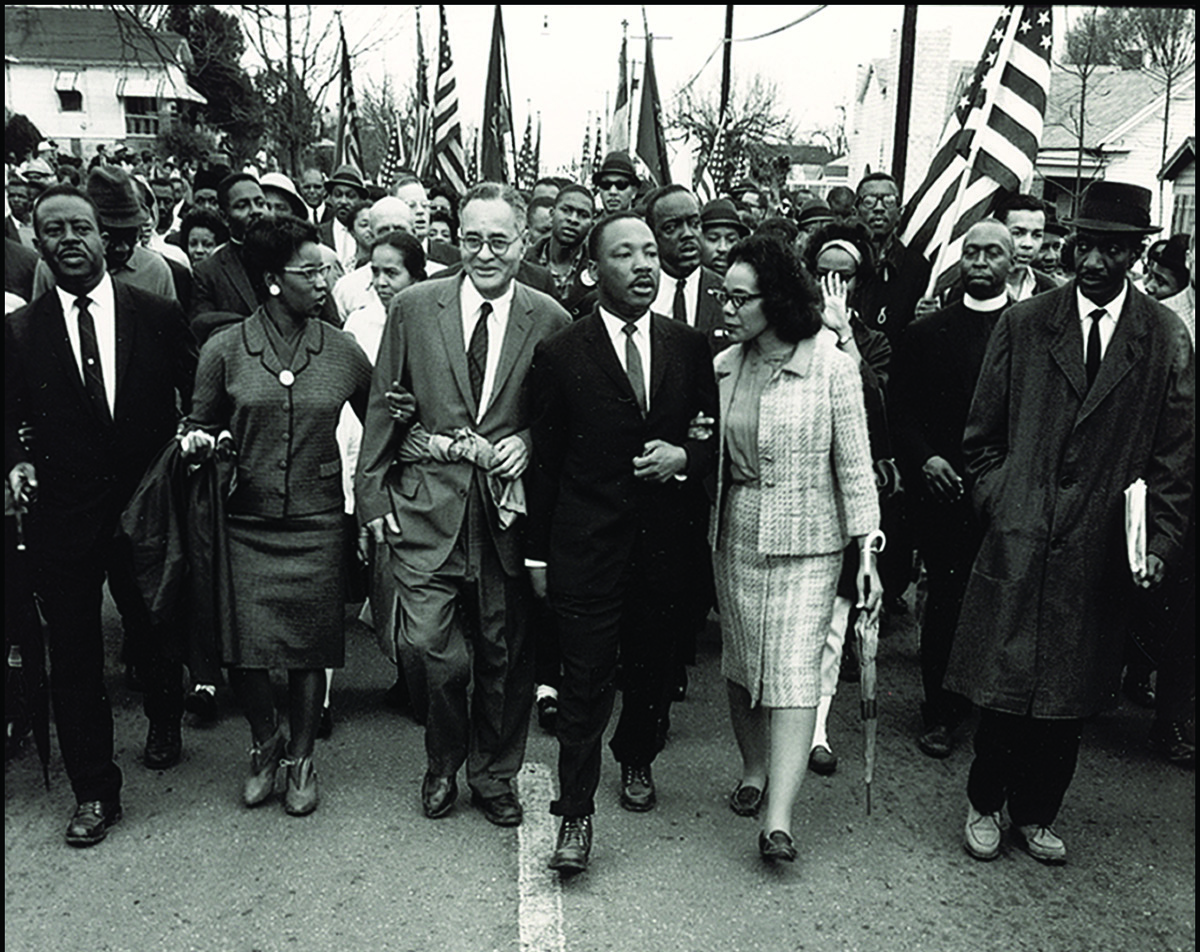
Having just celebrated the 50th anniversary of the historic March on Washington, where Nobel laureate Martin Luther King, Jr. delivered his famous “I Have a Dream…” speech, New African talked with the Photo-journalist Dan Budnik who covered that event and many of the seminal civil rights marches in the USA.
When you called at the newsstand to buy a copy of New African last month, you might also have been tempted to purchase the special commemorative edition of Time magazine that carried a photograph of Martin Luther King, Jr. on its cover. It was to mark the 50th anniversary, on 28 August, of the March on Washington – when a quarter of a million people assembled in the US capital. Dan Budnik took that photograph of Martin Luther King, Jr. moments after Dr. King ended his “I Have a Dream” speech.
Budnik describes the atmosphere of that hot summer’s day in Washington as “exciting”. “It was much more than a ‘freedom march’; the official title was ‘March on Washington for Jobs and Freedom,” Budnik states. “But you had to be there to have any idea of what it was like,” he adds.
The March on Washington, whatever its description, was a seminal event for African-Americans in their ongoing struggle for equality. As the TV networks broadcast the event live, and watched by President John F. Kennedy in the White House, people gathered – ostensibly to demonstrate for human rights – but a good many just to hear Martin Luther King, Jr. speak.
Budnik says he took a big gamble to get the photograph of Martin Luther King, Jr. used for Time magazine’s cover. “I made the decision not to be at the sides of the podium, or at the front, where all the photographers were. But I figured that he would have to go back up the steps after the speech to get out, so I positioned myself by those steps behind him, and I took the photograph as he was exiting, having made his speech.”
Dr. King was the last of the day’s speakers. Introduced to the podium on the Lincoln Memorial as “America’s moral leader”, he began reading the speech that he had worked on until 4am that morning. In the prepared speech, there was no mention of “The Dream”. Then Mahalia Jackson, his favourite gospel singer, spoke out from behind him. “Martin, Martin. Tell them about the dream, Martin. Tell them about the dream …” she pleaded. It was a theme that he had used in prior speeches. But, in fact, Clarence B Jones, Martin Luther King, Jr.’s speechwriter, had advised him to omit the dream reference from his address.
Budnik observed that Martin Luther King, Jr. pushed the pages of his speech aside and continued to extemporise, speaking from the heart. Here is an extract from what he was to tell the crowd packing the National Mall before him:
“I have a dream that one day on the red hills of Georgia, sons of former slaves and the sons of former slave owners will be able to sit down together at the table of brotherhood.
“I have a dream that one day even the state of Mississippi, a state sweltering with the heat of injustice, sweltering with the heat of oppression, will be transformed into an oasis of freedom and justice.
“I have a dream that my four little children will one day live in a nation where they will not be judged by the colour of their skin but by the content of their character…
“I have a dream today!
“I have a dream that one day down in Alabama, with its vicious racists, with its governor having his lips dripping with the words of interposition and nullification; one day right there in Alabama little black boys and black girls will be able to join hands with little
white boys and white girls as sisters and brothers.
“… when we allow freedom to ring, when we let it ring from every village and every hamlet, from every state and every city, we will be able to speed up that day when all God’s children, black men and white men, Jews and Gentiles, Protestants and Catholics, will be able to join hands and sing in the words of the old Negro spiritual ‘Free at last, free at last. Thank God Almighty, we are free at last’.”
It was, in Budnik’s opinion “…the greatest speech Martin Luther King, Jr. was to make in his life. It is so poignant, it reached around the world. The freedom movement came to a head a couple of years later in 1965 with the Selma to Montgomery March. Yes, that speech was his greatest speech, but the Selma to Montgomery March was Dr. King’s greatest achievement.”
The Selma to Montgomery March was extraordinary. It took five days for the marchers to travel the 54-mile distance and involved 3,900 soldiers and guardsmen as well as FBI agents and US Marshalls to protect the marchers. There were strong concerns that diehard white “segregationists” would attack them. It culminated in a huge festival just outside Montgomery featuring entertainers such as Harry Belafonte; Dick Gregory; Joan Baez; Peter, Paul and Mary; Sammy Davis, Jr.; Johnny Mathis; and Alan King.
The march was concerned with voting rights. In 1954, when Martin Luther King, Jr. became the Minister at the Dexter Avenue Baptist Church (now the Dexter Avenue King Memorial Baptist Church) Montgomery’s population was around 120,000. A third of the population were African-Americans – but few of them were registered to vote. This made voting rights an ongoing and imperative issue. Without the right to vote there was no way African-Americans could be empowered.
They were given ridiculous ‘intelligence’ tests before they could register to vote, like being asked how many bubbles a bar of soap made. Budnik explains, “But the dynamics, the demographics of the South changed after President Johnson pushed through the National Voting Rights Act in 1965.” It is clear that Budnik believes the civil rights’ marches made the difference and convinced US politicians to create the laws that would end segregation and discrimination.
As US former President Bill Clinton said at the March on Washington commemoration event in August 2013, without the voter rights’ changes, he would never have been elected, nor Democratic Party Presidents such as Jimmy Carter before him, nor Barack Obama after him. Essentially, the black vote goes overwhelmingly to the Democratic Party in the US.
In the early 1960s, most of the South of the US was still in the grip of overt racism and segregation. It was remarkably similar to apartheid South Africa. Black people had to use different and generally inferior public facilities such as lavatories as well as drinking fountains, as well as separate schools and restaurants. They were forced to sit on different public benches and sit at the back of buses – where white passengers had preferential rights and blacks would be forced off the vehicle so the white passengers could board.
But by the late 1960s, there was a huge groundswell of opposition to the “Jim Crow” state and local laws that enforced a segregation of the races. Segregation was most obvious in the Southern States (the old Confederate States where the plantation culture had taken hold).
But it was clear that racism also blighted the rest of the country; it is simply that it was never legislated for but existed de facto with opportunities being denied to black people, or very severely limited, in terms of housing and jobs.
The US Supreme Court declared state-sponsored school segregation unconstitutional in 1954 (in the Brown v. Board of Education ruling). Generally, the remaining “Jim Crow” laws were overruled by the Civil Rights Act of 1964 and the Voting Rights Act of 1965, but many of the Southern States prolonged the tension by dragging their feet in enacting this legislation – eventually to no avail.
Among those that raised their voice in protest were many of the popular entertainers of the day. A famous Budnik photograph of the March on Washington shows Charlton Heston, Julie and Harry Belafonte, closely followed by James Garner, Diahann Carroll and a very young and hirsute Paul Newman. They are followed by Anthony Franciosa and Marlon Brando.
At the March on Washington, Budnik also photographed luminaries such as Bob Dylan and Joan Baez who sang for the people, film star Sidney Poitier, writer James Baldwin, and director Joseph Mankiewicz.
Budnik also tells an interesting story of when he went to the airport in Montgomery, Alabama on the fourth day of the Selma to Montgomery March. He was standing next to Dr. King and his wife Coretta Scott King who were holding hands waiting for a delayed flight carrying Harry Belafonte from California.
“I raised my camera to take a photo, not knowing how they would react. Dr. King started pulling away but Mrs. King wanted me to photograph that moment and she pulled him back. In that moment I realised the strength and power of this extraordinary woman.”
In fact, when asked how well he knew Martin Luther King, Budnik says that although he did speak with him on a number of occasions, as with all his subjects, he tried to keep his distance from those he was photographing “or your concentration could get disrupted – it changes the dynamic”.
In October of 1958, during Eisenhower’s presidency, Budnik accompanied a group of young multi-racial student activists during the Youth March for Integrated Schools. Harry Belafonte and Bayard Rustin led the students to present the president with a petition calling for integrated schools. Presenting a petition is the constitutional right of every American.
“Reaching the gates of the White House, which to my relief were open,” Budnik recalls, “the two student leaders approached to present their petition. The gates to the White House were then flung shut in the face of the students.
“The captain of the guard yelled out ‘What y’all want’. Answering, they told this captain, who I could tell was a Southerner and most probably a racist, that they wanted to present their petition. The captain told them, ‘Well, he ain’t here right now, the president’s not here’. It was total intimidation.
“Then from behind the gates, where there was a little kiosk, two secret service agents came out with 16mm cameras. One started filming as if he was collecting mug-shots, but when he got to me he was startled as I was a white and I was photographing him. ‘And what do you think you are doing?’ he asked. I was so angry, I said, ‘You b*****d, I’ve been with these kids all day. They’re solid Americans and they are just doing what any American has the right to do’. Well, he didn’t have an answer to that and just turned on his heels.”
Since 1966, Budnik has been involved in the struggle Native Americans have been waging for their dignity and rights. While there are some echoes of the early African-American civil rights issues, the issue of American Indians (principally the Hopi and Navajo nations whose reservations are nearby to where Budnik currently resides in Arizona) is quite different. Budnik’s primary focus has been to call attention to the abuse that Native Americans endure.
Trolley Books (www.trolleybooks.com), began a Kickstarter Campaign to ensure that Budnik’s historic Civil Rights photographs reach a wider audience. Essentially, those that donate to the campaign will receive a copy of Budnik’s Marching to the Freedom Dream book in the Spring of 2014, but you’ll have to hurry. The Kickstarter Campaign finishes at the end of September, giving readers barely 10 days after New African’s October Black History Month special issue appears on the continent’s newsstands.
Budnik’s very first professional assignment was in 1957, photographing Tom Mboya, Eleanor Roosevelt and Harry Belafonte for Drum magazine. To learn more about Dan Budnik or view more of his images, please visit www.danbudnik.com.