The UN’s Educational, Scientific and Cultural Organisation (UNESCO) was founded in 1945, following the end of the Second World War, and has since become the guardian angel of the planet’s most important cultural and natural sites, with a mission to protect and conserve for the enjoyment and education of future generations.
At the end of July 2024, the World Heritage Committee held their 46th session in New Delhi, India. Twenty-four new sites were conscripted into the revered UNESCO Heritage Site list, bringing the total across the world to 1,223.
This year four African countries were the proud recipients of five new allocations on the list:
The Royal Court of Tiebele – Burkina Faso
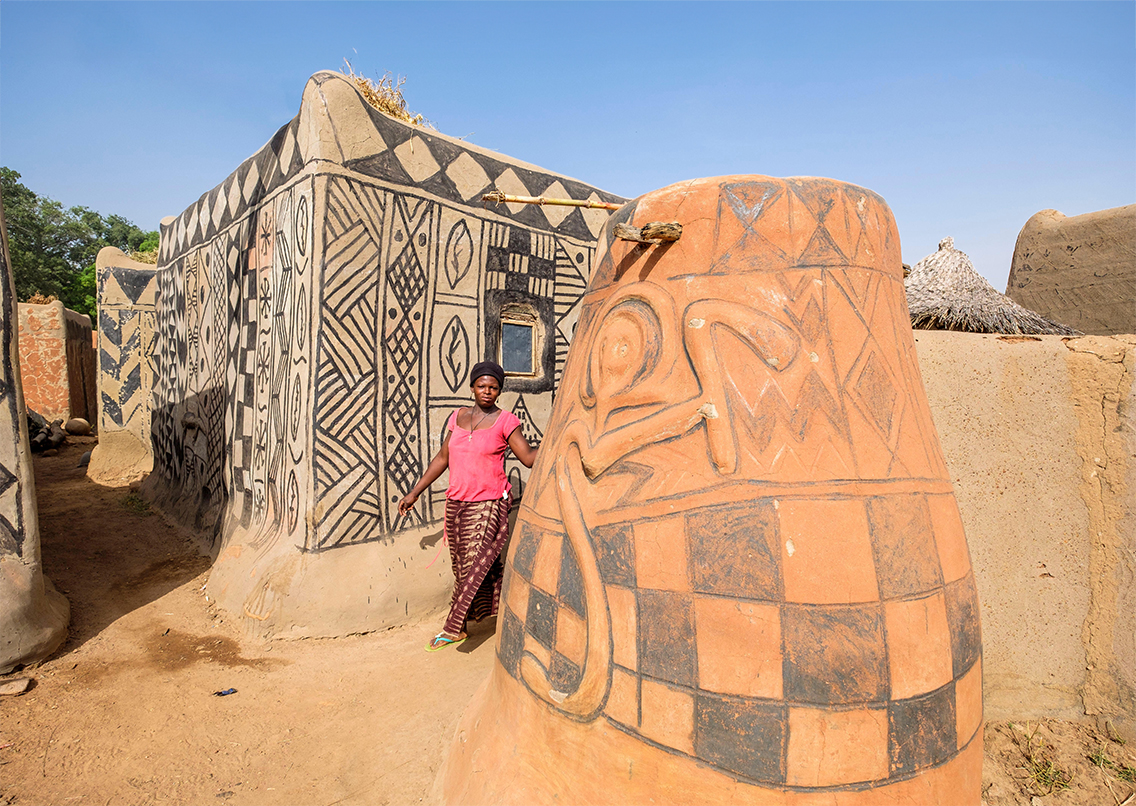
Burkina Faso’s Royal Court of Tiebele joins the country’s three other World Heritage sites. This almost magical architectural complex has stood since the 16th century. It was originally built by the Kasena men of the Royal Court, while the buildings were hand-decorated by the women, using bold geometric patterns interspersed with symbols and images of sacred animals.
Made up of several features, including the Pourou, a sacred mound where the placentas of the royal family are buried, each part of the complex is built around a ‘mother’ house, traditionally shaped like the figure eight – used in the past as a defensive measure.
After four centuries, the earthen compound is still home to the Kasena and its warren of vividly coloured village homes and narrow alleyways encompass the spirituality and ancient rituals of these peaceful people.
New homes are built and decorated using the same skills and techniques that their forebears used so long ago and the creative decorations have been the inspiration for fashion, furniture and even dictate the appearance of new modern buildings in the region.
Given the threat of erosion and flooding and the financial burden of decorating homes every three years, inclusion as a UNESCO Heritage Site will do much to nurture this enchanted kingdom.
Melka Kunture and Balchit – Ethiopia
Ethiopia’s rich cultural heritage and unique prehistoric locations have always been a draw for travellers. Now the incredible prehistoric sites of Melka Kunture and Balchit, which form part of the Upper Awash Valley in Ethiopia’s highlands, have secured a coveted place on UNESCO’s Heritage list.
Discovered first in 1963, they have remained an invaluable source of knowledge to archaeologists and scientists around the world, providing information on early human settlements on the continent. More than 70 archaeological levels have been discovered, although only 30, so far, have been comprehensively excavated, revealing thousands of primitive stone tools and bones estimated to be up to 1.7m years old.
The excavations have made it possible to reconstruct the changes in the area during the early and middle Pleistocene period (a geological time spanning 2.58m to 11,700 years ago). The site has plenty more to reveal and is likely to keep future generations of archaeologists and scientists remarkably busy!
This is Ethiopia’s 13th site inscribed on the World Heritage list, sitting alongside other treasured locations such as the rock-hewn churches of Lalibela and the Simien National Park.
The Pleistocene Occupation Sites and the Nelson Mandela Heritage Sites – South Africa
South Africa has a double honour with its Pleistocene Occupation Sites, described as ‘treasures for the study of human evolution’, and the Nelson Mandela Heritage Sites making the list.
The Middle Stone Age sites, now part of the UNESCO family, are Sibhudu Cave in KwaZulu-Natal, the scene of bone arrows, stone arrows and needles indicative of humans’ first foray into modern technology; Diepkloof Rock Shelter near Elands Bay, which has revealed evidence of the first human use of symbols; and the Pinnacle Point Site Complex in Mossel Bay, on the Western Cape, where the occupation of Middle Stone Age people between 40,000 and 170,000 years ago has been discovered. All three sites have been classified as notable contributors to the origins of modern human behaviour.
The inclusion of the Nelson Mandela Heritage Sites in 14 component parts throughout the country reflects the years of struggle against apartheid and Mandela’s humbling influence and lifelong campaign for understanding, forgiveness and peace.
They include the Union Buildings in Pretoria, now home to South Africa’s government, and a striking nine-metre-high bronze statue of Mandela which was unveiled 10 days after his death on 5 December 2013.
The Great Palace at Mqhekezweni, symbolic of Mandela’s youth and the Sharpeville Sites, a tragic reminder of the 1960 massacre of 69 people who protested the unjust anti-Black Pass Laws, are also part of the grouping.
South Africa, which has 12 sites on the UNESCO Heritage list, is catching up with years of withdrawal as in 1955, protests from the government over the organisation’s anti-apartheid policies, which they claimed were ‘interference’ with its country’s racial problems, led to their departure. They rejoined again in 1994 under the leadership of Nelson Mandela.
Gedi – Kenya
The Historic Town and Archaeological Site of Gedi marks Kenya’s eighth presence on UNESCO’s World Heritage Site list.
Based on radiocarbon dating of a stone slab used as a grave marker, settlement of the site is estimated to have taken place in the 11th or early 12th century, when it was a trading town until its mysterious abandonment in the mid-17th century.
With a surprising lack of written records, the reason for the settlement’s decline has always remained an enigma to historians and archaeologists alike.
Several reasons have been put forward including the arrival of the brutal Portuguese explorers and soldiers; a severe reduction in the water supply, affecting the main source of water from a well near the Great Mosque; and a raid by Wazimba warriors along the coast in 1859, or raids from Somalia. Any or a combination of all may have been responsible for the community’s demise.
Gedi is one of many coastal Swahili settlements in the area but distinguishes itself from most of the others by its advanced developments, such as a sewage system and a formally constructed grid system of streets. Studies have shown its importance in the Indian Ocean cross-continental trade of the day. It was originally lost to all but local tribes dwelling nearby for more than two centuries, hidden in impenetrable jungle. In 1884 it was rediscovered by colonialists but it was not until the 1920s that the ruins began to get attention, with excavations finally kick-started in the late 1940s.
Today the well-preserved ruins are one of the famous tourist attractions on the Kenyan coast. They are shrouded in mysticism, with whisperings of curses for anyone that dare harm this exceptional piece of history.
Senegal’s Niokolo-Koba National Park out of danger
A final good news story from the 2024 World Heritage Committee meeting, was the removal of the Niokolo-Koba National Park from the World Heritage Danger List.
The park was initially brought under the auspices of UNESCO’s World Heritage list in 1981 but in 2007 was considered in need of rapid protection due to intensive poaching, population growth around the park encroaching on its land, and other elements such as bush fires, mining and the need to improve the park’s ecological programming.
The park is one of West Africa’s most vital areas as it is home to one of the last two known populations of lions in the region, the endangered pangolin and a large population of leopards, as well as unique ecosystems, an abundance of fauna and incredible diversity of wildlife.
Due to the huge efforts made by UNESCO and its partners in conjunction with Senegal’s National Park Authority, 17 years later it has been removed from the danger list and has shown the positive improvements in conservation and ecological protection needed to take the park into a secure future.