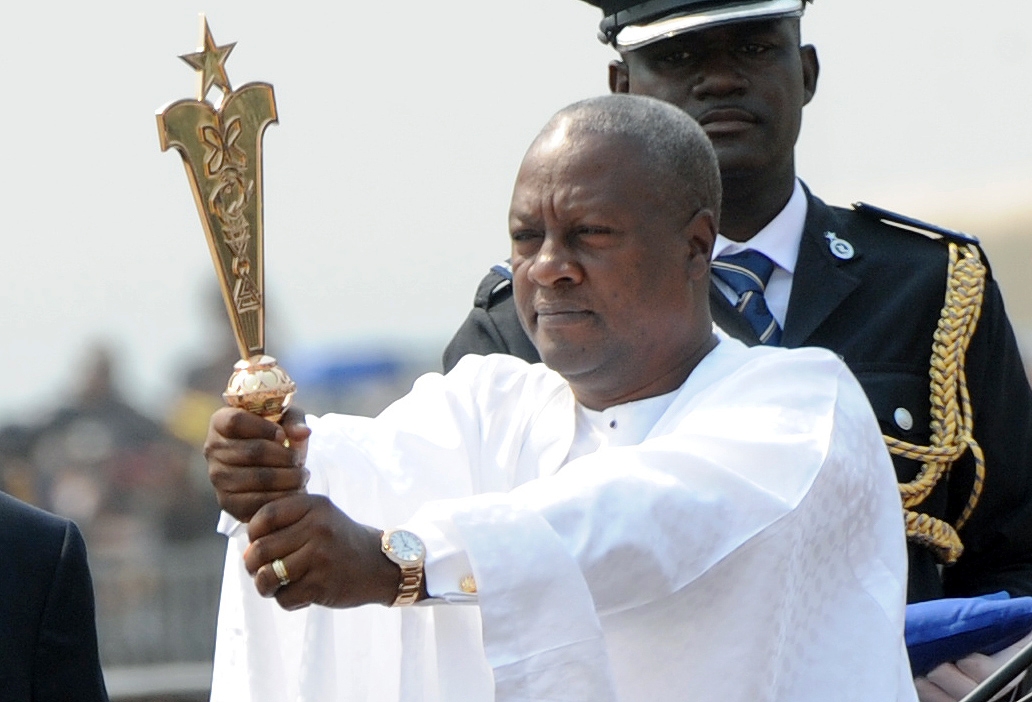
Ghana’s new president, John Dramani Mahama, was sworn in on 7 January, but the opposition NPP’s case against his election is still pending before the Supreme Court. It is a testing time for the country. If the court rules for the NPP, Mahama will have to relinquish power. If the NPP loses, Mahama will be home and dry, but it will be a major image disaster for the NPP. Cameron Duodu reports.
It has been described as the “mother of all court cases in Ghana”. And justifiably so, for the stakes are the highest imaginable – the presidency of Ghana, no less. It arose out of a petition filed at the Supreme Court in Accra by the New Patriotic Party (NPP) candidate in the 7 December 2012 election, Nana Addo Dankwa Akufo-Addo.
The petition challenges the declaration by the Electoral Commission of John Dramani Mahama as the winner of the election. Mahama was inaugurated on 7 January in a ceremony at Independence Square in Accra, attended by a large crowd, including 13 heads of state and 18 delegations from across the world.
The NPP is making its court challenge on the grounds of numerous irregularities that, it claims, were observed during the election. It prays the court to reverse the election result and declare Akufo-Addo the winner. Listed as defendants in the petition are President Mahama and the Electoral Commission (EC).
In the meantime, the chief justice, Mrs Georgina Woode, who swore in Mahama, is the same person who has the constitutional mandate to select, and has selected, a panel of nine judges to hear the NPP case against Mahama.
Because of the uncertainty of the case, everyone in Ghana has an opinion on the matter. Some say that since Mahama has already been sworn in, then he is the president and that should be the end of the matter. Others argue that such a view cannot hold water, because the swearing-in of the president at a given date is only a constitutional requirement and not a constitutional guarantee that the election result, as such, cannot be challenged after the inauguration.
In fact the confusion, such as it is, resides solely in the minds of those who do not fully understand how the political
process in Ghana, under the current constitution, works. The election of a president is carried out in four stages: (1) the filing of nomination papers by presidential candidates; (2) the actual holding of the election; (3) the declaration of the result by the electoral commissioner; (4) challenge(s) of the result, if any, by way of a petition or petitions to the Supreme Court. The judgement of the Supreme Court shall be final.
Despite this clear process, which allows a dissatisfied candidate to challenge the election of an inaugurated president, some Ghanaians think Akufo Addo and the NPP were wrong to file their petition. That viewpoint is naïve, however, for constitutions are very complex documents that borrow and adapt legal systems and practices from different parts of the world, and should never be seen through what might be termed “a tunnel vision”.
Ghana’s constitution, in particular, is difficult to comprehend in parts, because it tries to marry the explicitly prescribed provisions of the American republican system of government, with the unwritten practices and conventions that make up the “British Constitution”. Thus, Ghana has put in the same legal “bed” both an executive presidency (à la USA) and a parliamentary form of government (à la Great Britain).
The last time the American and British constitutional concepts engaged in matrimony, the marriage ended in a divorce sealed in blood (in 1776). Therefore, anyone who approaches the Ghanaian constitutional “progeny” of the two divorcees with the starry-eyed certitude of a legal ingénue, would be in for quite a few shocks.
How disputatious the legal landscape in Ghana can become was illustrated at the Supreme Court at the word “go” – even before the petition proper to the Court was heard. In a preliminary application, President Mahama’s ruling National Democratic Congress (NDC) asked to be “joined” as a co-defendant of the NPP petition.
But when the Supreme Court – a bench of nine judges presided over by Justice William Atuguba – sat to hear the grounds for this application, the NPP’s lawyers threw “a bucketful of nuts and bolts” (so to speak!) into the works. They took almost everyone by surprise when they asked to be allowed to address the Court “in chambers”. Apparently, they were going to “object” to the presence on the bench of one of the judges!
The lawyers never actually made public the name of the judge whose presence on the panel was considered by them to be objectionable. Instead, they asked to be allowed to state their case to the judges in private. However, the NDC’s legal team did not agree to this. They maintained that the case was of such unique interest to the people of Ghana that it should be heard in public in its entirety.
After consultations, the judges decided to hear the petitioner’s lawyers in chambers. But they were soon back in the public arena. They then told the NPP’s lawyers that if they had any objections to raise, they should do so in open court, by way of a formal motion. The unpredictability of legal proceedings had asserted itself with a vengeance. But there was more to come.
The president of the panel, Justice Atuguba, made an unexpected public outburst, which signalled to the members of the public that it might have been against him that the NPP legal team had sought to raise an objection.
According to Joy FM radio, Atuguba said: “This country is solid, but is breaking down because principles are being chopped down to pedestrian level. The court must be strong and truly independent. The health of [our] country depends on us.”
It was learnt later – though never in the court itself – that the NPP legal team feared that Atuguba would be biased in favour of Mahama, because the president had just appointed Atuguba’s nephew, Raymond Atuguba, as his executive secretary.
This, again, provoked endless discussion amongst Ghana’s chattering classes. Would the judge really be biased? If he knew his nephew was working so closely with the president, why didn’t he “recuse” himself from the panel?
On the other hand, some people asked, if Atuguba had recused himself, was it not possible that objections could also be made against other judges who might equally well be related to some individuals within the wider Ghana body-politic? In those circumstances, which judges would be left to adjudicate the case?
But before these questions could be answered, the NPP legal team announced that it would no longer raise any objections to the presence of any judges on the panel. It was doing this to save time and avoid a long drawn-out court process, the team said.
It can be argued that Akufo-Addo’s team might have embarked on a wrong strategy and thereby shot itself in the foot by casting insinuations against a member of the panel, and later withdrawing their objection, without making any attempt to substantiate it.
Judges do take themselves very seriously indeed and frown upon any action that they consider could sully the reputations either of individual judges, or of the judiciary in general. Thus, they show solidarity with one another, and actually address each other as “My Brother”.
Therefore, they will secretly resent anything done that treads on their toes. Their reputation for impartiality is something they value a great deal, for without it, no judge can be considered a judge.
This writer has personal experience of how judges behave when bias is alleged against them. In March-April 1970, I was editor of the state-owned Daily Graphic newspaper when a serious case, known as the Sallah case, arose over the dismissal of 568 public servants from their jobs by the Progress Party government, led by Dr Kofi Abrefa Busia.
One of the dismissed officials, E. K. Sallah, contested his dismissal in court. The government’s defence team was led by Attorney-General N. Y. B. Adade. Inexplicably, Adade raised an objection to two members of the panel that was sitting on the case. It was a frivolous objection based on allegations that the two judges were “friends” of some of the officials who had been dismissed. The case was thrown out.
But the acting chief justice of the time, Justice Samuel Azu Crabbe, felt so strongly that the judiciary as a whole had been affronted by the government’s principal legal officers that a message was conveyed to me that he would like to be interviewed on the case. I went to see him and he went to great lengths to emphasise that the judiciary had “no quarrel” with the government and that casual relationships played no part in the way senior judges conducted cases brought before them. Azu Crabbe mentioned a name that had appeared in connection with the Sallah case and stated that he knew that that person was known to the attorney general. So should the attorney general have withdrawn from the case?, Azu Crabbe asked rhetorically.
He left no doubt, in the interview, that frivolous challenges against the integrity of judges were not to be countenanced. I published his views fully on the front page of the Graphic and from then on, there was peace between the government and the judiciary – as far as could be seen from the outside.
The NPP case
With the withdrawal of the objection by the NPP legal team, Akufo-Addo’s case is now expected to be called soon and its substance subjected to examination – unless, of course, the NDC’s legal team decides to borrow a leaf from the book of the NPP team and try some mischief of their own.
Basically, the NPP’s case, filed on 28 December, is this: It accuses the Electoral Commission (EC) of doctoring the election results in favour of Mahama. The EC, in a defence filed to the Supreme Court, denies the claims and maintains that the results declared were credible and accurate.
But the NPP claims that as many as 24,000 “pink result sheets” from some of the polling stations indicate that irregularities were sufficient to affect the results of the election.
In a rebuttal, President Mahama, who is a respondent to the petition, said he would require from the petitioners, particulars of the polling stations, constituencies and regions where pink sheets from different polling stations allegedly bore the same serial numbers, and the votes allegedly affected in each case. The president said he would also demand from the petitioners, “names of persons who allegedly illegally padded and/or unlawfully reduced the votes; the polling stations, constituencies and regions where the alleged acts occurred, and the votes affected in each such polling station, constituency and region”.
The EC, for its part, maintains that the NPP petition is “without merit” and, accordingly, prayed the Supreme Court to “dismiss it”.
The EC also denies that any irregularities and electoral malpractices occurred during the election. And that it did not deliberately work to unlawfully assist Mahama to win the presidential poll.
Like the president, the EC prayed the court to “order the petitioners to give particulars of the polling stations in which the violations, irregularities, and malpractice are alleged to have occurred”.
Touching on the allegation of allowing voters to vote without verification, the EC urged the court to “order the petitioners to provide particulars of the polling stations in which voting without verification is alleged by them to have taken place”.
Naturally, it is only when these various viewpoints are argued before the Supreme Court that the strengths and weaknesses of the cases of the petitioners and respondents will become crystal clear. But in the meantime, a fairly shrewd assessment has been made of the case by a lecturer at the University of Ghana’s Faculty of Law, Kissi Adjabeng.
He noted that the admission by the EC in its response to the NPP petition, that it made a “genuine” error in the figure of registered voters stated in the declared results, raised questions as to “what other errors” might have been made by the EC. Adjabeng said the EC’s admission formed a sufficient basis for the NPP’s case to “go the full throttle”.
The NPP, he pointed out, had also drawn attention to the sudden jump in the number of registered voters from 14,031,793 (a figure given by the EC in November) to 14,158,890 (the figure stated during the declaration of the results).
Had the EC registered any new voters between November and December 2012 to account for the rise in the figure?, Adjabeng wondered. That admission, in and of itself, “constituted grounds for the whole election process to be thoroughly investigated,” Adjabeng affirmed. “It is entirely legitimate to ask, what other ‘genuine errors’ may have been made by the Commission in the election process which may have had a bearing on the outcome?”
The arguments before the Supreme Court will, without doubt, be so sharp as to demand every ounce of legal acumen that the judges can bring to it. All Ghanaians will be watching very carefully.
The Court’s decision can make or break the nation’s faith in constitutional rule and the rule of law. And, of course, it can make or break the Supreme Court itself and the judges thereof. In all seriousness, it is a case in a thousand.
[Editor’s note: At the time of going to press, the EC had explained that “the figure of 14,158,890 registered voters stated in the declaration of results was an error occasioned by picking the wrong figure. The number of registered voters which should have been picked was 14,031,793. In this context, it is important to emphasise that this error has no bearing whatsoever on the total votes cast in the election and, consequently, the valid votes obtained by each candidate. The error would only affect the voter turnout percentage and change it from 79.43% to 80.15%.”
According to the EC, the NPP is playing mischief by bandying about a wrong figure of 14,158,890, instead of 10,995,262, as the total number of votes cast for the eight contesting presidential candidates in the race.