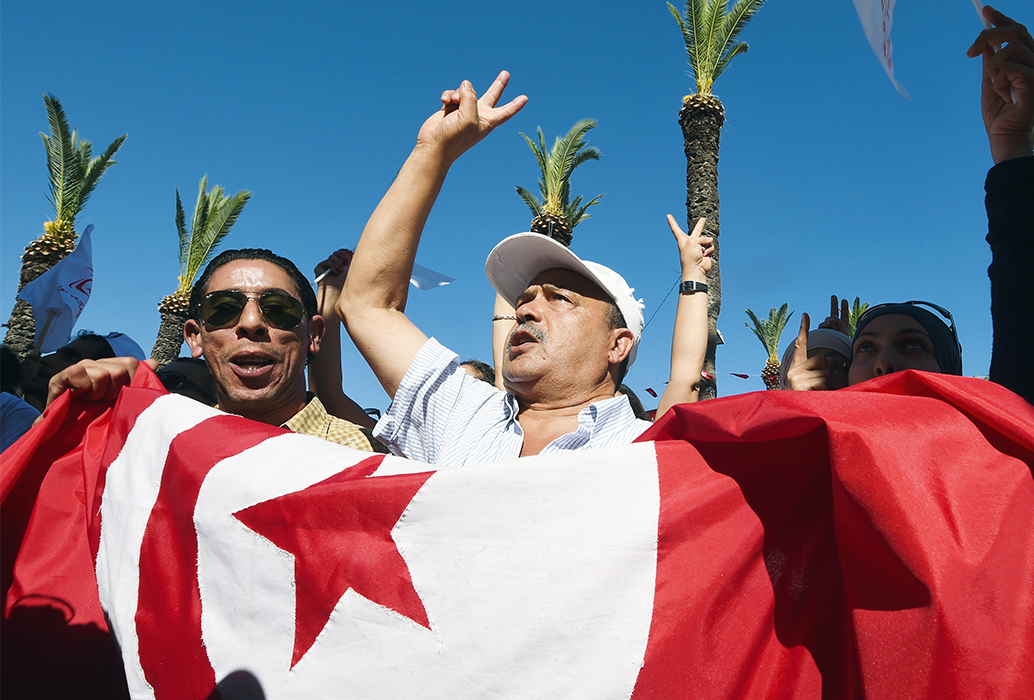
Tunisia’s parliamentary elections in October reinforced the tentative progress the country has made since the 2011 revolution. But its efforts to speed up the transition and compromise at the highest political levels have come at a cost. Mohamed-Salah Omri reports from Tunis.
The Syrian philosopher Sadiq Jalal al Azm observed that the main effect of uprisings across the Arab world has been “to return politics to the people and people to politics”. In Tunisia, the starting point of the so-called Arab Spring, this meant a return of politics as a subject of public concern and the emergence of a vigorous democracy expressed in the street, media and the arts. After decades of repression and monopolised power under President Zine El Abidine Ben Ali, Tunisia quickly saw individual and collective political voices being asserted in the form of parties and associations as new possibilities became imaginable. At the same time, Tunisians were also confronted by insecurity, a power vacuum, and a deteriorating economic situation.
In this period, three things took place: the legalisation of public emotion, the loss of innocence, and the rule of the shopping basket.
Over the last three years, Tunisia has made some key and undeniable gains: its media is free and generally fair; the iconography of dictatorship has all but disappeared; a very good constitution has been adopted; and two free and fair elections have been held. Furthermore, attempts to derail the revolution by escalating identity politics have so far failed; an outright return of the old regime has been curtailed; and large-scale violence has been prevented from spreading.
Many are still singing a revolutionary tune in Tunisia but political movement is no longer directed by them.
Tunisia has managed to avoid the fate of Egypt, Syria, Yemen and neighbouring Libya, for a variety of complex reasons such as its well-entrenched state institutions, largely well-educated population, and significant civil society organisations. In particular, the powerful independent union, the UGTT, has been crucial in mediating between political parties in times of acute crisis. The most important of these interventions have included peaceful transfers of power, harmonising views on the constitution, and agreeing a roadmap and timetable for elections.
The process of legalising public imagination started in 2011 when the transition was handed over to a body of non-elected representatives headed by a constitutional lawyer. And it continued under elected lawmakers who maintained the process of taking the reins of politics away from a euphoric people eager to assert their divergent desires freely. There were riots, strikes and street protests, but order returned quickly, even as the hard work of setting legal foundations for the new state took place amidst a fierce contestation over issues of identity, way of life and social justice.
With the assassination of the popular leftist leader Chokri Belaid on 6 February 2013, however, a major fear entered the nation’s psyche. This was followed by further assassinations and losses, particularly among the army and police, perpetrated by an emerging Islamist militant movement fueled by foreign preachers, reluctant security forces, and porous borders with Algeria and Libya which allowed external fighters to enter almost unimpeded. Tunisia became a base for terrorism, and has reportedly sent around 2,400 fighters to fight in Syria. The political process has managed to curtail violence considerably, but terrorism has not been uprooted. Meanwhile, fear and suspicion, while not rampant, have become a fact of politics and daily life, and affected the outcome of the latest elections. In the mind of the public, the suggestion that Ennahda, the Islamist party that became the country’s biggest party after the 2011 elections, is linked to or complicit in the Islamist violence haunted its campaign and no doubt contributed to its loss of support. Nidaa Tounes, the liberal party that won the largest number of seats in the 2014 elections, exploited these fears and capitalised on them.
Bread, freedom, and social justice
Tunisians often speak about the cost of the family’s shopping basket as a barometer to gauge the success or failure of those in power. And in the wake of the revolution, the cost of this basket climbed steadily, not only due to rising prices and unemployment, but also due to a drop in productivity and public revenues caused by relaxed control and accountability and the weakening dinar. Foreign donations were slow to arrive and the cost of loans increased due to a downgrading of the country’s credit rating. Much of the blame was directed at the Ennahda-led government, which was accused of incompetence, and this was one of the main reasons it was replaced in January 2014
with a cabinet of technocrats. This switch of leadership led to some improvements in governance, largely because the new team agreed not to run for office in the future, taking political considerations out of their decisions. But while there was a noticeable increase in efficiency and professionalism under the new government, the economy is not in better shape.
It is in this climate that the recent parliamentary elections took place. The results gave Nidaa Tounes 86 of the 217 seats available, while Ennahda came second with 69. But the real story is the large swing in the voting. Nidaa Tounes won the trust of over 1.3 million voters, while Ennahda lost the confidence of 550,000. Meanwhile, the other parties that had been in the coalition government all but disintegrated. The Congress for the Republic, President Moncef Marzouki’s party, went from 29 seats in 2011 (and 350,000 votes) to four seats (and 70,000 votes), while the secular Ettakattol fared even worse, winning no seats at all compared to 20 in 2011.

Nidaa Tounes emerged victorious, but with no outright majority, coming from nowhere and attracting a wide spectrum of voters, ranging from the left to Bourguibists (followers of Tunisia’s independence leader) to former regime loyalists. The party was expected to do well, but it exceeded even its own expectations as it benefitted from the fear factor, calls for tactical voting and the backing of Ben Ali-era loyalists.
However, one of the most important stories of the elections must be that of the Popular Front, a coalition of small leftist and nationalist parties, which stands at a distance from both Ennahda and Nidaa Tounes. The Popular Front won 15 seats, up from six in 2011, mostly in the interior of the country such as in Sidi Bouzid, Kasserine and Gafsa. Thanks to its success, it now has the possibility of instigating a shift in Tunisian politics, should it ally itself with Nidaa Tounes and the centre-right party Afek Tounes, which won eight seats, to make a majority and form the next government.
Some influential observers have portrayed the election results as the return of the old regime, but this is not exactly the case. Although Nidaa Tounes includes Bourguibists and a strong base of former supporters of Ben Ali, it is also home to known Ben Ali opponents, trade unionists and leftists. In fact, it was this mix that gave it such a broad appeal, allowing it to occupy the middle ground of politics and draw support from the middle classes. So far, the party has been held together by Beji Caid Essebsi, the 87-year-old veteran politician who re-emerged on the political scene to head the government in 2011, as well as by its broadly anti-Ennahda discourse and considerable financial resources.
The revolutionary tune
Tunisia is now poised for the presidential elections on 23 November, with a run-off on 28 December if required. Under the new constitution, the president’s role is considerably weakened and largely limited to foreign affairs and the army, which, in Tunisia, typically steers clear of politics and economics.
Ennahda will not be fielding a candidate, and if Nidaa Tounes and its potential allies came to control both branches of government, it would push Ennahda firmly into the opposition. However, with its various possible allies, the Islamist party can still remain a major force with the capacity to present serious challenges to the ruling coalition. Tunisia has chosen to have a mixed system of parliamentary democracy to prevent the rise of dictatorship, and it will soon learn the potential drawbacks as well as advantages of this system.
While the revolution may not have changed Tunisia’s social and economic policy, it did reshape the country’s political and cultural landscape drastically. Authoritarianism has been decisively beaten, no matter how we look at the election results. Culture emerged as a public issue largely in response to the visibility and robust drive to re-Islamise society.
Tunisia has also been a testing ground of the future of political Islam in the region, both as a global issue and as a local practice.
Tunisia, known for its stability and fairly homogenous society, was left shaken in unprecedented ways by the revolution and its aftermath, driving a popular desire for the transitional period to be sped up, even at the expense of key demands of the revolution. Transitional justice for instance – long the subject of emotional and financial investment as well as competition between political parties – has been sidelined, or postponed. Likewise, under the urgency of peaceful transition, an implicit consensus seems to have governed the relationship between the major players and may still continue during and beyond presidential elections.
Caid Essebsi, for instance, is the frontrunner in the presidential race and has been a major beneficiary of the National Constituent Assembly’s rejection of attempts to exclude former regime figureheads from politics. He was a minister under Ben Ali and was even accused of torture under the reign of Habib Bourguiba. Meanwhile, in turn,
it seems that Ennahda will also escape accountability for events that took place under its watch should Nidaa Tounes form a government.
In this way, Tunisia has curtailed its transition and postponed some of its conflicts. This was not the result of an intentioned strategy but was simply the outcome of a balance of power where emergent revolutionary forces were unable to push their agenda through and where the former regime never quite surrendered. The middle ground won the day and the revolution stopped midway.
A Uruguayan poet and keen observer of Latin American revolutions once noted that a revolution is like a violin: it is taken by the left and played by the right. There are certainly echoes of this in Tunisia. Many are still singing a revolutionary tune but political movement is no longer directed by them.