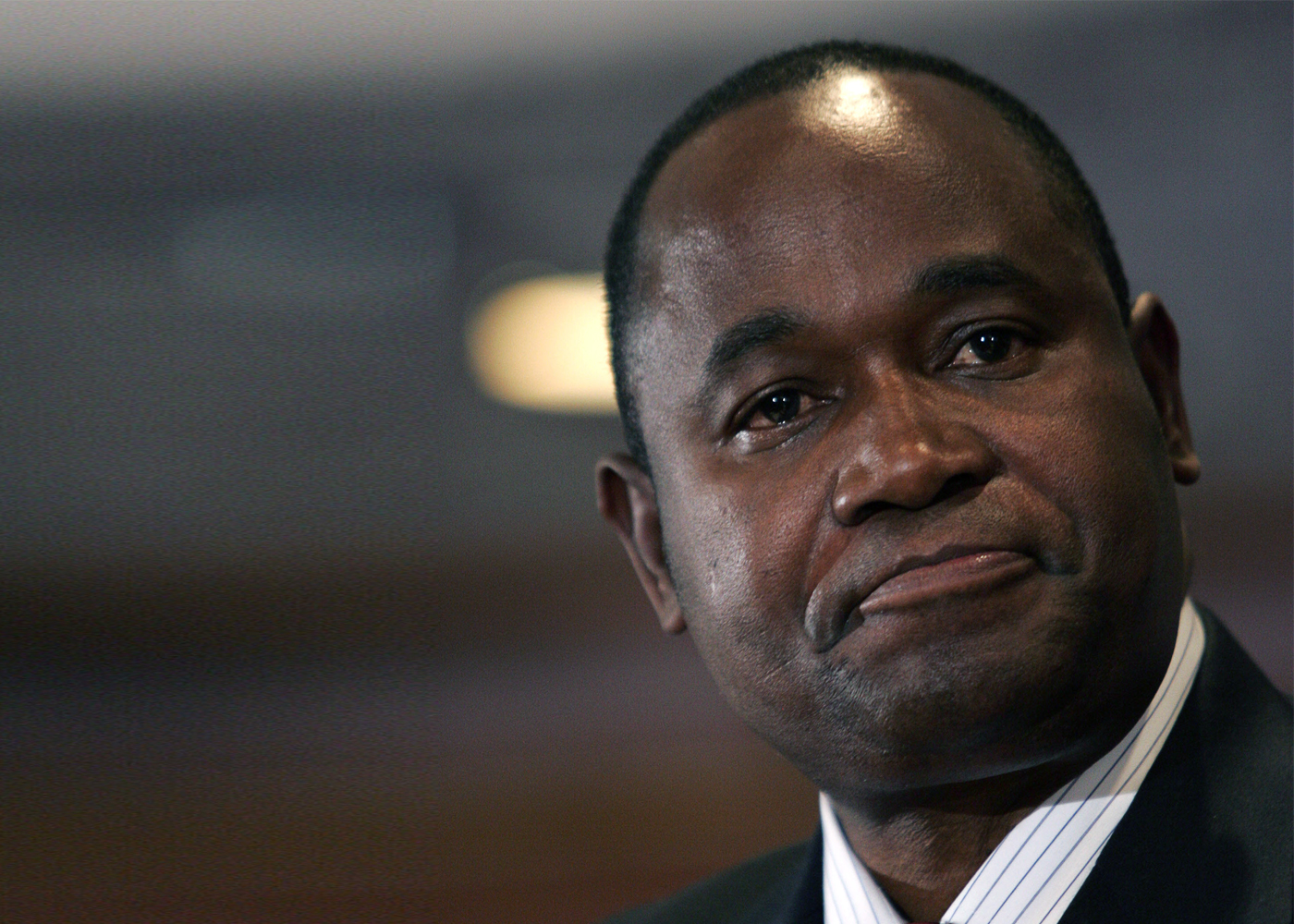
Dr Gideon Gono, who retired in December 2013, after a 10-year tenure as governor of the country’s central bank, the Reserve Bank of Zimbabwe, was at the forefront of the country’s fight to survive crippling economic sanctions. How Zimbabwe survived the sanctions is the story told here in graphic detail, and exclusively to our editor, Baffour Ankomah, by the man who was at the eye of the storm. This is Dr Gono’s first interview since his retirement as he has adamantly refused to speak to the media.
NA: You were in office for 10 years as governor of Zimbabwe’s central bank. Did you enjoy your time as governor and how would you like to be remembered in respect of that time?
GG: When the story of Zimbabwe’s survival between 2000 and 2008 is finally told, and told accurately, not by people who want to claim public credit for Zanu-PF’s 2013 electoral victory as if they are, or they were the only factor in that victory, the ending will probably read something like: “When it was easier to give up than continue; when some people who today bask in the glory of the country’s survival were throwing stones at it; when the country faced its greatest danger and economic onslaught post the liberation struggle; and when dark nights seemed to last forever with no dawn appearing in sight; when spring, summer and autumn seemed to have permanently disappeared from Zimbabwe’s seasonal calendars leaving unending the chills of winter for its people, he was there.
“He was there to defend the country, to stand by its people, by its economy and stood by all its legislature, executive and judiciary. He stood by its industry, its miners, farmers, security, defence and law enforcement machinery, and sustained them all in defence of the country’s sovereignty and territorial integrity. He was bashed left, right and centre but he and his team, under the wise leadership and guidance of President Robert Mugabe, remained standing, until a political solution was found which later brought in five years of sustained economic stability and growth.”
No other African country has been visited by such sanctions
That is how, in its sober moments, I think Zimbabwe itself sees my tour of duty over the last 10 years. I am sure that even my worst enemies will agree that Zimbabwe could have by now been turned into an Afghanistan or Somalia, with refugees all over and millions having died in what might have been the worst “human, not monetary inflation” in terms of the number of deaths that had ever been recorded in a post independent African country, if we had not done what we did. Some would be criticising me from their graves – that is, if the dead people were in a position to tell their tales!
Now, did I enjoy it? Of course there was no choice but to execute my duties with an outward passion that depicted equanimity and to suppress the internal misery, anger and hurt.
NA: You must have had high and low moments during your tenure, let’s begin with you telling us some of the low points?
GG: Well, I believe that the essence of leadership is to avoid sinking when the tide is low or being swept off your course when the tide is high. In both cases, the courage to remain in the water, the creativity to navigate out of the high or low tides, and conviction and common sense are what the ship’s captain requires.
President Mugabe has all these qualities and some of us who worked closely with him literally every day, during all the economic challenges of my governorship, were cushioned from the worst effects of that traumatic period by his sheer wisdom and dexterity in motivating troops under attack.
There were, however, some incidents that the president could not do anything about so I got really affected. One such was when my three children, Passion, Pride, and Praise were chased out of Australian universities as sacrificial lambs to feed the ego of the MDC-T leader, Morgan Tsvangirai, who was on a visit to that country. In order to appease him, the Australians took revenge on innocent children whose parents were being accused of standing in the way of Tsvangirai’s failed regime change agenda.
My three children were at various universities in Australia and they were deported together with five other students belonging to Justice
Minister Emmerson Mnangagwa, Defence Minister Sydney Sekeramai, Chief Justice Godfrey Chidyausiku, Commissioner General of Police Augustine Chihuri, and Legislator David Chapfika.
It was a very sad moment for us to go and receive these innocent children from the airport. Up to today, we and the children reflect upon that dreadful act, considering that it is a long-held tradition in any conflict situation that women and children should not be deliberately targeted.
An eight-day visit by Tsvangirai led to eight children’s academic lives being sacrificed. Thankfully, President Mugabe asked me to try to financially assist the children to find alternative universities, and today, the kids have found their feet again. But minus any apology from my home-boy, Tsvangirai, whose village ironically now falls under my political leadership as the Buhera Senator-designate, in Manicaland Province.
NA: That was the first low point?
GG: Yes, the second low moment in my tour of duty was when I woke up one day in July 2008 to find my name among a so-called “criminal cabal who now make up the Mugabe regime” (in the words of the then British prime minister, Gordon Brown), splashed all over the internet, especially on the Daily Telegraph website in Britain. Brown, and the US secretary of state Condoleezza Rice had drafted a UN Security Council resolution seeking to prevent me and 13 other Zimbabwean officials from travelling anywhere outside Zimbabwe or risk being arrested for non-existent crimes other than serving our country faithfully.
The other members of the so-called “cabal” were: President Robert Mugabe, General Constantine Chiwenga, Comrades Emmerson Mnangagwa, Augustine Chihuri, Perence Shiri, Happison Bonyongwe, Paradzai Zimondi, David Parirenyatwa, George Charamba, among others.
The third low point came in February 2012 when I discovered, to my great surprise, that my former personal assistant and policy advisor had for eight years been conspiring and working against me. I wasted no time in firing him. But in what I thought was an amicable separation, after being paid, the next day he was all over the place making all manner of allegations against me that the courts are still to decide on. To say I felt severely betrayed by his untruthful utterances and absurd claims against me is a serious understatement. Obviously I can’t say much beyond this because the matter is due to come for trial in September 2014, after which the real truth and motives behind the betrayal shall be exposed.
NA: You single out three low points, what of the high points?
GG: Sure, sure you cannot talk of hell without heaven. The high points were in fact many more than the low points. I will single out just one or two.
In 2005, the International Monetary Fund (IMF) publicised to the world that they were going to expel Zimbabwe from the IMF membership over our arrears, which amounted to $120m. Because of the catastrophic effect of such an eventuality on Zimbabwe and the SADC region as a whole, incredible diplomatic efforts were made and pressure applied to Zimbabwe through regional power blocs to get Zimbabwe to accept help from certain quarters on condition that President Mugabe would publicly announce when he would step down from office and also, dismiss certain ministers in his cabinet.
Of course the president rejected such conditionality and together we calculated how we were going to rescue the country using our own resources. This we succeeded in doing and with less than 24 hours of the deadline, the world woke up to the news that Zimbabwe had settled its arrears, to the great chagrin of its detractors.
The pleasure of walking in the IMF corridors of power and addressing the IMF Board, who, instead of being happy that we had settled our arrears, were now criticising us for “wasting scarce foreign currency resources on debt clearance instead of buying food and medicines for the people”, simply threw me into a state of uncontrolled positive shock over what I regarded as a hypocritical concern for the welfare of our people, yet inside their folders the same Board was carrying papers to close us down for non-payment of our arrears.
Another high point was when we had run out of foreign currency to buy anything and everything we wanted, including fuel, medicines, fertilisers and seeds, food and critical spare parts for our intelligence, defence, and military machinery among other needs.
We decided to convert our Zimbabwe dollars into foreign currency in a legal and transparent way without violating any international laws. You would therefore read reports predicting that Zimbabwe would close shop in so many days time, yet come the appointed time, the country was booming. It is these and many other mind games which are responsible for our continued survival during those extraordinary times, which demanded extraordinary interventions and thinking outside the box.
It was after the then USA ambassador to Zimbabwe, James McGhee, caught wind of our financial engineering and gymnastics keeping the country afloat against all odds, that they hatched a sinister plan “to offer me a job as a senior vice president of the World Bank or any other international financial institution which they [the USA] controlled” as a way of getting me out of the Reserve Bank of Zimbabwe, our central bank, and out of the country in July 2008. I declined.
Some of the “highs” relate to how we mechanised our agriculture, how we fought and contained the 2008 cholera outbreak, how I negotiated with former UN secretary general, Kofi Annan in Geneva to stop Zimbabwe from being discussed negatively at the UN Security Council.
NA: Turning to the economy, what was the greatest challenge that precipitated the decline in the country’s fortunes for almost a decade?
GG: Sanctions, sanctions, sanctions! The country’s liberation struggle was centred on the land and it became inevitable that in order to fulfil the aspirations of the people, land redistribution, which was part of President Mugabe’s government agenda from 1980, had to be tackled head on. You know well that land is an emotive issue the world over.
To put the land question into perspective, one needs to go back to President Mugabe’s historic speech on the eve of our independence: “There are people without land who need land, people without jobs who need jobs, children without schools who need schools, and patients without hospitals who need them. We are also fully aware of the need for increased wages in all sectors of employment. My government will certainly do its best to meet the existing needs in these areas.”
We never wanted any Zimbabwean to suffer
Twenty years on, there was no land redistribution to the landless majority, so the masses took the matter into their own hands and demanded that the president fulfil one of his inauguration promises. The government had no option but to embark on a Fast Track Land Redistribution Programme and this was the whole genesis of the illegal Western sanctions that were imposed on the country from 2000 onwards.
The economic measures and tactics employed were brutal, vicious and dirty, all aimed at bringing the Zimbabwean economy to its knees and causing “regime change”. Uninformed people will talk about economic mismanagement, human rights abuse, absence of the rule of law, and all other forms of nice-sounding descriptions as the causes of our economic problems, but the real reason was the illegal sanctions that were imposed on our small country. They led us to behave and react the way we did, as we tried to survive the unprecedented onslaught against our country.
No other country in Africa has ever been visited by such sanctions and pressure from all corners of the West, and survived a change of government or regrettable re-enslavement and re-colonialisation of its people other than Zimbabwe.
NA: President Mugabe has become the only African leader – both traditional and political – in pre- and post-colonial African history who is still standing after being assailed by the combined might of the nations of European stock. How do we account for this?
GG: Well, as I said, no other African country in the history of economics has actually withstood the kind of pressures that we went through. We are yet to document how we did it, but let me say to you that we surprised many people and the credit must go to President Mugabe. He directed all our actions and operations, so credit for the survival of the country and Zanu-PF as a party goes to him, not me.
NA: Zimbabwe’s inflation rate rose astronomically. Couldn’t you have controlled it to a more reasonable level?
GG: We could have kept inflation below double digits if this was an option but it wasn’t. As a central bank, we could have pushed a hard-nosed tight monetary policy and not printed any money. We would have had low inflation if we had decided not to try to assist industry and get involved in other quasi-fiscal operations. By being blind to the realities of our situation, and pursuing conventional in-box economics, we could have kept our inflation to even single digits but at what cost? This is the issue! At the cost of very high inflation in terms of dead bodies!
There would have been lots of dead bodies lying in our streets, of children, the elderly, the vulnerable, and the sick, piling up in the hospitals and streets on a daily basis. Our only option was to go for a lesser evil, and we chose monetary inflation in place of dead bodies. It was a deliberate choice!
Dead men have no tales to tell, and that was our philosophy. With the wolves at the door, we had to use each and every tool at our disposal to defend the family rather than let the enemy have their way.
During that period, we experienced floods and droughts that destroyed our crops, and if we had not done what we did through the central bank, and through the interventions that were directed by none other than President Mugabe, people would have died of hunger or from the lack of medicines.
NA: What you did was quite revolutionary, wasn’t it?
GG: Yes indeed, and as I said earlier, the credit should go to President Mugabe. We sat down, the President and I, and agreed to deploy any sovereign tool that was at our disposal and that included the printing of money or “quantitative easing” as it was later called the world over after 2008.
We had no foreign currency, but we needed foreign currency to buy medicines and food. We are not a fuel producing country but we couldn’t do without fuel. Our industry depended literally on 70% imported inputs and needed foreign currency. Our agricultural output was not good enough at the time and we needed foreign currency to import food. Our military needed spare parts. We had national elections that required funding as a constitutional imperative, and all these requirements needed our creative attention.
If we had not done what we did and our law enforcement agencies had failed to do their duties properly, the same outside forces would have been the first ones to scream the loudest about the breakdown of law and order in Zimbabwe, and the need to send international forces to “protect civilians”.
NA: Like they did in Libya.
GG: Exactly. They would have used the pretext of protecting civilians to come in here to execute their selfish regime change agenda. If we had not done what we did to capacitate and keep our military machinery in place, we would have been fodder for our enemies. But because the world was aware that our defence forces were well taken care of, they dared not even dream of attacking us militarily.
NA: In fact, you also promoted the mechanisation of agriculture.
GG: Thank you for reminding me about that. Yes, in order to fortify ourselves against hunger, we had to get our farmers to use the land more productively and this meant that we had to quickly mechanise our farming operations. We also had to print money in order to build dams and irrigation infrastructure on farms, turning some farms from one-season farms to two- or three-season operations.
NA: But in choosing not to keep inflation to below double or single digits, a lot of your countrymen and women seriously suffered during this time.
GG: I concede that point. But what confronted us was no walk in the park. It was war, economic and political war! We never promised anyone that there would be no pain. We had to sweat! We had to work in overdrive, and in the process there was collateral damage or unintended consequences that befell our people. I regret that, but we had no option. The choice was for us to succumb, put our necks on the guillotine and accept being cut. That we refused.
We never wanted a single Zimbabwean to suffer. But I accept that people suffered, and I take full responsibility for that. It was in the execution that we may have erred or failed. But the failure was not out of a desire to inflict pain on our people.
NA: You once described yourself as “a development-oriented governor”. Yet under your watch, Zimbabwe’s economy imploded. Looking back, what would you say was the real cause or causes? Many people have propounded theories about the causes. I want it from the horse’s own mouth.
GG: [Laughs.] Zimbabwe’s economy never imploded. Yes, it suffered but never imploded. It depends on which matrix of survival you choose to use but nevertheless, I will start by referring you to what President Mugabe once said during a State of the Nation address. He said: “We are all witnesses to the futility of trying to turn around our economy in an environment of pointless conflict.”
In other words, he was pointing us to the elephant in the room, which was conflict among and between Zimbabweans, pointless conflict. In our situation, it is a fact that the economy is subservient and highly susceptible to the politics of the day, it is a servant of the political unity or disunity in the country and the politics between Zimbabwe and its trading partners, as well as the goodwill or otherwise of those with the power to upset our economic welfare.
The political history of our country that led to what others call economic “implosion” can be traced back to October 1997 when we started the process of land identification in terms of the 1992 Land Identification Act.
On the genesis of our problems, our president has always said: “It was always about the land. It is today about the land, and it will always be about the land.”
The land issue has been at the centre of the economic sanctions imposed on us, which I have alluded to earlier, and everything around us revolves on the land. Over and above the land-induced sanctions, it is very instructive – and many people don’t know this – to point out that Zimbabwe had never at any time during its history been without external aid and support of one form or another. During Federation days, it was Britain and the others who used to help the country financially with balance of payments support.
During the days of Ian Smith (1965-1979), again, it was some British, South African, and American innovative financial structures that helped ameliorate the funding impact on the economy and country at large. Then from 1980 to 2001 (after the new state of Zimbabwe was born) the country received a total of $2.5billion of IMF, World Bank, and AfDB balance of payments support.
Now, from 2002 until I left the central bank in December 2013, nothing, and I mean zero funds, came to Zimbabwe from the IMF, World Bank, AfDB, and other donors in the form of balance of payments support. Absolutely nothing! Zero!
I became governor in 2003, two years after the beginning of the drying up of external support. Therefore, people who talk about my era of governorship and try to compare it with that of any other governor are misinformed because the periods are different, with different challenges. It is a miracle how we survived. When you see the impact of the lack of support graphically, you begin to appreciate what we had to do. In short, it is the illegal sanctions, which I equate to terrorism, that led to the deterioration and near collapse of our economy.
NA: You have been saying that “sanctions are equivalent to massive military action against poor societies”. Is that how dramatic it is?
GG: It is worse than that. It is genocide. It is indiscriminate. Therefore, it is a fallacy, the height of hypocrisy, for any nation to have said these were targeted sanctions. What targeted? When a country cannot get funds to buy drugs, there is nothing “targeted” about it.
The lack of medicines in hospitals affects the unborn, it affects the woman who is in labour, it affects the newly born, it affects the elderly, it affects the child who is going to a kindergarten, it affects teachers, nurses, priests, drivers; it affects adults who are supposed to be working, it affects even the dead in the sense that when they are in the funeral house waiting to be taken to their final places of rest, they stay in the morgue longer than they should.
The reason being that the hearse does not have fuel or has broken down, and there are no spare parts. This is the nature of the banditry called sanctions.
NA: Again in 2007 you said: “The last line of defence is the power within ourselves to print money. We don’t need foreign exchange to build roads and dams. We need local currency. So we print the money here to finance infrastructural development, because infrastructure is not inflationary.” This is why your critics say the subsequent economic implosion was all your fault. You printed too much money?
GG: But if we had not printed money, which was our only line of defence, what would have happened to the cholera victims, what would have happened to the disaster-recovery programmes that were executed by our very able, well-equipped, well-trained, and well-fed soldiers who, without the printed money, would have left flood victims to die? Today, the same critics are sitting in the comfort of their offices because they still have the breath of life in their chests. If we had not printed money, by now they would have been eaten up by moths, and most of them would not have probably made it to heaven.
NA: In 2007, you also said: “We are guided by conviction and not convention, and where convention meets conviction, well and good. What drives us is the belief that what we are doing is the correct thing.” My question is: If what you were doing was right, why did the country ditch the Zim dollar for the US dollar as its national currency?
GG: Whenever you are fighting a war, you ought to be guided by pragmatism. We are a pragmatic people. We know when to take two steps back in order to make 10 forward. The stage at which we are now is a stage where we are re-starting our engines, we had cooled them down. Re-starting your engines or cooling them down is no sign of defeat at all. It is only a pause, and a pause is not a defeat.
NA: Towards your retirement, you became a fervent advocate of the non-return of the Zim dollar, why?
GG: No, no, no. I was wrongly quoted. In fact if the people of this country had followed my advice and that of President Mugabe, when we introduced the multi-currency regime, we would not be experiencing the liquidity challenges that we are facing today. Furthermore, for your information – and this is backed by documentation, dates, and facts – multi-currency was not introduced during the Government of National Unity as is often said. Not even just before it. Multi-currency was something that we studied as a central bank project between May and August 2008.
We even licensed petrol stations, certain supermarkets, and wholesalers to participate in the exercise. We held a launch of this approach at the Harare International Conference Centre in August 2008 and pronounced that we were going to carry out this experiment under a licensed framework until November 2008, when we laid the groundwork for multi-currencying this economy.
NA: And you say you were misquoted about not wanting the return of the Zim dollar?
GG: Once the authorities have decided on a way forward, a cadre’s duty is to support that way forward and not necessarily be discordant. I never said the Zim dollar was not going to come back. But as governor of the central bank, I did set conditions that would allow the Zim dollar to come back, and such conditions include at least 6 months’ worth of foreign reserves, a sustained track record of economic growth, with factories operating at not less than 80% of capacity utilisation, with a debt-GDP ratio that is below the 50% mark, with exports significantly outpacing our imports …
NA: But that is a tall order!
GG: A tall order, yes. But when you look at the different kinds of fruits, some are produced by some of the tallest trees, but people never stop going after them just because it is a tall order. No. It is the determination of the people to get there that matters. The taller the challenge, the greater and more exciting it is to achieve it.
NA: And somehow when the multi-currency regime was introduced, the massive hyperinflation which was tearing the economy apart, disappeared overnight. How was that possible?
GG: It was merely a base that we were using which changed. There was nothing magical about it. Where we needed one trillion Zim dollars to get one US dollar, we now decided to talk about the US dollar alone, no reference to the Zim dollar. So it doesn’t mean much, it is simply the currency of measurement and transacting which changed. The mindset did not.
And here is the dichotomy, which is the question that I want to throw back to those people who believe or believed that Gono was the problem. Here is the mantra that was sold to people in 2008-09: One, “For us to do well in this country, for us to enjoy life and prosperity, Gono must go.” Two, “Gono must stop printing currency.” Three, “The Zim dollar must go.” Four, “Gono must stop quasi-fiscal operations”. Five, “Gono’s powers must be clipped. Once these [priorities] are done, we shall live happily ever after.”
So, since 2009, Gono never printed a single penny. Gono never undertook any quasi-fiscal operation. Gono’s powers were clipped. For the last six months, from January to June 2014, Gono is nowhere to be seen. But what is the situation now?
People are worse off than when Gono was there. The capacity utilisation of factories has gone so low (30%) that you can’t believe it; it is the lowest since records began. Poverty levels are far, far higher than they were in 2008. The banks can’t get any money. Civil servants, soldiers, police, pensioners, war veterans, and the rest of them are not getting their pay and pensions on time. But Gono is not there. Gono is gone!
In 2008-09, it was also said that if our inflation were in single digits, we would live happily ever after. Our inflation today is below 0.5%, not even 1%. It is actually better than America’s! But we are worse off. Our budget deficit is serious, our import bill is serious, our balance of payment position is worse! Similarly, unemployment is high – every week people are losing their jobs. You can’t look at our social poverty statistics, it’s terrible. And order is nowhere in sight. It shows the laziness in the thinking of people.
There are fundamental issues that have remained constant with or without Gono, and those are what must be tackled, not personalities. We are not singing from the same hymnbook. It is the politics again! The sanctions are there, and we are witnessing the futility of trying to turn around our economy in an environment of pointless conflict.
NA: Given what has happened to Zimbabwe in the last 14 years, do you still have faith in the international financial system?
GG: Yes, there are no two ways about it. We have a role to play and we shall play it as a giant. We have just been asleep and elephant riders know when to ride an elephant. It is when it is on the ground, when it is asleep. That’s the best time to ride an elephant because when it rises, it will rise up with you.
By this I mean there are people out there who do not see the opportunities in Zimbabwe now. They can only do well if they ride us at this stage, not later.
Gideon Gono’s full interview is in New African N °541- July issue