Seventy years have passed since Alan Paton’s remarkably prophetic novel, Cry, the Beloved Country was first published, but the issues raised then still continue to haunt South Africa. Fred Khumalo* describes why the book still continues to exert a powerful influence on emotions in that country.
Many may not have realised that 70 years after Alan Paton’s Cry, The Beloved Country was first published, much of the novel’s persistent message of the inevitable triumph of good over evil has been fulfilled: the National Party, which came to power at the same time as the publication of this classic novel and immediately introduced the racist policy of apartheid, is now dead.
Written in a hot-white rage, at a frenetic speed – Paton started writing it in September and finished on Christmas Eve in 1946 – the book was a cry of despair and a cautionary tale of how the theft of black people’s land by their white conquerors would not only complicate race relations in South Africa but might lead into a bloodbath.
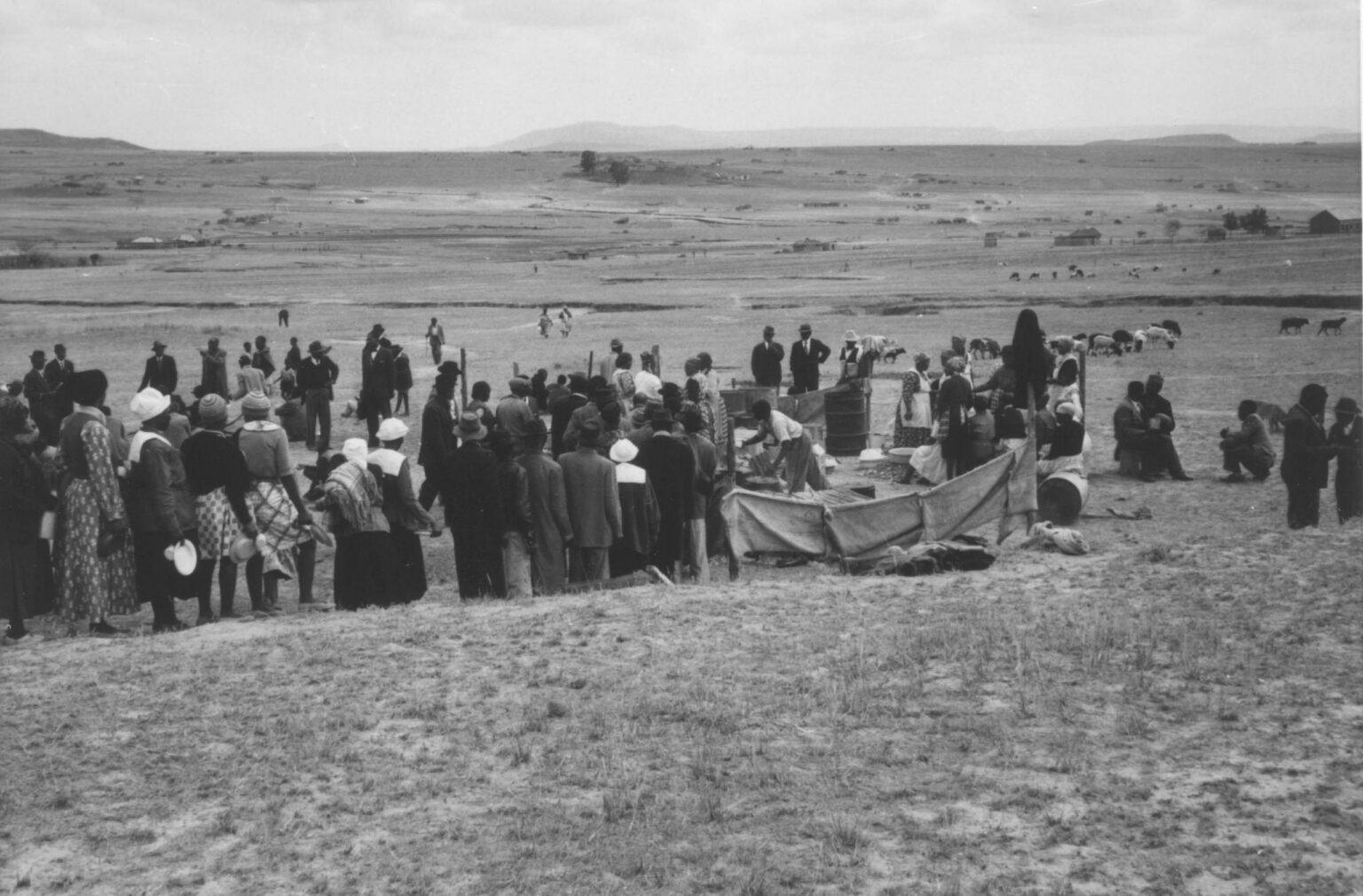
The power of Cry, the Beloved Country is its simplicity. It tells the tale of Reverend Kumalo, whose family flees to the city when it becomes clear to them that the land that they have been dumped on, after being forcefully removed from their ancestral home, cannot sustain them.
But the move to the city happens gradually. Reverend Kumalo has a younger sister, Gertrude, who is married to a local man who, after being blessed with a son, decides he has to go to the gold mines, there to earn enough money to sustain his new family.
When his time is up, however, the man does not return from the mines of Johannesburg. So, Gertrude asks her brother for permission to go to Johannesburg to look for her missing husband. Upon arrival in Johannesburg, she writes back home to say she arrived safely and that she will duly embark upon her search. Weeks pass, months pass, Gertrude does not write again. A worried Reverend Kumalo then sends his son, Absalom, to look for Gertrude in Johannesburg.
Absalom is swallowed up by Johannesburg, never writing back to his parents. While they are still figuring out how to deal with this growing crisis, the Kumalos receive a letter from a mission house in Johannesburg. The author of the letter says the mission house has found Gertrude. She is very sick. Would Reverend Kumalo come up to Johannesburg to fetch her?
Indeed, he jumps on the train. In Johannesburg he is happy to be reunited with his sister. Gertrude then tells the reverend that she’s been in contact with young Absalom. But he’s gone missing.
A few days later, Reverend Kumalo learns that his son has been involved in the killing of a white man. The dead white man happens to be the son of James Jarvis, who owns a farm that adjoins Reverend Kumalo’s own mission station! Fate works in mysterious ways indeed.
When the book came out in February 1948, published by Scribner’s in the US, it became an instant bestseller for the simple reason that it opened the horrors of white oppression in South Africa for the whole world to see. More importantly, as the following years would show, the book proved to be highly prophetic.
Written in 1946, it foretold the story of apartheid (literally, ‘apartness’), a policy of racial segregation in all spheres of life as it was officially introduced by the National Party which came to power in May 1948.
“And some cry for the cutting up of South Africa without delay into separate areas, where White can live without Black, and Black without White…”
The book has sold millions of copies over the years, and been translated into numerous languages, including Zulu. It has been adapted for the big screen twice: the first movie adaptation came out in 1951 featuring Sidney Poitier as Rev. Msimangu, Canada Lee playing Rev. Kumalo. The second came out in 1995, with James Earl Jones playing Kumalo.
A lot has happened in South Africa in the 70 years since it was first published, but the book still hasn’t lost its power to hold the imagination.
Tragic theatre
One could argue that many of the prophecies in the book have been fulfilled; that way, present-day readers are given a perspective on the book in some ways comparable to that of audiences in the Greek tragic theatre who know the outcome of the fateful struggle unfolding before them.
Five years after the National Party was kicked out of power, and Nelson Mandela’s ANC had ascended to the pedestal of power, the Ixopo area, in which the story of Cry, the Beloved Country unfolds, fell under the spotlight. White farmers were under siege, their cattle killed, fields burnt to the ground.
The horrific climax was the murder of a white farmer’s son, a story that would later be captured in investigative journalist Jonny Steinberg’s book Midlands.
When apartheid ended in 1994, two million black South African labour tenants were living under the proprietorship of 50,000 or so white farmers.
The advent of democracy emboldened black people who had suffered silently under the jackboot of white officialdom to question things without fear. Those whites still stuck in the past were soon to pay the price.
In an essay published in Granta magazine in 2013, Steinberg summarised the fate of the Mitchell family, who lost their son Peter to the violence: “Peter Mitchell died on a frontier, not so much between Black and White, or between the landed and the landless, as between the past and the future.”
The novel’s inevitable denouement speaks to this complication of race relations. This is what Reverend Msimangu, Kumalo’s friend says: “I have one great fear in my heart that one day when they are turned to loving, they will find we are turned to hating.”
The breathless intensity of the words can never be over-emphasised. At the time the words were written in 1946, the black masses were on their knees, begging their supposed white fellow countrymen to allow them a place under the sun.
Soon, the song would change. The 1950s would see blacks embarking on what came to be called the Defiance Campaign, where, as would happen with the civil rights movement in the US, they defied the laws of the land.
They used amenities reserved for whites. They burned their passbooks, which were official documents that authorised black people to be in an urban setting.
One of these campaigns of defiance took place on 21 March 1960 in a small township called Sharpeville, to the west of Johannesburg.
In the subsequent stand-off between the marchers and the police, 60 people were killed in cold blood, shot in the back as they were running away from the scene, when it became clear the police were intent on unleashing violence.
That same year, the people’s organisations, in the form of the African National Congress and Pan-Africanist Congress were banned.
It was only then that these organisations resorted to armed resistance to the violence of the apartheid state.
They each launched their armed wings. These in turn mounted attacks on strategic government installations – police stations, electrical power supply stations, and so forth.
A passage from the book presages the spectre of anger, of violence: “What if this voice should say words that it speaks already in private, should rise and not fall again, should rise and rise and rise, and the people rise with it, should madden them with thoughts of rebellion…”
The voice did indeed rise and rise, opening the stage for 16 June 1976 student uprising in which 500 kids were killed by the police in the first week.
The uprising continued, intermittently, until the following year when the father of Black Consciousness, Steve Biko was killed by the police in his cell in Pretoria on 12 September.
South Africa would never be the same again. The apartheid regime collapsed and was replaced by the ANC of Mandela in 1994.
But the new party couldn’t readily reverse the horror of land dispossession without falling foul of the carefully crafted constitution of 1996, the result of the give-and-take negotiated settlement between the old regime and the black liberation movement. The constitution put great emphasis on the protection of (white) private property.
What is called The Land Question in South Africa has become topical once again, after the government proclaimed its expropriation without compensation campaign.
Mixed messages
This sent mixed messages. Some white farmers said it was the government’s way of saying black people could just plunder white-owned properties. But the other side argued that those whites who asserted that they had bought the farms they occupied should go back into history, which would show them that they’d bought stolen property in the first place. It’s a long and intricate subject that deserves a book on its own.
Only days after President Cyril Ramaphosa made the proclamation, US President Donald Trump tweeted: “I have asked Secretary of State @SecPompeo to closely study the South Africa land and farm seizures and expropriations and the large scale killing of farmers. The South African government is now seizing land from white farmers,”
Meanwhile, back in Ixopo, many white farmers have regained their equanimity. The Mitchells and others from the old era have left. The Mitchell farm has been taken over by labour tenants, some of whom have lived there for five generations. They live on it but are too poor to farm it.
The other neighbouring white farmers who stayed behind have moved fast to build bridges between white and black, landed and landless. But the fear is far from over.
“Cry, the beloved country, these things are not yet at an end. The sun pours down on the earth, on the lovely land that man cannot enjoy. He knows only the fear of his heart.” NA
Fred Khumalo* is the author of Dancing the Death Drill.