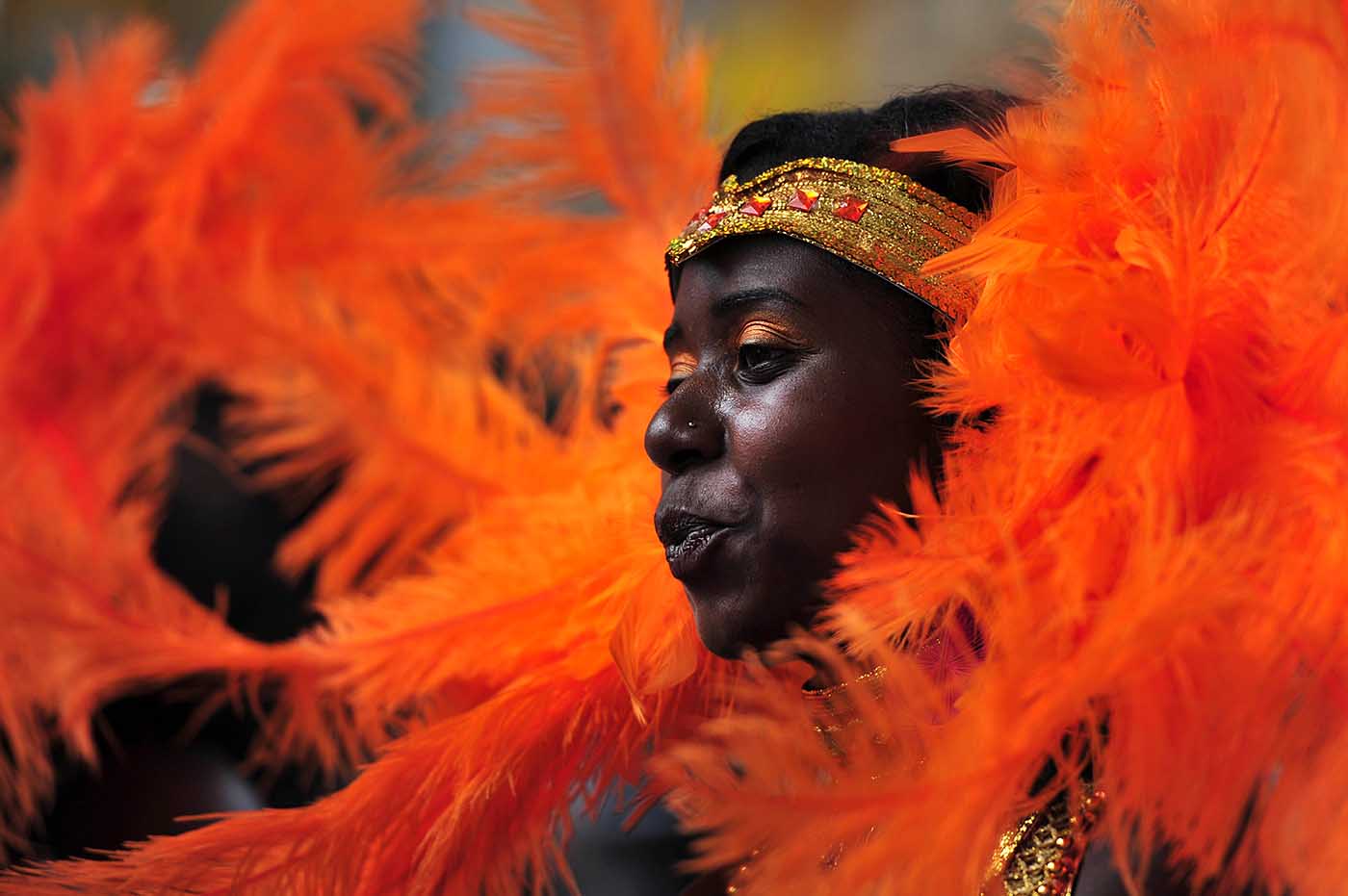
The Notting Hill Carnival, which takes place every August in London, is the world’s second largest street festival, after the Rio de Janeiro carnival in Brazil. A new book tracing its roots shows it was conceived as a way of healing the racial tensions of the area by releasing pent-up emotions through music and dance, and integrating the community regardless of race or creed. Juliet Highet reports.
The main component of Carnival – A Photographic & Testimonial History of the Notting Hill Carnival, is the evocative, dramatic and often moving images taken by several photographers over the decades.
A collaboration between Margaret Busby OBE, writer and publisher, and Ishmahil Blagrove Jr, a filmmaker and the book’s editor, Carnival is the first book to tell the inspirational tale of how a minor street festival held in what was once one of Britain’s most deprived and racially turbulent areas, blossomed into one of the largest and most dynamic celebrations of international culture anywhere in the world.
Carefully chosen, succinct quotes pepper this weighty 351-page triumph, like: “[In] all the years that the Carnival has been going, the media has never explained its historical, cultural or artistic aspects … [It] is still portrayed as a place where people are mugged and where there are plenty of drugs. There are more drugs at Ascot and more violence at a football match” (Charlie Philipps, photographer).

The book chronicles the origins and history of the Carnival, with journalist and broadcaster Darcus Howe saying: “Carnival is a continuity of what we had been doing before slavery. We brought Carnival to Britain in our bones… [It] wasn’t a memory, it was an instinct.”
As Margaret Busby points out in her preface: “It has spiritual, sacred and secular roots. Carnival is a time to throw off shackles, cast inhibition to the winds, to reclaim freedom, to be whomever one chooses to become, to feel what it is to be another personality, to lose oneself through playing mas… It would be difficult to deny the African roots of carnival.”
Carl Gabriel, a Carnival artist, explains: “Mas is short for masquerade and masquerade is a mask on your face. Mas comes from traditional ceremonial or religious practices. In the Caribbean, we no longer have that connection so much with Africa, and so we have transformed the religious purpose into a secular one.”
Michael La Rose, a former Carnival organiser, adds; “The masquerader is taken over by the mas and interprets [it] through dance and movement. It comes directly from African spirituality. In Trinidad it is dominated by the Yoruba orishas. It’s all about possession, the music taking you to a place where you are possessed by the orisha and the orisha tells you what you should do…
“If you look at Egungun masquerade in Nigeria, it’s the same as the Sensay masquerade in Dominica… they call it Pierrot Grenade in Trinidad, and I think ‘shaggy bear’ in Barbados. African retention in masquerade is strong all over the Caribbean.”
Leslie Palmer, Carnival organiser from 1973-75, says the event has an ancestral significance: “The mysticism and sacrificial element involved in playing mas serves as the final milestone in the transportation of our deepest culture in a foreign land.”
Carnival is Europe’s biggest street festival with, as Busby points out: “Annual attendance figures, according to police sources, at more than one million in 2013, while others suggest more than two million, [making it] second only in size to Brazil’s Rio de Janeiro carnival.”
She also highlights the fact that it is “nothing short of miraculous that it continues to thrive, despite chronic lack of official funding… with year on year reductions.”
“In their millions” is the caption for a photograph of the vast, multi-cultural surge of humanity through the streets for two glorious days, though “the seeds of preparation are sowed and nurtured all year long”, as the caption for a photo of a contemporary interpretation of African mask and costume demonstrates: “Some costumed bands have as many as 300 performers who work throughout the year to create their costumes. Skills in batik and tie-dying, fabric design and printing were used by this band.”
Other repercussions run deeper. The award-winning band, Mahogany, operates constantly as a not-for-profit social enterprise, run by designer Clary Salandy, who says of its far-reaching role: “We are dedicated to helping underprivileged young people develop their skills and build greater confidence through the art of Carnival.”
Carnival has often been used as a vehicle of protest, a means of highlighting injustice and drawing attention to social problems
Carnival has become part of the UK calendar, it is not just Caribbean people’s Carnival. With “audience” participation part of the spectacle, Winston Findlay, a steel-pan musician, summarises: “Carnival is now part of our English heritage. It is about freedom of expression on the streets. Britain would be a very gloomy place without it.”
Actor Jules Walter, cousin of Kelso Cochrane, an Antiguan carpenter murdered in 1959, says: “Carnival is a feast of fools where you take off your social masks and become who you want to be.” Michael La Rose adds: “A man who is a dustbin collector can dress up as a King. He is a King because he believes he is a King and his costume takes him to that fantasy.”
As the racial murder of Kelso Cochrane indicates, the story of Carnival had dark beginnings. The post-war backstreets of the London district of North Kensington housed a community scarred by racial tension, poverty, slum landlords and consequent acute overcrowding and appalling accommodation. Photos show how Carnival has often been used as a vehicle of protest, a means of highlighting injustice and drawing attention to social problems, the 1973 Carnival being titled “Mas in the Ghetto”.
The carnage of the Second World War bequeathed a desperate labour shortage in Britain, and so waves of Caribbean immigrants arrived, joining working-class English, Irish, Greeks, Spaniards and Jews in the degraded and degrading tenements of Notting Hill and Brixton. Militant, often unemployed whites were attracted by the fascist Oswald Mosley, whose slogan “Keep Britain White” exploited their fears, setting them on a collision course with immigrants, black ones in particular.
A climax of racial tension exploded into the Notting Hill Race Riots of 1958. Darcus Howe comments: “If there weren’t race riots in Notting Hill, I don’t believe that we would have had the Notting Hill Carnival. If it wasn’t for the murder of Kelso Cochrane, Carnival wouldn’t have happened… If you saw [his] funeral, there were thousands of people singing and dancing. It was that rhythm of resistance that said we are done with this.”
Some political activists were inspired to bridge cultural gaps to ease the tension. One of them, Claudia Jones from Trinidad, initiated a Caribbean Carnival in 1959, an indoor celebration televised by the BBC. The concept was to build unity among disparate peoples by showcasing Caribbean culture, and having a good time together. Jones edited the West Indian Gazette, the first black weekly newspaper in Britain, which organised subsequent indoor Caribbean Carnival cabarets.
The outdoor Notting Hill Festival of 1966, from which Carnival eventually grew, was the brainchild of social worker Rhaune Laslett, of Native American and Russian descent.
The idea came to her in a vision, a haublecha, as it is known among Native Americans, in which she saw people of many races dancing together in the streets; “in brightly coloured costumes, they were dancing and following bands and they were happy,” as she described it to The Caribbean Times.
Together, Laslett and photographer John “Hoppy” Hopkins founded the London Free School, a community action adult education project. Their members joined Trinidadian steel-pan players and Guyanese activist Andre Shervington, who encouraged the Caribbean community to participate, and publicised the upcoming 1966 Carnival, playing their saxophones in small processions.
The objectives were to entertain local children, lift the spirits of people in slum conditions and ease racial tensions. The Sunday prior to the bank-holiday event is still dedicated to children. At this first Carnival, when the Trinidadian musician Russell Henderson and his group started playing pan, Caribbeans flooded onto the streets, hearing familiar home sounds.
Metronomes band-leader Everley Mills says of pan: “I got into trouble quite a few times with the law, but it was the love of the pans that kept me focused.” Later, steel bands joined Carnival, and more and more elaborate costumes appeared.
Although Carnival was always characterised by its multi-culturalism, and played a key role in expressing the identity of Black British youth of both African and Caribbean descent, it became increasingly militant for a while. Jules Walter says it was “a bohemian rebellion against the whole society, created by people who were left out of the structure by the conservative society”, rebelling against oppression by the police and the Establishment.
Both the Black Power movement spreading across the Atlantic and Rastafarianism gripped minds. The 1976 Carnival was the year of major confrontation between young blacks and police, with steel-pan player Rasta Billy saying, “Carnival became the opportunity that many of the black youths born in Britain had to express their anger on a national basis and to confront the police and let them know the forces of black anger.”
Darcus Howe adds: “In that time Bob Marley was kicking it with Get up, stand up, stand up for your rights. We didn’t need a better anthem than that.”
Now it’s 2014, and “Carnival is all about good vibes and happy times,” says musician Phil Fearon. “Jazz, Blues, Reggae, Soca… we have given the world a lot and the Carnival is all part of that journey,” adds Clary Salandy.
Margaret Busby sums it up: “Carnival remains emphatically and defiantly emblematic of Notting Hill. That alone is a lasting tribute to those who conceived it as a way of healing the hurts of the area – as Rhaune Laslett put it, ‘of releasing pent-up emotions in music and dance, and integrating the community regardless of race or creed.’”