The Nigerian media did cover the Boko Haram massacre in Baga, northeastern Nigeria. The international media mainly did not. In the wake of this brutal mass killing and the massive coverage that the attack on French satirical magazine Charlie Hebdo received, Elnathan John asks whether Nigerian lives are “ungrievable”.
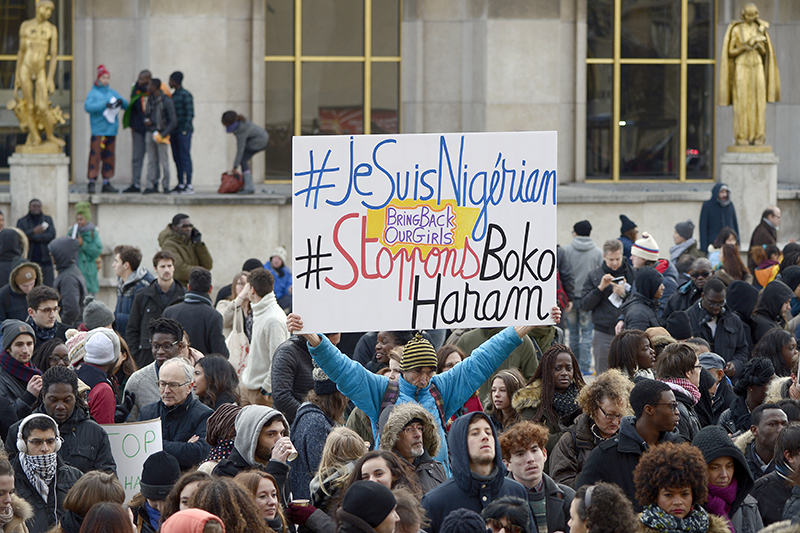
On 7 January 2015, two masked gunmen found their way into the premises of the French satirical weekly magazine Charlie Hebdo and killed 12 persons including the editor. On the same day, suspected Boko Haram militants were in the closing moments of a killing spree that lasted days, in Baga, a town in Borno State, northeast Nigeria. Amnesty International says the Baga massacre may have claimed two thousand lives. As the world binged on the Paris massacre, outrage followed in many quarters, accusing the international media of ignoring the Nigerian attacks, which were, at least by the numbers who died and the property destroyed, massively more disastrous.
Beyond the rhetoric on social media, many other commentators tried to explain this disparity in media coverage. Ethan Zuckerman, Director for Civic Media at the Massachusetts Institute of Technology, in his article “Media Coverage of Charlie Hebdo and the Baga Massacre: A Study in Contrasts” posited that one of the reasons there was “no global hashtag campaign or march for the victims of these most recent Boko Haram massacres” was that while Paris is a “highly connected global city with thousands of working journalists”, Baga is “isolated, difficult and dangerous to reach”. He stated also that while the Paris attack came as a shock, the Baga massacre was just another violent incident in Boko Haram’s five-year insurgency, pointing out that even in Nigeria the Paris attacks received far more coverage online.
Mixed reactions
Zuckerman was right about the Nigerian response, but only to the extent of the online media. A lot, if not most of Nigerian media is still largely print, radio and TV. A close look at newspaper headlines between 3 January and 7 January, when Baga was under siege, reveals that the charge that even Nigerian media chose Paris over Baga is, at least, exaggerated. On 5 January, Daily Trust, one of Nigeria’s biggest newspapers and certainly the most widely read and distributed in Northern Nigeria, had as its front-page headline the Baga story as it was unfolding. That same day another of Nigeria’s most popular newspapers, THISDAY, had as its front-page story: “Boko Haram Captures Baga, Kills Scores in Borno, Yobe”. Weekly Trust, a weekend edition of Daily Trust, on 10 January carried “Shocking Tales of Baga Survivors” as its main story.
It might be easy to claim, based on online statistics, that Nigerian media did not report enough about an individual horrific act. This claim ignores certain important facts. First, there was an attack in Paris, while there is a war in Nigeria. This war is over five years old and hardly a week goes by that there aren’t reports of kidnappings, bombings, massacres or the ambushing of Nigerian soldiers.
Second, the nature of the conflict makes it impossible most of the time to do more than estimate the destruction or number of deaths after Boko Haram has attacked. Also, more recently, Boko Haram has changed its hit-and-run mode of operation to hit-and-occupy. The Catholic Church in Nigeria, through Archbishop Oliver Dashe Doeme, has listed up to 25 towns in the northeast of Nigeria that were under the control of Boko Haram. Local journalists are hardly ever able to reach the actual locations of the fighting and rely on the evidence of persons who claim to be eyewitnesses. Much of the time, there is no way of verifying such claims.

Third, there is a numbness that has developed among Nigerians from regular reports of killings. Based on this alone, one might even commend the Nigerian media for still giving the war front-page coverage, five years on. The inaction of the president himself has done much to add to the general apathy. It took him three weeks and much pressure from all around the world to acknowledge that there was indeed a mass kidnapping of schoolgirls who were preparing to write exams in the town of Chibok in April 2014. It also took the visit of the Pakistani activist Malala Yousafzai to prompt the president into meeting some of the parents of the kidnapped schoolgirls, three months later. Some supporters of the president had even denied the kidnapping ever took place and called it a plot by members of the opposition to discredit the government. It is important to note that Boko Haram militants had regularly kidnapped boys, girls and women prior to that Chibok incident. In fact, a lawmaker from the region, Senator Ahmed Zanna, claimed in July 2014 that Boko Haram had over 500 women in their custody from several abductions.
MIA government
Also worthy of note is the fact that Baga had been decimated before; only then, in April 2013, the massacre was allegedly carried out by the Nigerian military. In that attack, according to Human Rights Watch, over 200 persons were killed in what seemed to be a scorched earth reprisal by soldiers, following the death of one of their number in a shoot-out with Boko Haram in that town days earlier. As the army blocked journalists from getting there following the massacre, President Goodluck Jonathan ordered a probe into the killings. As is so often the case, it led nowhere.
The posture of the Nigerian government suggests a general embarrassment with the horrible manifestations of the war against Boko Haram. This embarrassment, however, is not one that spurs the government to action or creates a will to win the war or at least show that it is tackling it head on. While the media in Nigeria has deep-rooted problems of its own – poor education, a lack of financial independence, little job security, no insurance, low salaries and corruption – most outlets have, in the case of Boko Haram, been as diligent as is possible under the circumstances.
The obligation of the journalist to report the truth or to keep news proportional and comprehensive is only effective if the persons in power and the citizens are capable of responding to such truth. There is a tragedy fatigue that seems to have overcome Nigerians, mostly through decades of dehumanisation in the form of unresolved massacres, ethnic and religious violence, crime, and extrajudicial killings by security forces. Thus, the reports of the murder of hundreds of persons in a war that has taken the lives of several thousand over a few years, are unlikely to have the same effect as those about the killing of a dozen people in an otherwise peaceful city.
‘Destructible’ lives
Judith Butler writes on “grievability” in war in the book Frames of War: When is Life Grievable?, saying that: “The shared condition of precariousness leads not to reciprocal recognition, but to a specific exploitation of targeted populations, of lives that are not quite lives, cast as ‘destructible’ and ‘ungrievable’. Such populations are ‘lose-able’, or can be forfeited, precisely because they are framed as being already lost or forfeited.”
In a general sense, Butler’s words apply to the Nigerian condition. With a war going on, half of the Nigerian population living in poverty and not connected to the national power grid, the country’s population seems to be “lose-able” and in many ways our ability to grieve again and again for victims of relentless violence is greatly reduced. In a specific local sense, Butler’s words also apply. The northeast of Nigeria has about the worst human development indicators in the country. It has one of the lowest rates of education, and some of the highest rates of infant and maternal mortality, to mention just a few. The region is a far cry from the bustling cities of Lagos, Port Harcourt or Abuja. It is for this reason that, within the country, it is easier to sympathise with educated victims of violence living in large cities than with dozens who die weekly in the far-flung towns and villages of Borno.
There is no way around having a responsive and responsible government that understands the need for bringing its population out of poverty using its vast resources. Nigeria needs a government that has the ability to feel shame and act on that shame when tales of tragedies fill up the front pages of its newspapers.