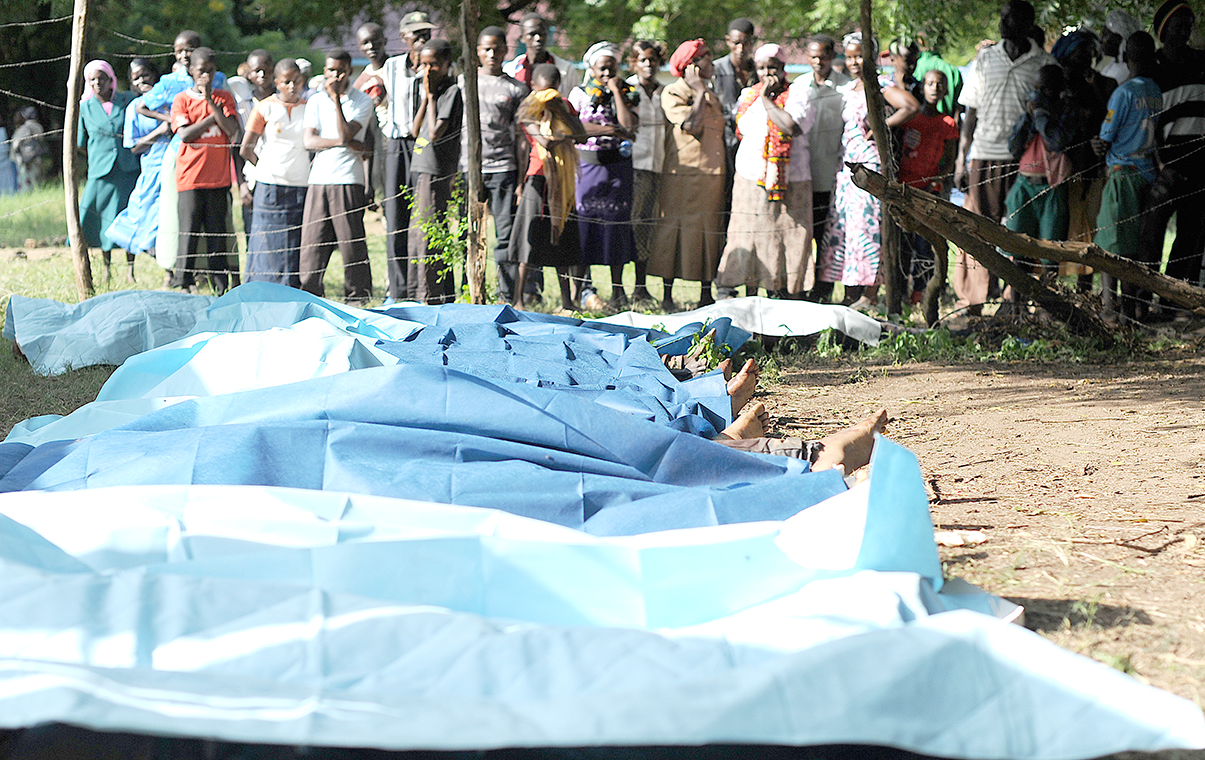
Somalia’s Islamic militants al Shabaab were not responsible for the mid-June killings of over 60 people in Mpeketoni in the Kenyan north coast resort county of Lamu, about 300km from Mombasa. Wanjohi Kabukuru reports.
According to Kenya’s President Uhuru Kenyatta, the bomb-blast killings in Lamu county in June were politically engineered by a section of Kenya’s disenfranchised political class.
“The attack in Lamu was [the] well-planned, orchestrated and politically motivated ethnic violence of a Kenyan community, with the intention of profiling and evicting them for political reasons. This therefore was not an al Shabaab attack,” said President Kenyatta in a televised address to the nation a day after the macabre killings.
Al Shabaab had claimed responsibility for the attacks in this tourist region, acknowledged as one of Kenya’s most secure zones owing to the concentration of security agents within a 200km radius.
In September 2013 the Somali militants had laid siege to the up-market Westgate Mall in Nairobi in what they claimed to be a revenge attack due to the presence of the Kenyan military in Somalia.
“Evidence indicates that local political networks were involved in the planning and execution of the heinous attacks,” Kenyatta added. “This also played into the opportunist networks of other criminal gangs,” he said, giving a new twist to the saga.
The demands made by CORD for the national dialogue include discussing rising insecurity.
According to Kenyatta, the security agents in the region have been suspended from duty and some of them will be charged with “negligence and abdication of duty” as intelligence on the planned attack had been shared suitably. But while the security officials were interdicted, Kenyatta was silent on the measures taken on the politicians and financiers connected to the killings.
In recent weeks there has been heightened political tension in Kenya following the demands by former PM Raila Odinga, who leads the opposition’s Coalition for Reforms and Democracy (CORD), for a national dialogue on issues confronting the country.
This insistence by the opposition has been rejected by Kenyatta. Among the six demands made by CORD for the national dialogue are to discuss rising insecurity, the weakening economy, changes in the electoral body and sleaze in government.
Odinga claims that the unwillingness of Kenyatta to summon a national conference would create a “storm”.
Two days before the Mpeketoni massacre Odinga had reiterated his challenge to the government at a political rally in Mombasa to drum up support for his national dialogue demands.
The killings also coincided with travel warnings issued by the British government and followed the closure of the UK Consulate in Mombasa.
Legislators drawn from President Kenyatta’s ruling Jubilee coalition have rallied in support of the rejection of “national dialogue” and accused Odinga of being used by the West to foment a crisis in Kenya.
Apparently, unlike Kenyatta, Odinga enjoys warm relations with the west. They cite Kenyatta’s dalliance with the Chinese and other emerging economies as key reasons for the frosty relationship between Kenya and her former Western allies, including the US.
The Jubilee coalition – made up of the United Republican Party (URP), led by Deputy-President William Ruto and Kenyatta’s The National Alliance (TNA) – has been engaged in a bitter war of words against CORD.
Odinga’s Orange Democratic Movement (ODM), the Wiper Democratic Movement (WDM) and Ford-Kenya, led by former Vice President Kalonzo Musyoka and a former foreign affairs minister, Moses Wetangula, are the parties that make up the CORD alliance.
According to the Jubilee parliamentarians Odinga is not sincere with his “Nusu Mkate” (half-loaf) demands which are a derisive interpretation of Kenya’s brand of power-sharing coated as a coalition government. Since Odinga’s return from a three-month tour of the US his scathing criticism of Kenyatta’s government and calls for dialogue have dominated news headlines for the entire month of June.
With both Kenyatta and Odinga hardening their respective positions, security fears and political tension are building up at an alarming rate, setting the stage for a particularly rough political time for Kenya.