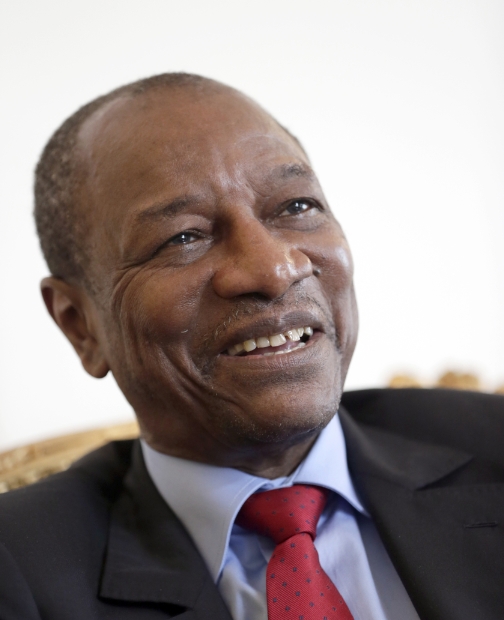
When President Alpha Condé came to power in Guinea in November 2010, he talked about “inheriting a country, not a state”. Does he share the same view three years on? Nick Kochan interviewed him for New African.
President Alpha Condé has spent the last three years building the structures of a state, not least a democratic government and a durable economy that is relevant to Guinea’s state of development. These worthy goals need to be sold to the people of Guinea. That is Condé’s challenge.
According to him: “The people are keen to see their standards of living improving. But because macroeconomic progress, including the lowering of inflation, does not really materialise in a day-to-day way for the people, there is a great deal of impatience. We have an African expression: ‘An empty stomach doesn’t have any ears’.
“It is also important to understand that when everything is a priority, it is perhaps difficult to focus on one aspect that you can demonstrate has improved, because you have to tackle everything at once. And where do you get the resources?”
Condé believes the country moved into a new phase following last September’s parliamentary election, which succeeded in producing a new legislature. Riots and deaths preceded the election but electoral procedures were followed and the outcome strengthened his position.
He says: “The democratic process was finalised recently with the legislative elections. So really the country has entered a new phase. It is going to be all about investment, attracting more bilateral and multilateral partners as well as the private sector. The focus of this investment will now be on youth employment and the fight against poverty. This is the priority moving forward.”
He goes on: “Since coming into office, the priority has been to re-establish macroeconomic stability, the normalisation of the country, and re-engaging with multilateral partners – other than the IMF and World Bank – who have not engaged with Guinea before. It has taken about two-and-a-half years to get to this level. Now we are ready to show the world that we have much to offer private investors.”
Condé, who is 75 years old, had a long time to develop his plans for the renewal of Guinea. For many years, he lived outside the country, mainly in France, where he worked at the Sorbonne University in Paris as a law academic. He watched as his country moved in 1958 from a French colony to independence, suffering under one autocratic president after another.
His party, the Rally of the Guinean People, entered presidential contests in 1993 and 1999 but failed each time. He was imprisoned at various times.
Civil war risked tearing Guinea apart in the years before he took power. The previous president, Lansana Conte, died in 2008 and competing factions let the economy collapse. Guinea had failed to service its debt obligations and was blacklisted by the IMF.
Only essential aid was allowed in. Money was printed to pay soldiers, but many public servants were unpaid and inflation was rampant. Corruption, says today’s finance minister, Kerfalle Yansane, was endemic.
The country held democratic elections under pressure from international agencies and governments which were concerned that Guinea would become a failed state.
Condé’s victory in the elections was by the narrowest of margins, but it was all the more remarkable as he comes from the Malinke ethnic group, which makes up 35% of the population. His defeated rival, Cellou Dalein Diallo, is a member of the Peul ethnic group, to which 40% of Guineans belong.
The new government, to cement its position, quickly adopted economic and political measures that pointed a way forward. The international community was involved from an early stage and they pushed for the appointment of an Africa Governance Initiative (AGI) in 2011 to strengthen Guinea’s democratic procedures.
The AGI is an organisation set up by the former British prime minister, Tony Blair, after he left office, to assist African governments to better manage their affairs. Condé was introduced to Blair by George Soros, the hedge fund manager who runs the Open Society Foundation.
According to Condé, Blair has been helping Guinea “by bringing in technical expertise and the human resources that we are lacking. We are centralising the implementation of the vision so that change can be organised from the centre, and driven by the leadership.”
The president says Blair has provided experts and “he has helped us fill some of the capacity and human resources gaps that we had. We are clear about where we want to go, but we probably need some more help in implementing it.”
George Soros is thought to be interested in the progress of a Mining Code, recently developed by Guinea. Another international statesman supporting Condé has been Bernard Kouchner, the former foreign minister of France under President Sarkozy and a personal friend of Condé’s.
The international community sought to assist Condé’s efforts to cement democracy by enhancing scrutiny of the country’s armed forces, which had become bloated and inefficient because of corruption.
Military spending was a drain on the country’s budget, accounting for 40% of the total, and Condé took a knife to the structure. “We had an inverted pyramid with more officers than you had enlisted men,” Condé says. “Some of the colonels could not write their own names but each year everyone was promoted, regardless of their performance.
“There was no proper structure, no meritocracy, and it was pillaging the country. No change could have taken place in Guinea without reforming the army.”
The changes Condé brought in were typically forward-looking and geared towards professionalism rather than privilege. The government performed a barometric census of the army and subsequently retired 4,000 soldiers.
A ban on promotion was also introduced, at least until individual qualifications had been established. “One needs to get back to a system where there is accountability of performance for promotion,” Condé insists.
The measures allowed the government to greatly reduce the military burden on the budget but the changes came with a price. Disaffected soldiers attacked the president’s house in July 2011, six months after Condé took power. The president narrowly escaped with his life. Observers say this only strengthened his resolve to speed up the reforms.
Away from the armed forces, economic reforms have also been urgent. The development of agriculture has been a priority for President Condé. “We need to encourage labour-intensive industries, notably around agriculture. The motor of this will be trying to produce locally what we consume, and consume what we locally produce.
“We don’t only want to reach self-sufficiency very quickly by seeing imports decrease and production increase, but we also want to move rapidly beyond the stage of local production for domestic use, to become one of the greatest exporters of such commodities.
“We believe that in the future, commodities such as rice and all other foods will be just as important as oil is today, because food security is increasingly becoming an issue for the rest of the world.”
In addition to agriculture, the president sees the scope for building a small- and medium-sized enterprises (SMEs) sector. Two banks are being set up to boost SMEs and stimulate employment. One is a development bank to grant loans and credit at lower rates than offered by the commercial sector. “This,” Condé says, “will enable them to lend to SMEs and to entrepreneurs.”
The second bank will offer mortgages, because, in Condé’s opinion, “poverty alleviation is critical to ensuring that people have decent housing. And the microfinance linked to the development bank represents another opportunity to provide loans to those who are not currently able to obtain finance.”
The question of import substitution is critical to Condé’s plans as the country seeks to create a domestic business infrastructure to protect its currency.
“We are basically trying to reverse the current trends in regard to investment,” the president says. “Currently, banks tend to focus on import-driven activities that do not create value. So we want to reverse this by creating a different profile of financial institutions which will then target our goals.”
Guinea’s efforts to build its domestic infrastructure are matched by a push to attract outside investment into the natural resources sector. The country’s undeveloped mineral resources include graphite, iron ore, limestone, manganese, nickel, and uranium.Mining currently accounts for 26% of Guinea’s $6.7 billion GDP (as of 2012) and agriculture accounts for 20%. Rio Tinto, Vale, and Chinalco are already present in the country, but Condé is seeking further investors, including those from the Gulf.
The strategy is already bearing fruit following a conference held in late November 2013 in Abu Dhabi, when a $5 billion investment from Guinea Alumina Corporation (GAC), a joint-venture company owned by Mubadala (an investment and development company in Abu Dhabi close to its rulers) and the government of Guinea was announced. This will develop a bauxite mine and aluminium refinery.
Condé says: “The development plan will create at its peak 14,000 direct and indirect jobs and contribute substantially to the country’s GDP. We are seeing further benefits from our long-term strategic partnership with the UAE.”
Guinea can now be said to have a visionary leader whose mission is to appeal to all levels of society, from the wealthy investor to the unemployed. But the pressure to deliver on his electoral promises is intense, while the consequences of failing to make the changes he promised are severe. It is not enough to set the roadmap. Condé has to show his government is moving down the road at a pace the people can believe in and appreciate. There is his challenge.