African sustainable energy enterprises swept the board at the Ashden Awards this year. The Ashden Awards are the renewable energy standard, and extremely valuable both in cash terms and the worldwide attention they draw to the people and companies they honour. Stephen Williams reports.
As the Ashden Awards recognise, we live in a world where 1.5 billion people lack access to modern forms of electricity and three billion cook on smoky, inefficient stoves and outdoor fires – while the industrialised world depends on fossil fuels and the inefficient use of energy resources. Most scientists are convinced that fossil fuels are doing irreparable harm to our planet through global warming and threaten the global population in general, and the lives and livelihood of Africans in particular. That is why the Ashden Awards promote universal access to sustainable energy.
As Sarah Butler-Sloss, the founder and director of Ashden explains: “At Ashden, we’ve seen that enterprise is vital to achieve the speed and scale we need to get clean energy to the people who need it most – and tackle climate change.”
Each year, a shortlist of projects and companies deemed worthy of recognition is chosen. Ashden Awards are made to both UK-based enterprises, including a special Award to school projects, and international candidates – and this year was no different, except in one regard. The international candidates were all drawn from Africa.
Winning the gold prize, and a cheque for over $60,000 was Solar Aid. New African spoke with Steve Andrews, the company’s chief executive and learnt that this company has already sold well over half a million solar-powered lamps in East and Southern Africa – Kenya, Malawi, Tanzania and Zambia (and is about to move into and begin operations in West Africa later this year). Andrews wants to have one million lamps distributed by the end of 2013. “Our goal is to eradicate the kerosene lamp from Africa by 2020,” Andrews says.
What seems to have caught the Ashden Awards’ jury’s attention with this company is both the messianic zeal they have to rid Africa of nasty, inherently unsafe, smelly and polluting kerosene, and how the company has tackled the “final mile” in terms of getting its solar lamps to remote rural communities.
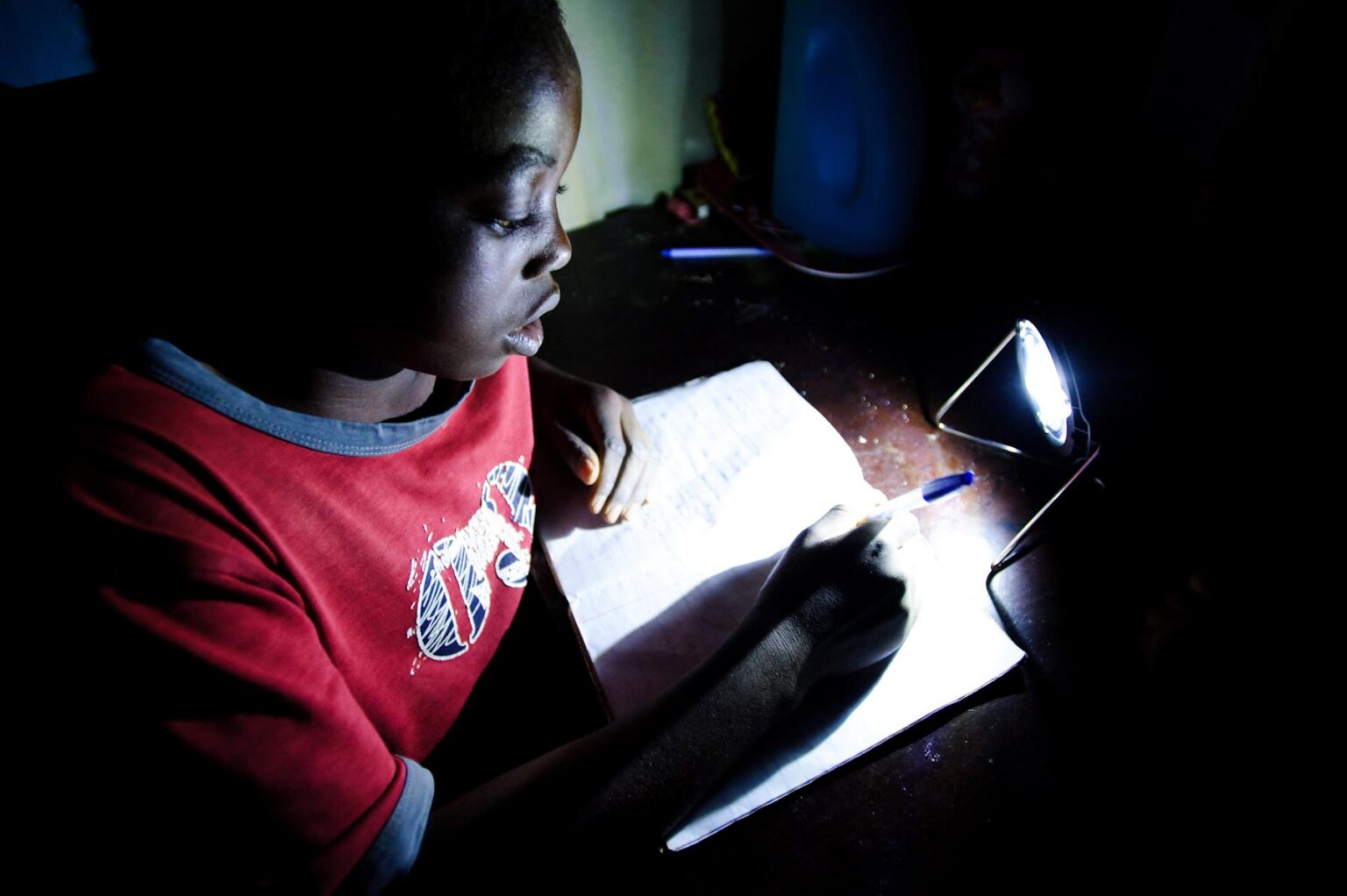
It is a staggeringly simple business model. Andrews explained that Solar Aid invites rural school teachers to meetings in provincial towns and there explains and demonstrates the lights to the teachers. The teachers then return to their schools and take orders from their pupils’ families. The basic light, that costs around $10, is a quite sizable expense for many families, but they soon find that they can save a considerable sum on buying kerosene or candles.
It is not just the savings they can make, but parents quickly understand that their children, by having reliable reading light after sunset, do far better with their homework and school studies in general. That also provides the incentive for the teachers to promote the lamps, and while they do not earn a commission as such, their schools can also benefit from receiving some of Solar Aid’s larger products.
And it is not just light that the Solar Aid products can provide. These handy little photovoltaic units, small enough to slip into a jacket pocket, can also recharge mobile phones, saving subscribers who are not on the grid the trudge (and the time and money) to travel to a local store to recharge their phones every few days.
When New African asked Andrews just how he thought Solar Aid and its partner company Sunny Money, would use the prize money, he explained that in his opinion it was not the money that was so important, but the stamp of credibility that the Ashden Award would place on his company. As he put it: “This is considered the gold standard by our peers in the renewable energy industry.”
Solar Aid was not the only solar energy project to receive an Ashden Award. So too did the Tanzania-based Azuri Technologies. Azuri, which launched in 2011, is now in 11 countries in sub-Saharan countries and supplies solar solutions in the form of small systems that can bring good quality light and phone charging to off-grid households. Recognising that many potential customers for their devices would find it difficult to meet the up-front costs of solar panels and inverters, they have developed a pay-as-you-go system that operates in exactly the same way as mobile phone top-up scratch cards.
Households usually sign up for what Azuri calls its “Indigo Duo” package. This comprises of a small 2.5W photovoltaic panel (about the same size as a large-ish notebook computer), with a 3.3Ah LiFePO4 re-chargeable battery that can power two 60 lumen lights plus a USB output for mobile phone charging. As the customer uses the weekly pay-as-you-go system, the equipment is gradually paid for.
If the customer runs into any sort of problems, Azuri monitors usage and, as Simon Bransfield-Garth, the founder and chief executive of Azuri explained to New African, they will call the customer to discover any issue with the equipment, and rectify it, should usage stop. When asked whether the security of a photovoltaic panel being installed on people’s roofs posed a problem, Bransfield-Garth said that would-be thieves realise that the equipment is useless without Azuri’s scratch-card top-up, and that the company had also designed it in such a way as to get around this particular problem. As another layer of security, top-up codes are sent via a secure SMS to customers, after they send the customer services department the scratch card number. Without the code, the system will not generate electricity.
But the Ashden Awards also recognised other types of sustainable energy systems as deserving of acknowledgement, such as the many enterprises that are focussed on supplying efficient cook stoves that will use less biomass fuel, such as firewood and charcoal. Impact Carbon is one such organisation. Its operational model is to partner with local and international organisations the world over to improve health, protect the environment and fight poverty by using carbon finance.
Impact Carbon are experts in developing carbon finance projects and have over the last decade brought efficient and cleaner technologies to over one million people. It is a simple concept. Impact Carbon has identified that exposure to smoke from dirty fuels and inefficient cook stoves – which they believe over half the world’s population rely on to meet basic energy needs – causes two million premature deaths each year, mainly of women and children.
While they are also involved with water filtration initiatives, that can also attract carbon credits as they save the firewood and charcoal that would be used to boil water to make it potable, the cook stove has posted some major achievements in East Africa. Impact Carbon reckons that improved cook stove technologies can save families more than $110 a year in fuel costs, typically reducing biofuel use by two thirds. In Uganda for example (one of five cook stove projects around the world), the improved cook stove has been distributed to close to 200,000 families. The organisation employs around 50 individuals and supports the income of 880 retailers.
Evan Haigler, who leads the Impact Carbon team in developing carbon finance for projects in less-developed countries, explained to New African that the Uganda operations alone have displaced nearly one million tons of greenhouse gas emissions and saved some 700,000 trees.
It’s a similar story in DR Congo where the World Wildlife Fund (WWF) is supporting the establishment of the local production of efficient cook stoves in order to cut down the use of charcoal. After trials and testing, the WWF selected the Jiko Nguvu Nyeusi (Black Power Stove) for mass production and distribution. This has a ceramic liner (made by local womens’ associations) with a metal stove body (made by mens’ associations).
The success of this project is staggering. By March this year, a total of 45,000 stoves had been produced by the WWF affiliates, with 55 per cent of them sold in Goma. Each stove costs under $10, and with the savings from charcoal they pay for themselves in about two weeks of normal use. The WWF project has also helped start a 3,900ha plantation to supply fast-growing trees for charcoal production on a sustainable basis.
The WWF is trying to stop the felling of trees in the Virunga National Park by illegal charcoal producers that previously supplied about 80 per cent of the charcoal sold in Goma, which the WWF’s Juan Sève (who leads the project) estimates has a population of around one million, 90% of who cook with charcoal. Virunga National Park is considered of huge importance for the biodiversity it contains, and it is also home to the endangered mountain gorilla. It is estimated that the Jiko Nguvu Nyeusi has saved 7,500ha of forest.