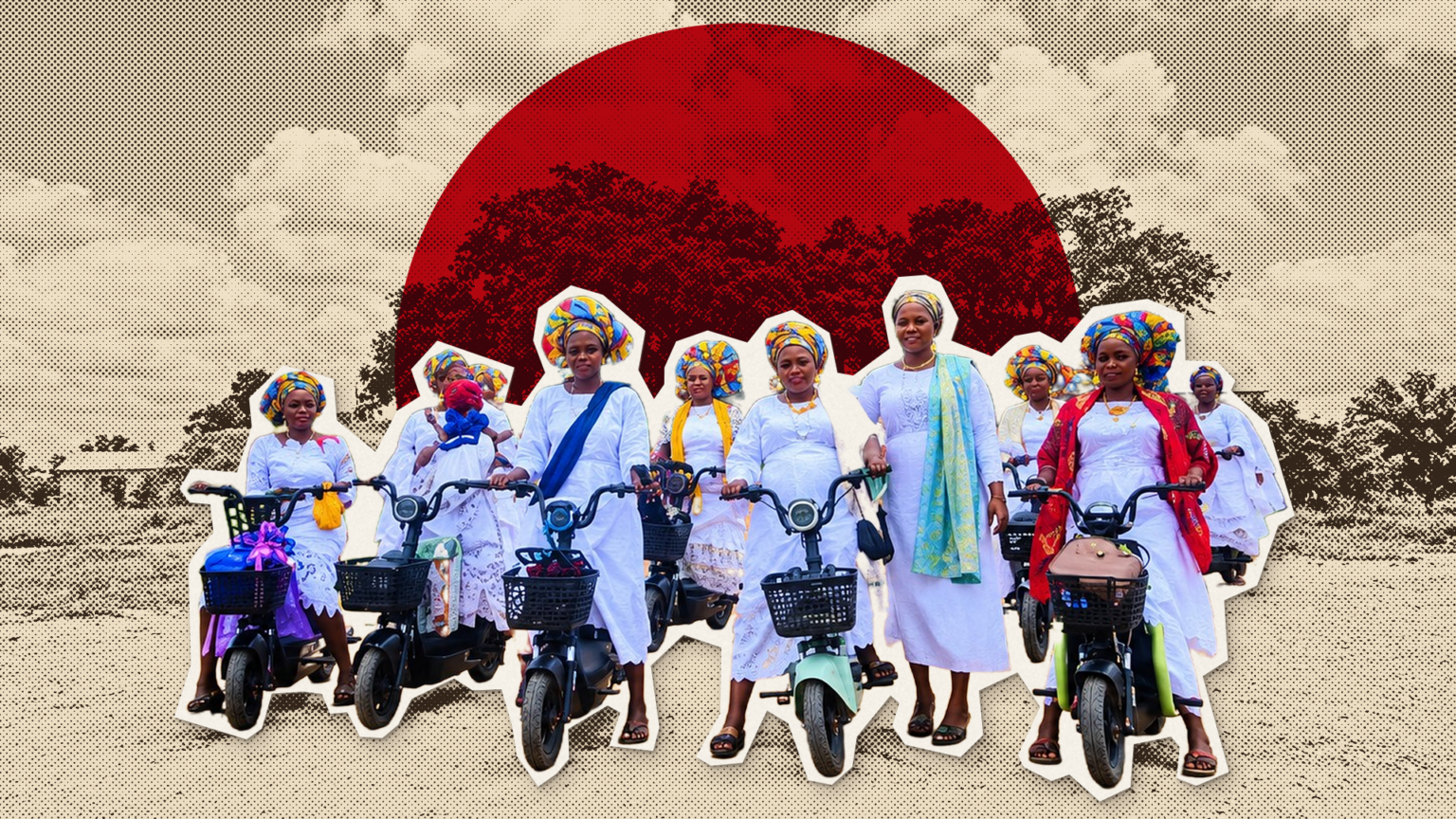
In Bolgatanga and Bawku, in Ghana’s Upper East Region, and other parts of the country, electric bicycles are providing some women with a new way to move around, conduct business and carry out their daily activities, offering an alternative to conventional petrol-powered motorcycles.
For traders who depend on transport to reach customers and move goods, the cost of fuel and the time spent travelling is directly connected to their livelihoods. Electric bicycles, commonly known as e-bikes, are emerging as an option that could ease some of these pressures while reducing dependence on petrol.
Hafsa Yemboni, a trader in Bolgatanga, is among the women who have adopted the technology. She says the bicycle is easy to operate, convenient to charge and has improved her mobility.
“It is very simple to use; it has improved my mobility. The charging does not take much time. It is just like charging your laptop. It is far better than fuel-powered motorbikes,” she told New African Magazine.
In Bawku, Abubakari Jamila, who sells motorcycle spare parts and irrigation equipment, says her e-bike helps her transport goods and reach customers more easily.
“It saves my strength and is very convenient,” she said. “I am happy with the e-bike. I can work without any trouble.”
For Basheru Shafawu Kazusa, a nurse, the electric bicycle has made moving around during her daily activities easier.
“The electric bike allows me to move freely, and I feel healthier already,” she said.
Their experiences point to the potential of electric mobility to support women whose work requires frequent movement. For traders, easier access to transport can help with deliveries and customer visits, while workers may benefit from greater flexibility in their daily routines.
However, the extent to which e-bikes can transform rural mobility will depend on factors including their purchase price, access to electricity, battery life, maintenance and the availability of spare parts.
Affordable transport
Unlike petrol-powered motorcycles, e-bikes produce no exhaust emissions. Their overall environmental impact, however, depends partly on how the electricity used for charging is generated and how batteries are manufactured, maintained and disposed of.
Yadea Ghana, the local arm of the world’s largest manufacturer of electric two-wheelers, says its basic pitch is an alternative to conventional motorcycles at a time when fuel costs and interest in more sustainable transport options are influencing consumer choices.
The company’s Sales Manager, Stephanie Seli Broni, told New African Magazine that electric bikes could help individuals and businesses manage their transportation expenses.
“With the increasing cost of fuel and the need for sustainable mobility solutions, electric bikes present an opportunity for individuals and businesses to reduce transportation expenses while enjoying the convenience of personal mobility,” she said.
“Our goal is to make electric mobility more accessible to Ghanaians and contribute to the development of a cleaner and more sustainable transportation system.”
Broni said one of the practical advantages of the company’s electric bikes was that they could be charged using a standard household electricity outlet.
For riders with access to electricity at home or at work, she said, this could remove the need for regular visits to fuel stations and make charging easier to incorporate into their daily routines.
The actual savings, however, will depend on the cost of electricity, the purchase price of the bicycle, battery replacement and maintenance expenses.
Yadea is one of at least seven companies in Ghana’s budding e-mobility sector, with the landscape being increasingly defined by financing options, as well as reliability and affordability concerns.
Building consumer confidence
Despite the potential benefits, such companies face the challenge of convincing consumers to consider electric bikes as an alternative to familiar petrol-powered motorcycles.
Yadea’s Broni said some prospective customers needed more information about the technology, particularly its performance, charging requirements, maintenance and reliability.
“Like every business introducing a relatively new product into a market, we have encountered challenges. One of the major challenges is creating awareness and educating customers about electric bikes,” she said.
That education may take years to build formidable demand, but the vast opportunities cleaner transport offers rural women are already clear.
“Beyond environmental sustainability, E-bikes provide women with affordable, convenient, and reliable transportation, particularly in rural and peri-urban communities where mobility remains a challenge,” Sylvia Adipah, a Research Fellow at the University of Energy and Natural Resources (UENR) in Sunyani, Ghana, affiliated with the Centre for Climate Change and Gender Studies, said in an interview with New African.
“This development can create economic opportunities in delivery services, small-scale trading, agriculture, transportation, and other entrepreneurial activities while reducing transportation costs and improving access to markets, education, healthcare, and employment.”
For women such as Yemboni and Jamila, the value of an electric bicycle is already being measured in practical terms: getting around more easily, transporting goods and reaching customers.