
The ANC will hold its national elective conference in Mangaung in mid-December. Inevitably, there will be a heated debate over the party’s leadership, especially in the wake of the Marikana Mine tragedy. New African invited the noted author and academic, William Gumede, to comment. He writes that official assumptions in South Africa about economic development, industrialisation and job creation are simply wrong, and need a radical rethink.
The failure of South Africa’s post-apartheid economic and social policies, and an inability to make the public service more effective, have kept racial inequalities in wealth distribution inherited from the apartheid system the same – there is a mainly poor black majority and a generally well-off white minority. To a large extent it is to blame for persistent violent anti-poverty protests, such as those at Marikana mine.
The new South Africa was founded in 1994 on brittle foundations. The economic, political and individual self-worth inequality ran along racial lines, and was deliberately fostered so by apartheid governments.
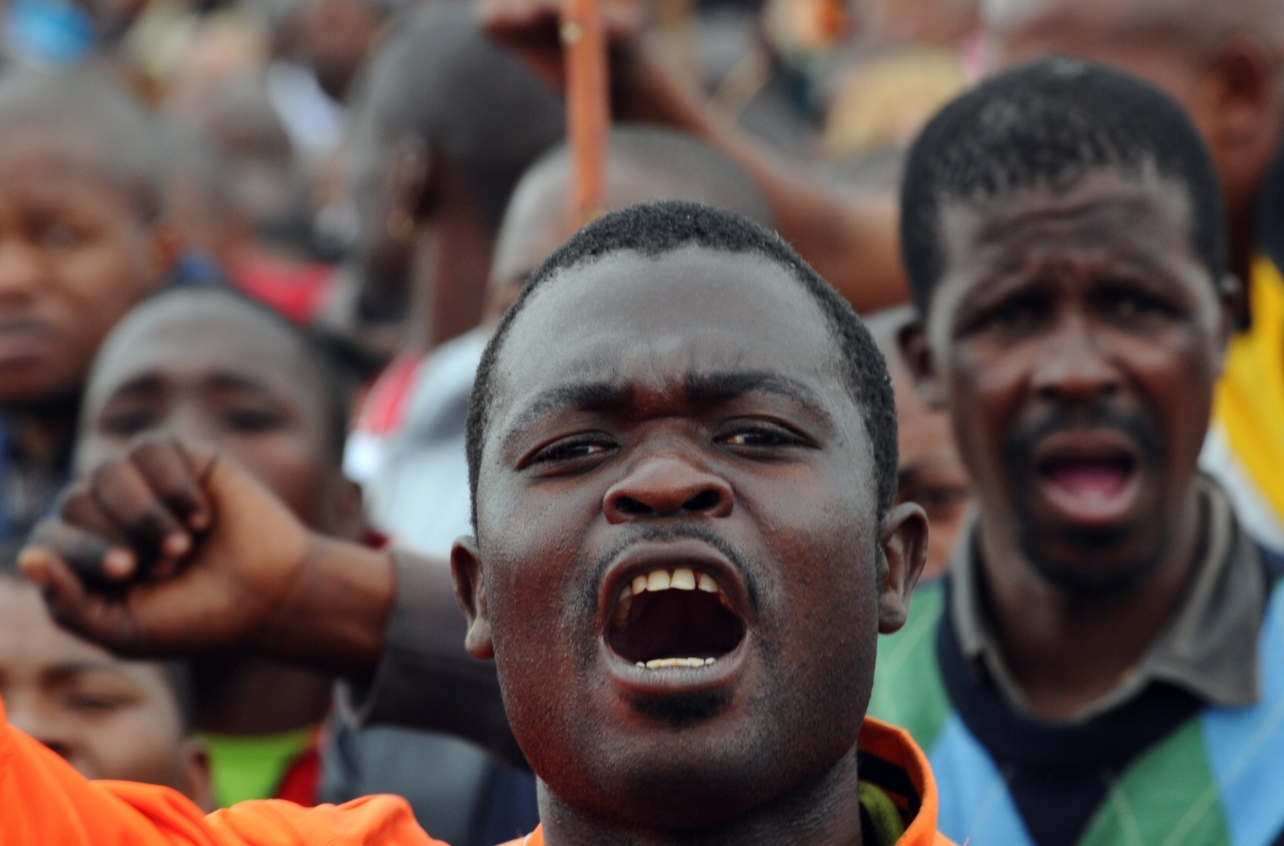
The success of the post-1994 democratic project depended on this racially-based inequality, specifically the economic element of it, to be quickly addressed. If not, rising black resentment would threaten the foundations of the new South Africa. In recent years, predominantly black communities have regularly protested, sometimes very violently, against poor public services, the lack of employment or poorly paid jobs, corruption and indifference by political leaders and officials across the country. There appears to be a general feeling that political party leaders and democratic institutions (such as parliament) are ignorant of their plight. Furthermore, there appears to be a feeling that protective institutions, such as the police and judiciary, remain as hostile as they were for blacks under apartheid – the police’s shooting of protesting miners at Marikana is a case in point.
Frustration often spills into violent protests
Marikana may present the tipping point where black anger spills over. Last year, South Africa replaced Brazil as the most unequal society, with the gap between the poorest and richest individuals the highest in the world.
Many black South Africans hoped that the ending of the obscenity of apartheid would bring jobs, effective public services and clean government. In many instances, such hopes have been dashed.
The ANC government has provided free public healthcare, education, low-cost housing and welfare grants to some of the most indigent. However, the “free” public services: education, healthcare, police and other services, have often been of poor quality, simply non-existent in many parts of the country, and often requires user fees.
However, a small black elite, from the ranks of senior ANC leaders, public servants and trade unions have become fabulously rich since 1994, mostly through the phenomenon of “political capital”. This is the seniority, or closeness to it, in the ANC hierarchy that can be traded for senior positions in the public service, government contracts, and shareholdings in established white companies (called black economic empowerment, or BEE).
Wealthier black and well-to-do white South Africans can circumnavigate poor public services by subscribing to private ones: security, private healthcare and education, “safe” gated communities. Economic growth since 1994 has failed to meaningfully increase employment opportunities for the masses. Several global crises since 1994, when the new South Africa’s economy entered the global economy – first the Asian financial crisis of 1997/1998, then several global commodity crises, and most recently the global financial and Eurozone crises – have hit the country like a tsunami.
Since 1990, the mining sector has declined from 800,000 to around 300,000 jobs. Those who lost their jobs were mainly black, low-skilled workers. Since the start of the global and Eurozone financial crises alone, almost a million jobs have been lost – most of these are black people with low technical skills, and with little possibility of securing another job.
The global financial and Eurozone crises have also affected the black middle class, particularly those working in the private sector. Many are struggling to pay mortgages, private education and healthcare. Poorer South Africans are generally experiencing a sense of despair. Those with jobs cling onto them – losing a job may mean never being able to get one again. Retaining a job and negotiations for higher wages are becoming ‘do-or-die affairs’, as in the case of Marikana.
Furthermore, there is a pervasive sense of systemic unfairness, a feeling that some lucky black South Africans appear to be doing very little, yet trading on their struggle credentials to get the most lucrative jobs, government tenders and BEE shares in private companies. Alternatively, fortunate white South Africans can trade on their social capital, wealth and education obtained during the apartheid years to prosper. CEOs of large companies are getting extraordinary huge bonuses, for doing very little, often while the lowest paid employees barely receive a living wage.
Worst of all, both the black (including the political elite) and white elite in South Africa show off their wealth in a blatantly conspicuous manner – building mansions, driving expensive cars, and spending heavily on “bling”. In fact it often appears that in the new South Africa the amount of “bling” a person has “proves” a person’s worth.
Sadly, some poorer blacks, in trying to emulate their richer black and white cousins, also spend hard-earned money on “bling” – many falling into debt pursuing the consumerist dream.
Adcorp warned last month (September) that South Africa is facing the real prospect of a “jobs recession”. South Africa’s big banks have all warned that they will have to cut more jobs in the financial sector – which has already seen large numbers of retrenchments since the beginning of the global and Eurozone financial crises.
South Africa’s unemployment of around 25% is at levels seen only during the Global Depression in industrial nations. Most of the unemployed are likely to be black. Only in the public sector have jobs grown. In the latest “Annual Economic Report” released by the Reserve Bank in July 2012, which includes data up to March this year, employment rates in the public sector increased by 4.6%, the “highest rate of growth since 1975”.
One in two young South Africans – and two out of three young African women – are jobless. The unemployment rate among all 15- to 24-year-olds is 51%, more than twice the national unemployment rate of 25%, according to the latest South Africa Survey published by the South African Institute of Race Relations.
The youth unemployment rate varies considerably between the races – it is 57% among Africans, 47% among coloured youths, 23%, and 21% among whites.
Drowning in debt
South Africans, especially black South Africans, are drowning in debt. South African household debt stands at 75% of disposable income, according to the central bank, the Reserve Bank of South Africa. Figures released by the Credit Bureau Monitor of the National Credit Regulator (NCR) show that almost 47% of the 19m credit-active consumers had impaired records.
South Africa’s debt-to-income ratio currently stands at 78.5%. In other words, for every $100 earned, $78.50 goes towards servicing debt. In many respects, South Africa’s governing African National Congress (ANC) has, while in power, made some of the same economic mistakes as many other African liberation movements when they assumed power after independence.
Firstly, in many cases they have simply pursued the wrong economic policies. In South Africa’s case, whatever economic growth has taken place since 1994 has often reinforced racial inequalities.
Immediately after coming to power in 1994, the new ANC government decided to lower tariffs faster and lower than required by the World Trade Organisation. This meant that cheap products, such as textiles and clothing from China, entered South Africa, without South African products being permitted similar easier access to other international markets.
South Africa’s textile industry was hard-hit. Since 1994, more than 200,000 jobs have been lost in the industry. Ebrahim Patel, the former general secretary of the Southern African Textile and Clothing Workers Union (SACTWU), and now the economic development minister, says South Africa dropped tariffs too fast and should have secured industrial policy measures to upgrade and modernise the industry before reducing tariffs.
The overall structure of the economy has not changed much since apartheid. There has been an inability to diversify from raw material and commodity exports – mining and agricultural – towards becoming an exporting economy that supplies value-added manufactured products from industries that actually create jobs.
It simply has not focused on “upgrading” what it produces from lower value products to higher value ones, as happened in the developmental states of East Asia after the Second World War; and exporting such higher value items to old and new markets abroad. In spite of South Africa’s producing key minerals, the country has not pursued an industrial strategy of controlling the whole global value chain from raw materials to the finished product.
Industrialisation was not centred on spinning new manufacturing sectors out of the mining and agricultural sectors – the mainstay of the South African economy. Since 1994, there has not been a genuinely committed effort to lift black South Africans out of poverty through providing quality technical skills, strongly improving public education and empowering the 5m black SMEs. Many of the technical and agricultural colleges, and artisan apprentice systems, which might have turned the millions of low and unskilled blacks into electricians, plumbers and welders, were closed down by the ANC government.
Furthermore, immediately after assuming power, the ANC government launched a voluntary retrenchment programme for teachers – which some of the best teachers took before leaving the profession – and closed down teaching colleges. Often these teaching and technical colleges were in rural areas where they were a crucial pillar of the local economy, and their closures often blighted their localities.
Even infrastructure development has not been integrated as part of broader social and economic development strategies – and has been mainly ad hoc. National passenger rail lines – used mostly by blacks – have in cost-cutting reforms bypassed smaller towns. There has been little investment in public transport, and the majority of black South Africans depend on minibus taxis and trains.
Low-cost housing was rolled out for the black poor, but was often built far from commercial centres, without schools or public amenities. Not surprisingly, many occupants left them and set up shacks closer to town to be nearer to job opportunities. The policy of black economic empowerment has simply been wrong. Former Trade and Industry Minister Alec Erwin said that R300bn was transferred in BEE transactions between the late 1990s and mid-2000s. However, only a few dozen individuals, closely connected to the ANC leadership and their families, benefited.
Many South African mainstream (white) companies have spent much on BEE that benefits a handful of people, rather than spending the same amount on adopting schools, training people, or building houses for those in the surrounding community – all measures that would lift thousands out of poverty.
In the successful East Asian states, indigenous companies and business leaders who got government contracts, who were “empowered”, were obliged to create new industries that are globally competitive – or forfeit such largesse.
If the ANC government had empowered, through access to finance, skills and government contracts, the 5m black SMEs (the taxi operators, small farmers and spaza shop owners) who survived apartheid restrictions on black business ownership – and who represent real indigenous enterpreneurs – it would have more broadly empowered black South Africans.
The ANC and the government’s reward system have not been based on meritocracy, rewarding hard work and excellence. This means that many ANC cadres have been appointed to critical positions in the public services, often without the necessary skills – and institutions such as municipalities and critical state-owned companies have often not delivered the public services to the black majority because they are poorly managed.
Often such poorly managed institutions have been bailed out with scarce public resources. Furthermore, struggle leaders involved in corruption or mismanagement in public positions have often not been held accountable because of their “struggle” credentials. This has created a culture of treating public resources as personal or party resources. This phenomenon has eroded the ANC government’s credibility and the trust that social stakeholders and ordinary citizens have in government.
The governing ANC have failed to forge a cooperative partnership for development between South Africa’s powerful private sector, government and organised labour. Influential leaders in the ANC have at times either ideologically rejected everything to do with business, or some have used business opportunistically for their own benefit. The perception has been created that the ANC is only governing in the interests of its own small leadership elite – this has helped create the sense of unfairness among ordinary ANC supporters.
No sense of urgency
Sadly, the political leadership in South Africa appears to lack the sense of urgency needed to deliver quickly on economic development for the majority, or to face up to the unmanageable social upheavals that have arisen. There is a shocking complacency about among South Africa’s leadership elite. South Africa’s rich mineral endowment appears to have helped to breed complacency. The thinking among the governing elite appears to go along these lines: that there are always the mineral resources and agricultural wealth that can provide jobs. Others, again, appear to argue that if in real trouble they can always nationalise economic sectors in “white” hands.
Some ANC leaders believe that its supporters will always vote for it because of its record in the anti-apartheid struggle, and the fact that the country has a lack of relevant, alternative political parties. The best solution for South Africa’s problems is to form a coalition for growth between all stakeholders – government, business, trade unions, civil society and citizens, which pursues pragmatic policies, and that can agree to mutual compromises that can make South Africa prosperous.
An economic “Codesa” (the political processes between the ANC, National Party and other stakeholders that negotiated South Africa’s political transition) is urgently needed between all stakeholders. But the ANC government must genuinely govern in the interest of all South Africans – and be seen to do so.
William Gumede is Associate Professor, Public and Development Management at the University of the Witwatersrand, Johannesburg, South Africa. His latest book, Restless Nation: Making Sense of Troubled Times, has just been published by Tafelberg (South Africa).








