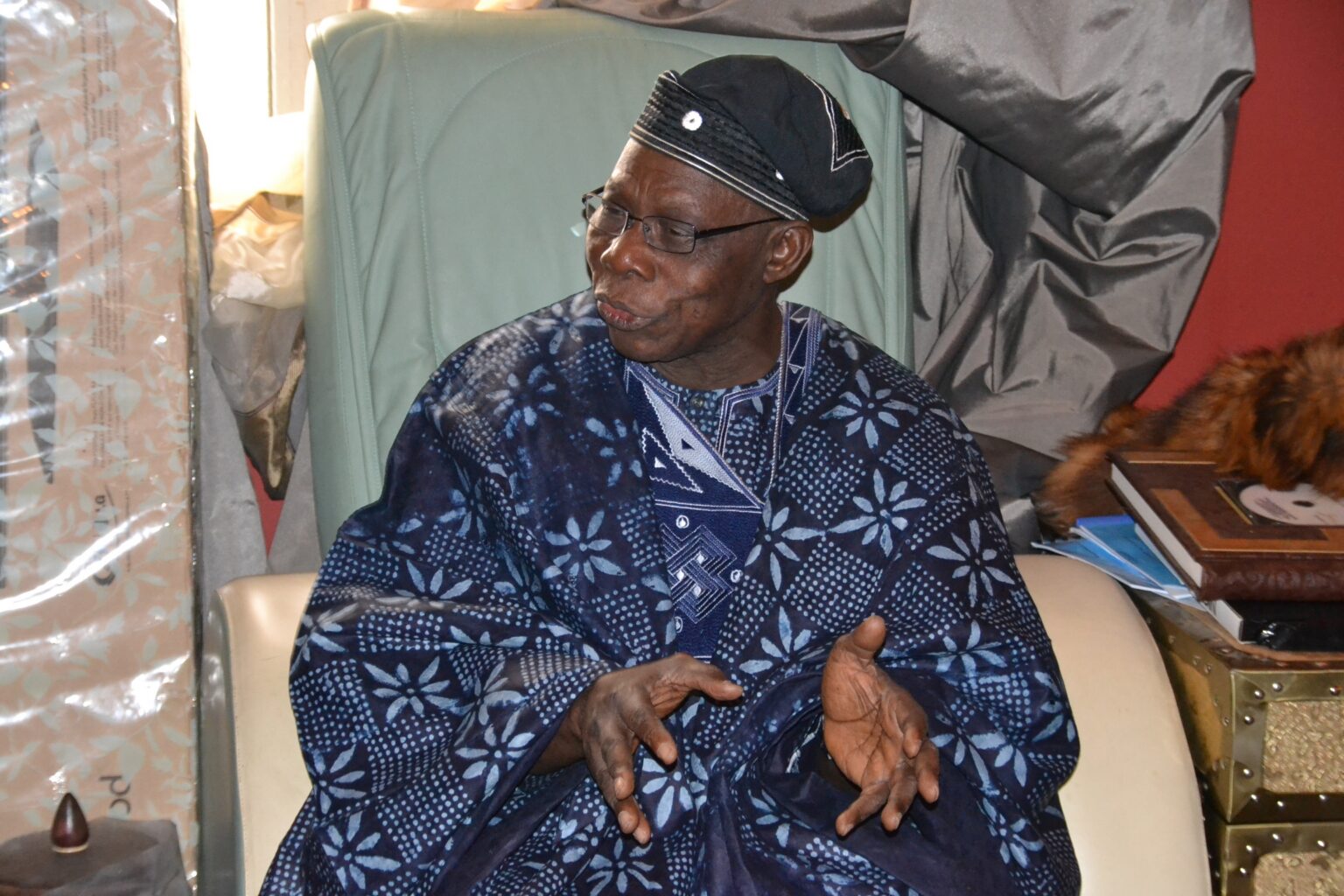
Getting Nigeria’s former president Olusegun Obasanjo, to sit down for an interview is no mean achievement. But our associate editor, Osasu Obayiuwana, finally got him after an initial kerfuffle. As always, OBJ, as Obasanjo is affectionately called, was as colourful as he can be: “How do you fight a brotherly civil war?”, he asked, referring to Nigeria’s civil war (1967-70). His answer: “A war is a bad thing and a civil war is even worse.” Please sit back – OBJ is on the way…
As the only person in Nigeria’shistory to serve as a military head of state (from 1976-1979) as well as a democratically elected president (1999-2007), retired General Olusegun Matthew Okikiola Aremu Obasanjo, or “Baba Iyabo” and if you want to be short, “OBJ” – the monikers he is popularly known by – sharply polarises opinion in Nigeria.
To his admirers, Obasanjo is a savvy statesman who did a great job steering the Nigerian ship of state for 11 years. His first phase of leadership, from 1976, began after a bloody, failed coup that killed Gen Murtala Mohammed, his predecessor. The first phase lasted three years.
The second phase, which went over two elected terms of eight years, followed the dark period of Gen Sani Abacha who left the country tottering on the brink of disintegration.
Managing, sometimes on a “minute-to minute” basis, a complex (some would say politically fragile) and diverse nation in which there are fiercely competing interests amongst its over 300 ethnic groups, made governance anything but a stroll in the park for Obasanjo, his supporters argue.
On 8 February 2013, he will officially launch his Foundation at a gala dinner at London’s Grosvenor House (see Obasanjo’s opinion piece on Page 64). It will be another chapter in his illustrious career.
His “non-admirers”, however, have another take. They think he is “brash, arbitrary, and ruthless”. This view was given much weight by his ex-wife, Oluremi, in her book, Bitter-Sweet: My life with Obasanjo – a revealing “tell-all” account of her years of marriage to the former president.
While she made damning descriptions of him, as a “master in the art of deception”, she surprisingly acknowledged what she also saw as his good qualities: “A hard-working man”, “a good cook”, and a man whose intellect has given him the capacity to hold his own in the company of presidents and royalty.
Visiting his Hilltop Mansion in Abeokuta, Ogun State, in December, for an exclusive interview for New African, was not bereft of drama, which clearly crossed the frontiers of the amusingly comical.
Arriving promptly for the 8am appointment, I was unable to enter the house, as my name, which had been “left” at the gate, had been wrongly spelt. On finally gaining entry, I exchanged initial pleasantries with a very polite Obasanjo, wearing his shorts and a green T-shirt with “OBJ 1” inscribed at the front. He was sitting in his dining room, just before the commencement of his morning prayers.
Obasanjo has been known to be quite rough in his treatment of many journalists in the past, including my former BBC colleague Barnaby Phillips, now with Al-Jazeera, during a national TV press chat. And a hot exchange with Stephen Sackur, on the BBC Hardtalk programme – “Will you dare talk to Tony Blair like that?”, Obasanjo bellowed – remains the stuff of high drama.
We were to commence what was to be a 45-minute interview after his prayers. But Obasanjo had to go into his quarters to change into his resplendent trademark agbada (a flowing three-piece Nigerian attire), following a request from our photographer, after which I was to go into his study to commence the interview.
But things took an odd turn, as two Americans – one supposedly an envoy from the US embassy in Abuja – strangely went into the office and “stole”’ my appointed time with the former president.
It left me puzzled when Obasanjo walked past, after finishing with the American pair, and flashed a quick smile at me and shook my hand, before driving off for a meeting at his presidential library complex.
The fact that I had not done the interview was clearly lost on him. Now in panic mode, I dashed down to his presidential library, a five-minute drive from his house, in order to pull the chestnut out of the proverbial fire.
“What are you still doing here?” Obasanjo asked me, in obvious surprise, when he popped out of the meeting and observed me lying in wait in the corridor. “I haven’t spoken to you yet, sir,” I said. “You were with two guests in your study and I couldn’t possibly have interrupted you,” I added.
“You mean those two Oyinbos (white men) were not with you? So, who were they? And who brought them to me?” he asked, clearly puzzled.
“I wouldn’t know,” I said in retort. Realising there had been a bizarre cock-up, he profusely apologised. We finally had the pre-arranged chat after he had concluded his meeting and a hearty lunch.
Talking on a range of national, continental and global subjects, Obasanjo also proffered a frank assessment of Nigeria’s current president, Goodluck Jonathan’s management of the country’s security situation. Here are excerpts:
Q It’s been close to six years since you left office. How has life been for you, outside the presidency?
Well, it hasn’t been six years just yet… It’s still short of six months… I haven’t lost touch with the things I should not be out of touch with – my farm, my village, my businesses, and the community from which I come from. So, when I am not engaged in running the affairs of Nigeria, I get myself fully occupied with these things and issues relating to the African continent.
I am involved in mobilising and encouraging investment into the continent and making myself available to young African men and women who want to be mentored. I have been working with the Africa 2.0 organisation in this regard… I keep myself very engaged, very occupied, so there is never a dull moment.
Q What is the biggest challenge facing Africa today, preventing it from competing effectively with the rest of the world?
Africa’s major drawback today is infrastructure – transportation, water, power and communication. Without infrastructure, you cannot make the economic, social or even the political progress that you need to make… Once you have infrastructure, you can do something about reducing levels of poverty and increasing levels of employment. Economic growth, that brings benefits to ordinary people, helps to lessen tensions within a society.
Q Africa has largely had over five decades of independence and yet these are still big issues. What does this say about the quality of leadership that Africa has had over those decades?
It’s not a matter of the quality of leadership alone. It’s also a matter of resources… the people that you are comparing us to [in Europe and North America] have a 200-year headstart on us. If you take the United States, for instance, in terms of democracy, in terms of infrastructure, they are light years ahead of us, not to talk of Europe.
But having said that, I would be the first to admit that our leaders could have achieved more than they have. But I will not take a brush and paint Africa black. We are not devoid of good leadership overall.
Q Young people have a sense of disappointment and deep anger that their elders have not bequeathed to them societies that will enable them to reach their potential. Do they have a justifiable cause to be angry?
We have a saying in my part of the world that a child who says that his father is not rich or is not prosperous, has started [his own life]… Let’s see how rich or how prosperous he will be at the end of the day. There are always those criticising leaders, armchair critics. It is always easy to criticise.
I remember a young man, while I was military head of state, critical of our government. I called him and said that I wanted to give him a job. He refused and said that I wanted to destroy him, as he knew his limitations and felt that he would be better off as a critic.
When you are confronted with what it takes to run a country, you will know that it is not so easy. I am not holding a brief for all African leaders, past and present, but I am saying that when you want to criticise, have knowledge, have some understanding. If you are a young man between the ages of 25 and 35 and you don’t have socialist inclinations, I would be very worried about you. If you are a man between the ages of 45 and 50 and you don’t have an inclination to accumulate capital for development, again I would be worried about you.
We are in a passing phase. There was a letter that someone wrote to me, after serving in government, in which he said that he now understood the level of perfidy that is there. Nothing should be taken for granted, and those people who have been out of government and are now in would be the first ones to confess that things from the inside are not as they look from the outside.
Q There are people who have admired your leadership. But you have your critics as well who have been very tough on you. In what spirit do you take criticism?
Well, the first thing I want to know is who is doing the criticism. You can be an objective critic, an ignorant critic, a mischievous critic, an enlightened critic, or a critic who just exists for the sake of being critical. If he is objective, I will take it.
Q Would you take it on face value?
If he is ignorant, I will take it upon myself to educate him. If he is being mischievous, I will ignore him. If he is enlightened and needs more information, I will give him more information. I rarely respond to criticism, and when I do, I do it with facts and figures and I want to make a point. But criticism is also part of living. If you are being criticised, whichever way, it means that you are relevant. If you are not relevant, nobody will think of you. One must understand this and appreciate it and say, “well, If I am relevant, let me see what I can do to continue to be relevant, and to continue to do what I believe I should be doing”.
Q When I spoke to a leader with global responsibilities, he said one of the most difficult things was having people around him who could tell him the truth, because they were afraid of falling out of favour with him. Have you had this type of challenge?
No. In fact I invite people [to tell me the truth]. When people come to me and say, “Oh, you are good, you are the best”, I say “look, this is not what I have called you for”. I need them to tell me what I need to do differently.
If you are telling me what I am already good at, then you are not helping. Tell me in all honesty why I need to do differently, and I will then explain the reasons for doing what I have done. And invariably, when I explain things to them, they tell me how they were not aware of certain things.
Look at this presidential library where we are now. When I started this project, many people were insulting and abusing me. But a few people who have come here, and seen what we are doing have apologised, that they really didn’t understand what I was doing and the role it can play in the community.
When I wrote a book and somebody started criticising the book, he was asked whether he had read it and he answered no. Such a person should be pitied. I am not that bothered about criticism. I try to satisfy two things mainly – first, my God and my conscience; and secondly, those that put their trust and confidence in me, to carry out a particular job.
Q It is interesting that you were just talking about books. Prof Chinua Achebe recently wrote one, There Was a Country – A History of Biafra, and made very strong remarks about how he felt the Igbos, his ethnic group, were treated during Nigeria’s civil war. Have you read the book?
No, I haven’t…
Q But are you aware of the remarks he made?
Well, I was a participant in that war and I conducted it in the most humane manner possible, because fighting a war is not a picnic. And when you are fighting a civil war, you are fighting to unite, not to destroy. You are not fighting to kill but you can be killed.
So how do you fight a brotherly civil war in a way that the other side will feel safe with the other side at the end of it, the very same people attacking them previously? I managed to achieve that, so I don’t think I fall into the category of the people that Chinua Achebe was talking about. A war is a bad thing and a civil war is even worse.
Q Having been a major participant in the civil war and its aftermath, do you really think there has been enough healing and reconciliation in Nigeria? When you read what Achebe has written, he insists that the issues that led to the civil war are yet to be resolved.
I haven’t read that book but you say you have read it. If that is what he is saying, then maybe he is making those remarks because he is no longer living in Nigeria. If he were living in Nigeria, when I was the president of this country an Igbo lady [Ngozi Okonjo-Iweala] was my minister of finance, an Igbo man [Chukwuma Soludo] was the governor of the Central Bank. What more do you do, to show that you take Igbos seriously?
An Igbo man was one of the military service chiefs. The permanent representative to the UN during my time was also an Igbo person. What more do you want? If people are complaining that they want more of the cake, then I see that as a healthy sign. If the Igbos say they want more of the national cake, I see nothing wrong in that. The Yorubas, Igalas, and other groups should be free to complain as well.
But for somebody to say the civil war has not ended, 40 years after its conclusion, that person is living in the past.
Q You are 75 years old now. What are you hoping to achieve with your Foundation?
Well, what happens after me is in the hands of God. What I am thinking of now is what I can do today. The Foundation that we are launching on 8 February is targeted at four areas – the first one is food and nutrition security, under the “Feed Africa” programme. We are hoping to increase the level of female education, as girls across Africa are still disadvantaged when it comes to having access to education.
For health, we are looking at dealing with issues like hypertension, diabetes, sickle cell and other non-communicable diseases. They may be looked at as rich people’s diseases but they cut across the spectrum. If people take care of their health in a much better way, they will have longer lives and be able to deal with the challenges of having these ailments.
Employment of young people is also a target. I was in Senegal the other day and when the chief of staff to the president read his speech, on the president’s behalf, it came out that over 60% of the population is under the age of 25. And 60% of those that should be in employment, within that age bracket, had no jobs.
That is hard-hitting for young people. What is their hope? How would they look, with encouragement, to another day? So, my Foundation is looking at trying to solve some of these problems. Some people can say that there are many Foundations or NGOs doing this type of work. But the field still has a lot of room for a Foundation like ours.
And we are not going to work alone. We will work with others with a track record of achievement, others who are active and we can act as catalysts to help them achieve more, all over Africa.
Q Is the high rate of youth unemployment, across Africa, not a failure of government policy?
There are unemployment problems in the United States. They have unemployment in Spain and in a number of developed and developing countries. Would you then say that all these countries, where they have a problem of unemployment, are having problems due to a failure of policy? If that is the case, then there is a failure of global policy.
What global policies are responsible for this situation? What requires a rethink? I would not say that the problems in Africa are totally due to a failure of government policy. But partly, yes.
Q Partly? Not largely?
Partly, yes. When you say largely, what happens in Russia, what happens in America, and what happens in Europe has implications for us here. Why should I accept responsibility for what happens in Europe? I will not. But my policy is to ameliorate [the problems]. What I can take responsibility for is the consequence of the policies that I introduced. But whatever other people’s policies have brought upon me, or my country, can only be partly my responsibility to deal with.
Q There can be no economic development without peace and security. The security situation in Nigeria has been less than ideal recently. What can be done to restore the required calm needed for economic development?
Stability, security, and peace are imperative conditions for economic development and growth. What are we now doing? If we have a situation of insecurity, we have to examine it and ask why it exists. When you know the why, then what is the solution? And if you know the solution, then you implement it. And if it works, then you have dealt with the problem. But you don’t have a problem and ignore it or treat it half-heartedly and expect that the problem will go away. It will not.
Q I will just ask you this bluntly: Are you satisfied with the way the security situation is being managed by the current president, Goodluck Jonathan?
But I have already spoken publicly about this. You don’t need to be blunt. If the president is the chief security officer of the country and there is a security problem, where do you look to, for the solution? Me? Or you? It is the chief security officer.
And if that solution is not coming from the chief security officer, who has everybody and can mobilise everybody, inside and outside, to get a solution, then he has the responsibility to solve the problem. And nobody else should be blamed but him.