The last 50 years for Africa makes for a sad, sad tale. The continent, blessed with the world’s most abundant natural resources, has not been able to utilise them to the benefit of its people. Will things change?
The African Renaissance. This is New Africa (TINA). Africa Rising. These are just some of the new catch-phrases now being used to describe our continent. For some, they are very true. Africa is most definitely the place to be. It is a land of opportunity. Everybody is rushing into Africa, to find their bit of El Dorado!
You see, unlike Europe, the US, Asia, Australia and most parts of the “developed” world, there is still a lot to be done in Africa. All the roads and high rises that could be built in Europe and America have been built. Africa is the new place to construct the roads, build huge skyscrapers, modern-looking offices, underground car parks and the like.
Europeans, Asians and North Americans are used to going to a park. It is now that parks and fairgrounds are going to be built across Africa. In fact compared to the “developed” world, we can argue that Africa has very little. Few huge department stores selling expensive designer clothes. Few chains and franchises of burger joints and other fast food outlets. Very few factories are producing even everyday products.
Yet 50 years ago, at Independence, we had the potential to do this. With leaders like Nkrumah and Lumumba across Africa, we not only had the potential but we were actually making strides. Slowly but surely, our new leaders were going about giving people quality education which they could use to the benefit of their respective countries and Africa as a whole. These new leaders created projects that would see their countries having basic amenities like water, power and good roads. And more importantly, opportunities were created for Africans in Africa. So in Ghana, for example, it was Ghanaians that were producing televisions and shoes. Yes, they may not have been top of the range and of a high standard; but with time, practice and experience, maybe today Ghana could be exporting fully functional televisions. The continent, blessed with people of high intelligence and physical strength, has not been able to re-educate her people to realise this. For many, it appears as though African history began with slavery.
We have forgotten that, before the arrival of slavery, Africans were producing everything needed to survive. All across the land, there were systems in place that helped the people govern themselves. Africa had tradesmen and blacksmiths. Africa had architects and merchants. Africans knew how to solve issues ranging from crime to family matters without necessarily attending law school.
African meteorologists could predict the weather simply by knowing the natural signs. Indeed, Africans in Africa had a fully functional life and society.
But then came centuries of slavery and colonisation. Even what happened after Independence is a story that continues to break my heart on a daily basis. People who were once building pyramids now find themselves turning to their former enslavers to build for them.
Rather than moving forward, Africa is taking giant leaps backwards. From good roads at our Independence, to the dusty potholes we endure today. From trained doctors who actually had a passion for and believed in what they were doing, to today’s group of frustrated young girls who go into nursing as something to wile away the time while they pray for a rich husband! Indeed, the African tale does not appear to be a positive one.
Well, that is, until now, with the advent of the new African Renaissance. Now, it indeed looks like Africa has a very bright future.
An El Dorado
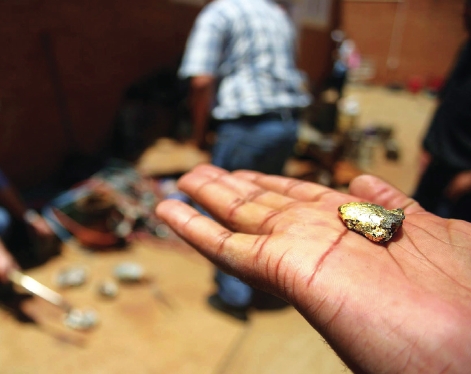
Africa is the new place to make money. And ultimately, that is what everybody is chasing. The El Dorado. The land of gold. The land of plenty. The land where any foreigner can be King. And this is my problem with all those singing about the new bright future for Africa.
Certainly it is a brilliant and bright new Africa if you are not African. It is a wonderful new Africa if you are an African in the Diaspora. And it is a very prosperous Africa if you are an educated African in Africa, with contacts to society’s movers and shakers. But the truth of the matter is that all the factors that are leading to a new African Renaissance are not provided by Africans on the continent.
It is not Africans in Africa who will get the contract to build roads or work on a water project. It is not Africans who are investing in the booming energy and gas sector. It is not indigenous Africans in Africa who are consulting on oil and gas exploration and deals.
No, the new African Renaissance is being led and enjoyed by an elite minority of people. There is no denying the potential for growth in all spheres of life in Africa. From music to fashion to banking to retail, Africa is fresh territory. And experts are moving fast and furiously to exploit this.
But how many of those experts are indigenous Africans? How does the fact that some of Africa’s capital cities buzz with a healthy nightlife really translate to a good life for the majority of people? On the one hand, we see one person enjoying a luxury air-conditioned vehicle – on the same road as we see a hawker selling dog chains. One will clearly agree that indeed Africa is a wonderful place to be. Whilst the other will either be cursing God for the day he or she was born, or praying to that same God for a way out of Africa.
In terms of culture and traditions, I see a (potentially) bleak future for Africa. That is, if those of us who are passionate about it do not preserve and pass on our African heritage to the next generation. With the globalisation (or Americanisation as I have always put it) of the world, it seems the youth of Africa are losing their culture and traditions.
Today, visit any African country and you will find the youth prefer to speak English (with an American twang!), rather than their own languages. Ask the same youth to attend an African dance class and they will tell you no, they now prefer Salsa.
This is the same youth that walks around Africa wearing low-hanging jeans, showing us their boxer shorts. I bet if I challenged some of these youths in Ghana, they would have no clue how to wear a cloth the way men traditionally wore it.
And look at women across Africa. The majority of them are ashamed to wear their own natural hair. They all follow trends set in London and New York. And the current trend says, as an African woman you need to resemble Beyoncé or Nicky Minaj! Utterly ridiculous, if you ask me.
Today, we are putting aside some of our cultural practices because of modernity. I agree there are some aspects of African culture that need to be abolished, for example female circumcision. But on the whole, most aspects of our culture work in keeping society together.
For example, across Africa, children call people who could be their elder siblings “Brother” or “Sister”. They will address someone like me as “Sister Akua”. If the person looks like they could be a parent, they are addressed as “Aunty” or “Uncle”, even total strangers!
With The New African Renaissance being led by foreigners, soon it will become acceptable to call an elder person simply by their first name. How about the rich African culture of dress, food, music, dance etc. All this will be lost if we are not careful.
Across Ghana, the youth will eat greasy fries any day over healthy local delicacies such as plantain and kontomire stew.
As I write these reflections, I am actually in Ghana. And as wonderful as it is to see the number of roads and buildings being constructed since I last visited last year, it is also alarming because the average Ghanaian is not part of this new movement.
In fact, life for the average Ghanaian is very hard. And this is an indication of how things will progress, not just in Ghana but sadly, across Africa. The rich will certainly only get richer and the poor will really feel the harshness of life.
No doubt Africa has a booming future. But personally I think for the average African in Africa, the next 50 years look bleak. Current deals that have the potential to create wealth are going to the Chinese, Americans and Europeans. International business franchises are being introduced into Africa by diasporans or foreigners. The indigenous Africans are not forerunners in the New African Renaissance.
Africans are still sitting and selling in their kiosks and little container shops and when Africa becomes full of malls, these people will not be the owners. Foreigners will own these glistening new temples of consumption, with their African partners probably having a minority share.
For the privileged few, Africa indeed looks like the place where they will find their piece of heaven. Even if there is no electricity, they can buy generators. Even if we all moan about the rising cost of petrol, they will still fill up their luxury vehicles. And there is nothing wrong with that.
I adamantly believe poverty is a sin against God. Seriously. I do not believe God put any human being on earth to suffer. However, human greed and the unequal distribution of the world’s wealth have led to the huge disparity between the rich and poor. So, in as much as some of us are going to enjoy a very bright future in Africa, I think we really need to invest in indigenous and local Africans so that they too are part of the Renaissance. But, hey, these are just the reflections of an ordinary African woman.