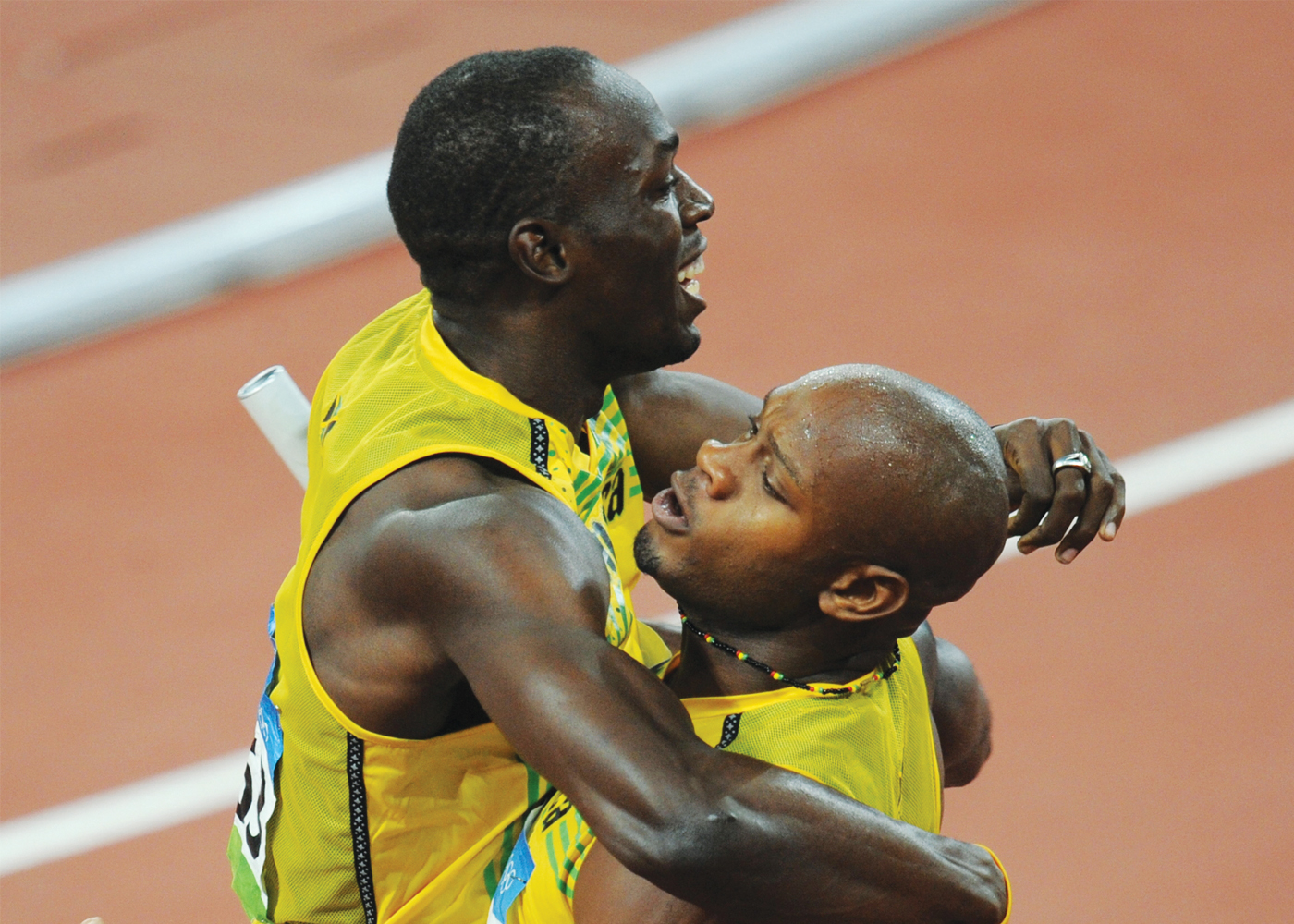
Its not yet even over, but 2012 has been an excellent year for sports lovers – especially black sports lovers. The displays put on at the London Olympics by Usain Bolt and Mo Farah and all the other athletes of African descent reawakened the debate over whether there is a genetic dimension to black prowess in sports. Cameron Duodu explores the issues.
It is a tempting argument to suggest that black people are genetically gifted athletes – until one stands it on its head and asks: if blacks are genetically gifted in terms of sports performance, then can whites too claim that they are genetically gifted with regard to inventions and other skills that require a great deal of intelligence? In other words, is it nature or nurture? I think the jury is still out on that one.
And that is OK, because if the argument is not marshalled carefully and with a knowledge of genetics, sociology and psychology, racists could readily hijack it.
What is indisputable is that some weekends in 2012 were absolutely brimming with black pride. For instance, on 7th and 8th July, we had our fill. At the age of 30, Serena Williams defeated Agnieszka Radwanska of Poland to win her fifth Wimbledon Ladies’ singles title. This is a woman whose future was supposed to be behind her – if one listened to the female US commentators who believe they have a monopoly over what the gameof ladies’ tennis is all about.
One reporter joined these ladies in allowing ageism to snake through his brain like a flesh-eating virus. He described Serena as “the oldest woman to win a Grand Slam … since Czech-turned-American Martina Navratilova some 22 years ago”.
“Oldest woman”? Who on earth was this clown. Who could possibly look at Serena Williams and describe her with the words “oldest woman”? The woman’s angelic, unlined face and looks are the stuff of dreams for many men, doesn’t he know?
The day after Serena’s victory, it was the turn of “British pride” as Britain, en masse, went on a binge of “Murray-mania”. This phenomenon is the worship of tennis player Andy Murray, who had qualified for the Wimbledon Men’s Singles Final. Murray was the first Briton to reach the Wimbledon Men’s Final since Bunny Austin in 1938. If he won at Wimbledon, he would be the first Briton to win the title in 76 years.
No matter that the opponent Murray was to meet, the Swiss player Roger Federer, had won Wimbledon six times before. Federer had also won a record 17 Grand Slam titles, while Murray had won none at that time. But, while Murray lost, later in the year he took gold in the Olympics final, against Federer, and he was to win the US Grand Slam. But going into the Wimbledon final, Murray’s highest achievements had been as runner-up in three Grand Slam finals.
Murray, although a Scot, was regarded as a fellow-national by even the most nationalistic English, despite the differences that surface when the question of nationality arises. Murray, on Wimbledon Finals day, was everyone’s darling – that of the English, the Welsh and the Irish, as well as his fellow Scots. All “Britons”, mind.
Why, the Scots even appeared not to mind sharing him with their neighbours – although they are usually anxious to decouple the rest of Britain from their petroleum resources, their legal system and muchelse besides. Although Murray lost to Federer 4-6 7-5 6-3 6-4, he gave his countrymen hope for the future.
Indeed, Murray managed to remember to point out, amidst his tearful remarks after his defeat, that Federer was “30 years old”! In other words, he was summoning Murray-mania to run for, at least, another five years. And more. After all, Federer might come back to Wimbledon in 2013. And if he could do that at 31, why not Murray?
It was sweet revenge for Murray during the Olympics, when he won on the same ground – Wimbledon – against the same opponent, Roger Federer. You should have been in Britain in the week that followed Murray’s victory, and the triumphs of other members of Team GB.
I said the weekend of Wimbledon was a major one for British sports. That is because on the same Sunday as the Wimbledon gladiatorial Men’s Final contest, the British Formula One Grand Prix was also taking place.
Now, the British probably love motor sports more than any other nation. If you mention the name Stirling Moss (for instance), almost every living Briton would have heard of him. Yet he never became a World Champion in Formula One! And he stopped racing grand prix cars as far back as 1962! I remember vividly the day Moss crashed at Goodwood. I knew he was racing that day, and I sat close by the radio, hoping the BBC World Service would announce the result of his race in its famous Sports Roundup programme. I heard nothing until much, much later, when I learned from an ordinary news bulletin that Moss had crashed at Goodwood and was in a coma in hospital, close to death.
Fortunately, he recovered from his injuries, but he retired soon after the accident. Okay, Stirling Moss, (or Sir Stirling Moss as he was to become) had a most impressive driving career. He drove for the Rob Walker team from 1958 to 1962, taking part in 93 races, finishing first 46 times – a remarkable success rate of just under 50%, in a very dangerous sport in which car reliability was always a problem, no matter how good a driver happened to be. Moss also drove for Maserati in 72 races, finishing in 50 with 25 first places.
The Stirling Moss website adds that “Out of the 375 competitive races in which he finished during his professional racing career, [Moss] won an astonishing 212, which is more than one win in two!” That is why he is still remembered, though, in practice, his legendary status in British motor racing ought to be overshadowed by the exploits of such drivers as Jim Clark, Graham Hill, Jackie Stewart and Nigel Mansell, each of whom won the world championship more than once, whilst Moss was never to achieve that prize. The British admire true grit and honourable failure as much as victorious achievement.
The venue of the British Grand Prix 2012, Silverstone, was a nightmare of a circuit and nearly lost the right to stage the race due to its lack of facilities compared to other circuits around the world.
But a determined effort has been made to save it for motor racing and its future now appears safe. But the circuit’s public approach roads are always jam-packed and the car parks are turned into impassable mud-fields when it rains, as it did, relentlessly, on the days preceding the 2012 race.
On the Qualifying Day (Saturday), when drivers race against the clock for their starting grid positions, the organisers of the race actually advised ticket holders not to come! But the advice was not followed andthere were traffic jams leaving the circuit, some of which lasted for eight hours.
On race day (Sunday) the weather was better and almost the full complement of ticket-holders turned up. There were TV pictures of spectators with mud sticking to their boots, and of cars being pushed out of the car parks that had turned into quagmires. But so what? If you want to see doughtily committed sports lovers, come to Britain!
Unfortunately, the British former world champion in whom most hope was placed, Lewis Hamilton, could not perform as desired. For the uncertainty about weather conditions had turned the outcome of the race into a gamble that depended upon tyre choice. Whether a team used wet-weather tyres or medium-weather tyres or hard tyres, meant for the dry, depended on how well it could guess what the weather would do. The Red Bull team turned out to be better at forecasting than Hamilton’s McLaren team. So Red Bull’s Australian driver, Mark Webber, won the race, followed by Ferrari’s Fernando Alonso, with Red Bull’s Sebastian Vettel third and Hamilton only able to place eighth.
Maybe this played some part in Hamilton’s decision, announced in September 2012, to leave McLaren and go to Mercedes in the 2012 season, but on seeing how the British public stood by Hamilton, I was forced to admit that if the Ghanaian footballer, Asamoah-Gyan, had been British, it would never have entered his head to quit the British team, just because he had lost a penalty kick in the bizarre game that Ghana played against Uruguay in the 2010 World Cup.
A penalty shoot-out was only made necessary because the game was drawn, after the Uruguay striker, Luis Suarez, had caught the ball with his hands, as it was entering the Uruguay net from a majestic shot by Asamoah-Gyan. A penalty was awarded, which Asamoah-Gyan missed. So, the score still drawn, a penalty shoot-out ensued. The Ghanaian players were overcome by nerves, and lost the game. Ghanaians, angry that they had been prevented from advancing to the next stage of the World Cup, never forgave Asamoah-Gyan for his penalty miss, and he decided to leave the national team, the Black Stars. But his petulance only lasted a few months, and he is now back in the team. But not all the British have forgiving hearts.
The media, especially the tabloid press, constantly harass British sports personalities, especially football stars, seeking scandal about relationships with their “WAGS” (wives and girlfriends) that titillate the public and guarantee the sale of newspapers.
How different from the West Indies, where the sports stars are actually allowed to bask in “obscurity”. The West Indies cricket team used to be the best in the world, having won the one-day cricket World Cup several times in the 1970s, and having excelled so much in five-day Test cricket that they once whitewashed England 5-0 in England, with the result that a new word in cricket was coined: “Blackwash”. But from the mid-1990s West Indian cricket began to decline.
Incompetent administrators handled the players so badly that two of the greatest batsmen the game has ever seen, Desmond Haynes and Chris Gayle, were lost to the game for long periods. Fortunately Gayle is back – and it is no accident that the West Indies won the ICC World Twenty20 championship title in Colombo, Sri Lanka, last month.
Jonathan Agnew, the famous BBC cricket commentator, had this to say about the current “Windies” team: “I have not seen, for some time, a West Indies team as united and focused as the one that beat Sri Lanka to claim the World Twenty20 in Colombo.
“It’s great news for West Indies cricket and hopefully the win will rejuvenate some enthusiasm amongst Caribbean cricket lovers.”
In the US, where sports means really big money, due largely to the influence of television deals, the attitude to sports heroes sometimes approaches unbelievably absurd limits. When the basketball player, LeBron James, was about to leave his home town team, the Cleveland Cavaliers, for the Miami Heats, one television network, ESPN, kept everyone on tenterhooks for 24 hours by running back-to-back announcements, stating that it would be mounting a special live programme, entitled “The Decision”, in which LeBron would announce whether he was leaving Cleveland or staying.
When LeBron eventually made his announcement on live TV, both his announcement and the way he chose to do it were greeted with extreme bitterness by Cleveland fans. Some claimed that the “suspense” of not knowing what LeBron had decided, had nearly caused them heart failure! LeBron himself had, apparently, not decided on his move until a few hours before the live TV announcement! It was all too much for the Cleveland Cavaliers owner, Dan Gilbert. In a move unprecedented in the National Basketball Association (NBA), he published “An open letter to Cleveland fans”, in which he tore into LeBron James. It was as if LeBron James had committed “treason”!
Gilbert wrote: “As you now know, our former hero, who grew up in the very region that he deserted this evening, is no longer a Cleveland Cavalier. This was announced with a several-day, narcissistic, self-promotional build-up culminating with a national TV special on his “decision”, unlike anything ever witnessed in the history of sports, and probably, the history of entertainment.
“Clearly, this is bitterly disappointing to all of us … you simply don’t deserve this kind of cowardly betrayal. You have given so much and deserve so much more. In the meantime, I want to make one statement to you tonight: ‘I personally guarantee that the Cleveland Cavaliers will win an NBA Championship before the self-titled former “king” wins one.’
“You can take it to the bank …”
Of course, Gilbert’s hysterical curse had no effect on LeBron James: true, he did not win the NBA championship for his new team, the Miami Heats, in his first season there. But in 2012, he won the championship for Miami, and was also crowned the most valuable player during the playoffs against the Boston Celtics that earned him the championship and the finger ‘ring’ that, according to Gilbert’s empty ‘curse’, he’d never have received!
The attitude of sports fans towards their heroes is, of course, not new. In an article that brilliantly fused the principles of physics, history and the classics with those of sports, entitled: “LeBron James Is a Sack of Melons”, the New York Times Magazine, datelined 5 July 2012, reminded its readers that ancient literature is littered with sports-mania.
The Greek and Roman writers and philosophers had not been niggardly in heaping praise upon sports legends, the article pointed out. The author, Sam Anderson, implied LeBron James was present in the psyche of the ancient Greeks “in the 5th century BC”.
Then, “LeBron James” [Anderson doesn’t say, but this person he calls LeBron could not be anyone, except perhaps Hercules!] was the “most dominant athlete in the Olympic Games”.
Eight hundred years later, LeBron James materialised again in the form of “a gladiator” in the Roman Empire! Spartacus perhaps? Again, the author doesn’t say!
And among the 16th-century Aztecs, Anderson continues, LeBron James was the undisputed king of “the ullamaliztli players”, who entertained crowds and Aztec royalty by bouncing balls off their hips or off their knees, or who threw “themselves to the ground in order to bounce the ball off their spines …”
“LeBron James is the unanimous Most Valuable Player of interplanetary quarkball. His highlights, which recur infinitely, are too numerous to name: there is the match in which he splits 12 of his team’s final 13 atoms; the match in which he rides every wave of the light spectrum, visible and invisible, all the way to the event horizon of the neighbouring galaxy’s black hole; the match in which he executes a spin move so powerful that it opens a parallel world. And yet despite all of these heroics, just because of the nature of quarkball, it is impossible to tell whether James is winning or losing.” Surely, that is the answer to the question: why do we love sports so much?
We rejoice with Mario Balotelli when he scores two unbelievable goals against Germany to put Italy in the finals of the Euro 2012 football tournament, but we are also secretly pleased when the same Balotelli is unable to prevent the Spaniards from putting four past the Italians and winning the European championship. After all (we secretly tell ourselves) the Italians have been acting in an abominably racist manner towards African migrants of late.
What a delightful state we find ourselves in, then, as we watch sports! We are, more or less, in permanent suspense! Our conscious selves revel in the victories of the heroes and heroines we see on the TV screen, with beer or soft drinks at hand, and a mobile-phone nearby to exchange our thoughts with friends and family.
But deep down in our sub-conscious, every failure is toasted: we are not the only ones who are unable to achieve athletic or sporting success. Look at that guy who is coming last in the 1,500 metres!
Look at the miserable young lady who has got sand all over her knickers and yet could only jump half the distance of the leading athlete in the long jump. Can there be anything as sweet – as full of the human tragedy and the human triumph all rolled into one – as sports? No! Therefore, please say with me: “Long live King Sports!”