
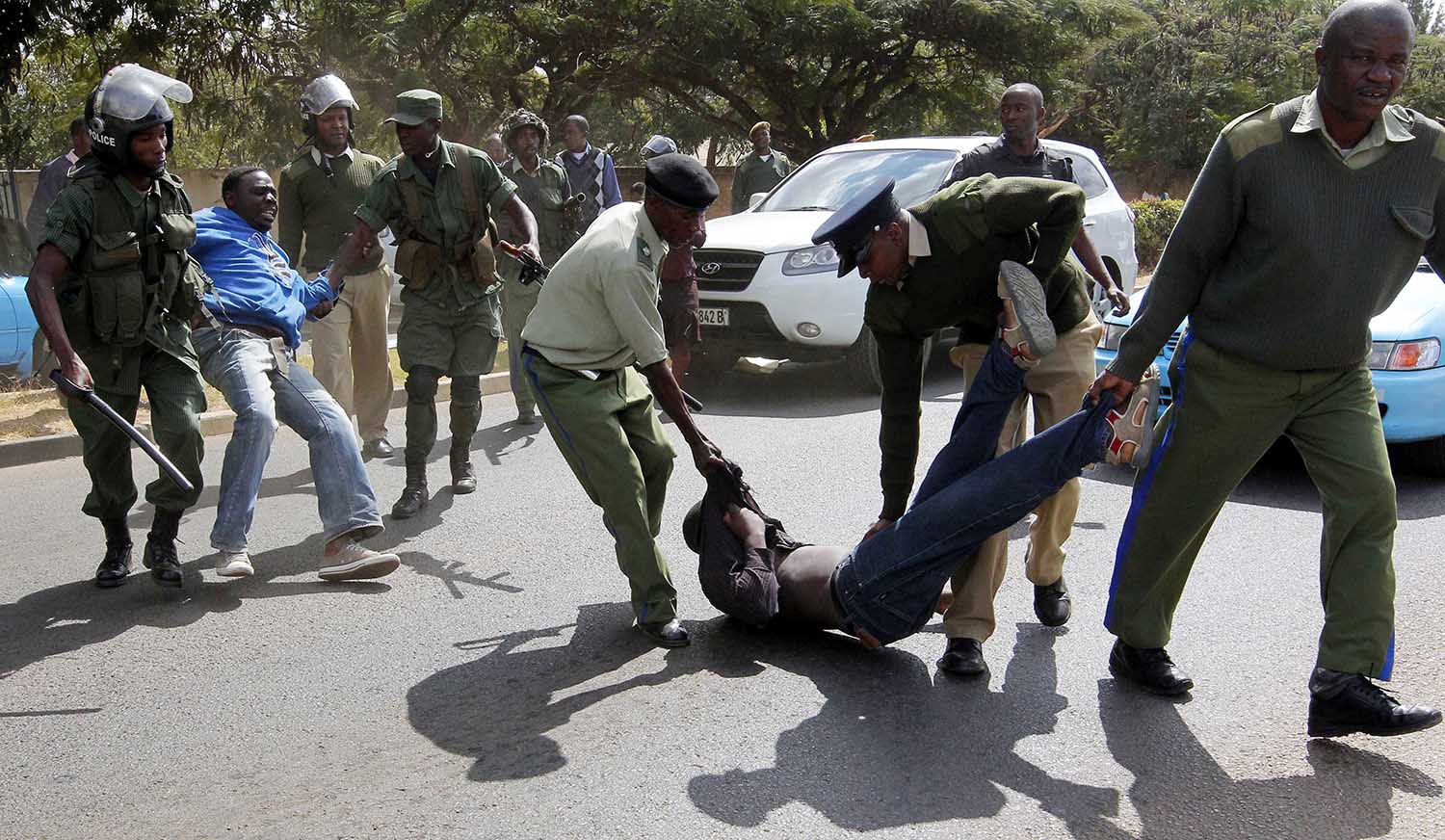
It is 18 months since the Patriotic Front (PF) government of Michael Sata came to power in Zambia. Apart from being under pressure to deliver its mega election promises, the government has now come under criticism for its human rights and governance record. But the government insists it is upholding the rule of law. Reginald Ntomba reports from Lusaka.
Zambia’s opposition leaders have lately been trooping to police stations and courts to answer what they believe are trumpedup charges. Their parties have been denied permission to hold rallies and they have accused the government of engaging in what they claim is a well-orchestrated scheme to paralyse the opposition. According to Cornelius Mweetwa, legislator and deputy spokesperson of the opposition United Party for National Development (UPND), his party has had 10 applications to hold rallies turned down by the police since the PF came to power in September 2011.
At the centre of controversy is a law that was enacted in colonial times called the Public Order Act. The colonialists used it to suppress the freedoms of Africans. They may have long gone, yet this law has somehow survived the times and maintained its notoriety.
It states that convenors of public gatherings should notify the police of their intention to assemble seven days before the event, by stating the venue and the names of speakers. While this law has always been in place, it has in recent times acquired a certain prominence, albeit for the wrong reasons.
The police have been accused of bias against the opposition in their application of the law. The bone of contention is that while the law only requires convenors to notify the police, the police have seemingly assumed their role is to grant permission. This is despite the Supreme Court setting the precedence to the contrary in two previous cases that have challenged this understanding by the police. There are also questions being asked as to why it is only the opposition having difficulties in holding meetings, while members of the ruling party take to the street whenever they like without police approval.
The irony is that while in opposition, the PF was known for holding rallies throughout. The opposition is now questioning why the PF is “so scared of us holding rallies to engage the people on various national issues,” says Hakainde Hichilema, leader of the UPND, who has been arrested three times in the last six months.
Like his UPND counterpart, Nevers Mumba, leader of the former ruling Movement for Multiparty Democracy (MMD) party, has also been arrested three times. But the state recently dropped two cases, leaving one where he is accused of misappropriating government funds when he served as high commissioner to Canada. The country has recently experienced a wave of political violence, mainly between the PF and UPND. The opposition complains that their members have been arrested arbitrarily, while members of the ruling party have gone scot-free even in cases where they were the culprits.
The most recent case was in the southern resort town of Livingstone where a member of the ruling party was murdered during a by-election campaign. PF officials, cabinet ministers and the police pointed an accusing finger at the UPND and charged one of its legislators, Gary Nkombo, and eight others with murder. But in March, prosecutors dropped the charges. Instead the police arrested another person for the murder. It is such cases that have left the opposition fuming with a deep sense of injustice and arguing that the government is out to harass them.
The reaction from legal experts, human rights watchdogs, and the church suggests that the opposition does have a legitimate case. The Law Association of Zambia (LAZ) has noted that the recent events in the country were “indicative of a breakdown of the rule of law”. “Sadly, these events and occurrences have, by and large, been orchestrated by the executive arm of government in apparent abuse of the power and authority vested in it,” the association said.
Reacting to the arrest of the MMD leader for “unlawful assembly”, the Human Rights Commission (HRC) observed that “the nation seems to be descending into a disregard for fundamental rights and freedoms as guaranteed by the Constitution and international standards on freedoms of assembly, opinion and expression.” In their strongest rebuke of President Sata’s government so far, the Catholic Church (of which Sata is a staunch member) in their January pastoral letter deplored the manner in which the Public Order Act was being applied.
“Maintenance of ‘law’ and ‘order’ cannot only mean preventing opposition political parties from exercising their basic right to freedom of assembly. The unfair restriction of people’s liberties is breeding dangerous discontent,” the Church firmly warned. “We call upon the government to embrace the spirit and letter of democracy before the nation is plunged into chaos. The Public Order Act, in its current form, has no place in our statutes. It is both repressive and anachronistic. It needs to be repealed.”
Enter the Commonwealth
The foregoing is what has compelled the opposition to seek the support of the international community. They argue that since Sata came to power, his government has made it increasingly difficult for the opposition to operate. They accuse the government of intolerance, oppression, and creating a climate of fear and intimidation, fomenting ethnic violence as well as abusing state institutions.
In February, four opposition leaders held a press conference in Johannesburg, asking the international community to take interest in what was happening in Zambia. They presented to the Commonwealth Secretariat a 40-page dossier detailing several incidences, which to them, amounted to a gross violation of human rights. They called on the Commonwealth to provisionally suspend Zambia from its councils, subject to a report of a fact-finding mission.
“Since taking over as president, Sata has embarked on an aggressive agenda to re-impose his vision of a one-party state, positioning his family and personal allies at the centre of the economy while damaging Zambian democracy, human and civil rights, and rule of law,” they charged in their dossier.
While the government and its supporters have condemned the opposition for taking the issue outside the country, the HRC said the holding of a press conference outside Zambia was a “non-issue”. The issue should be on what the opposition leaders raised. “From a human rights point of view, there is absolutely nothing wrong with people, irrespective of their nationalities or political affiliations, addressing press conferences in foreign countries to draw attention to what they may perceive as violations of human rights of nationals by their sitting governments. Examples of this abound in many parts of the world,” the HRC chairperson, Pixie Yangailo, said after meeting the Commonwealth fact-finding mission in early March.
The HRC added: “Sadly, the debate has centred, not on the substance of the press briefing, but on whether it was justifiable for the concerned people to hold a press briefing in a foreign country and supposedly ‘denounce’ their own country. This approach has tended to relegate the main [issues] raised by the concerned grouping.” The HRC agreed with the validity of some of the concerns raised by the opposition.
“In our view, the complaints about human rights violations may be justifiable in certain instances. Lately, Zambia has indeed experienced suppression of some of the fundamental rights and freedoms, and in the greater majority of instances, this has been directed at prominent politicians and selected political parties which, it may be speculated, are seen as the major threat to the ruling Patriotic Front,” the HRC said. It however opposed the proposal to impose sanctions on Zambia.
“Experience has shown elsewhere, that the targeted politicians do not suffer when sanctions are imposed on a country. The brunt of the sanctions is fully borne instead by the innocent majority in the affected country who have little influence on the political direction of the country once they have elected a government into office. As such, [we] totally disagree with this call as it might lead to more rights being denied to the common people of Zambia,” it said. Muhabi Lungu, spokesperson for the MMD president Nevers Mumba, also argued that the issue of the Johannesburg press conference was “peripheral”. “The core issues here are the human rights abuses,” he said.
Those who warned that Sata would become a “dictator” if elected now claim they have been vindicated. But his admirers argue that the opposition are just bitter because they lost the September 2011 elections and are now exaggerating the situation at home. The opposition and their supporters have justified their going international, but others think it was unnecessary. Dr Lewis Chilufya, a political science lecturer at the University of Lusaka, said:
“As evident from the reactions to the appeal to the Commonwealth for the suspension of the country, we are not all on the same side of the divide even though we live in the same country. Zambia is certainly nowhere near the situation of large-scale and persistent abuse of human rights as some voices want to portray. On that score, calling upon the international community to sanction Zambia is by all definitions unjustified at this stage.”
Government reaction
On its part, the government has come out in strong defence of its governance record. Seemingly caught unawares by the opposition’s move to address the international community, the government reacted sharply, accusing their opponents of lacking patriotism.
“[The] act on foreign soil by these disgruntled opposition leaders alone is a serious indictment on their preparedness and eligibility to lead this country. It’s very clear that they are not ready for the task they so much long for,” said the government spokesperson, Kennedy Sakeni. “Who takes pride in discrediting a country they aspire to lead? It’s totally wrong; unAfrican and falls short of the elementary dictates of patriotism and focussed leadership.” In their meeting with the Commonwealth team, the government countered the opposition dossier, arguing that it was just aimed at scandalising the country in the eyes of the international community. The government has since warned that it will not condone lawlessness in the name of freedom of expression.
The Commonwealth is yet to pass its verdict. The last time Zambia came close to sanctions was when donors froze aid to the government of Frederick Chiluba in the 1990s over human rights violations. Thus, watchers of governance will eagerly look forward to the Commonwealth report.
Banda’s immunity lifted
In the past few weeks, the above issues have dominated public discourse, but they are certainly not the only ones occupying discussion. The government continues to pursue its predecessors to account for their stay in power. Several former government officials are appearing in court, while some are still under investigation.
In February, the Anti-Corruption Commission (ACC) went for the big one when they summoned the former president, Rupiah Banda, for questioning. Banda declined, citing his immunity from prosecution. But on 15 March, there were dramatic scenes in Parliament when the government tabled a motion to have Banda’s immunity lifted. A day earlier, Banda’s lawyers had gone to court to stop Parliament from discussing his immunity. But the government went ahead regardless.
When the motion came up, the opposition tried to block it but failed when the speaker of Parliament, Patrick Matibini, ruled that Parliament had its procedures to follow. Justice Minister Wynter Kabimba had a hefty charge sheet that included corruption and money laundering allegations against the former president. As the opposition boycotted the session, the motion passed with 80 MPs voting “yes”, three voting “no”, and four abstaining. Reactions were mixed. Banda said he had the strength to withstand his new status without immunity. His party, the MMD, decribed the move as “vengeful and hateful”.
The opposition UPND said it was a “waste of time and money and meant to divert attention from PF failures”. Banda’s international lawyer, Robert Amsterdam, said it was a “political move unrelated to justice”. Transparency International (Zambia), which had campaigned for the lifting of the immunity, welcomed the government action but said it should not be used for settling political scores. But the government argued that it was sending a strong message that those entrusted with public office must not abuse. If experience is anything to go by, the lifting of Banda’s immunity is only the beginning of what might turn out to be a lengthy legal process. Former President Frederick Chiluba’s immunity was lifted in July 2002; the trial that followed lasted six years, ending in a controversial acquittal.
Meanwhile, in stark contrast to what is happening to his name at home, Banda has been a guest of many institutions abroad, receiving awards, giving lectures on democracy and leading election observer missions, the most recent being in Kenya where he led the Carter Centre. Whether this is a classic case of a prophet being without honour in his homeland or an international community that is ignorant of their guest’s image at home, is open to debate. But the Anti-Corruption Commission (ACC) which is at the centre of all this, suffers from a credibility crisis and is widely viewed as toothless when it comes to investigating government officials, but active when pursuing opponents of the establishment.
President Sata’s utterances have not helped the ACC’s image. He publicly rebuked the Commission for announcing it was probing two senior ministers – Justice Minister Wynter Kabimba and Defence Minister Geoffrey Mwamba – who are his close allies. He told the ACC to first consult him before probing any of his ministers. Sata was widely criticised for his intervention, with the LAZ telling him that there was no such law in the country. As was widely guessed, the ACC dropped the investigations against the two ministers, further putting its credibility in jeopardy. The question in the public domain was: “Is it that there was nothing against the ministers or the investigators simply pandered to presidential pressure?”








